---
title: "Self-X Architectures: Beyond Simple Redundancy for Reliable Sensor Arrays"
description: Optimize redundant sensor arrays with Self-X architectures. Use dimensionality reduction to hit 0.1° precision with low-cost TMR sensors.
image: https://content.redpitaya.com/hubfs/blog%20featured%20image%20-%202026-02-05T151019.503.jpg
---
[](https://redpitaya.com/)
[](https://redpitaya.com/)
- Products
- [STEMlab 125-14 Gen 2](https://redpitaya.com/stemlab-125-14-gen2/)
- [STEMlab 125-14](https://redpitaya.com/stemlab-125-14/)
- [SIGNALlab 250-12](https://redpitaya.com/signallab-250-12/)
- [SDRlab 122-16](https://redpitaya.com/sdrlab-122-16/)
- [STEMlab TI (Texas Instruments)](https://redpitaya.com/stemlab-ti-texas-instruments/)
- [Multi-channel Solutions](https://redpitaya.com/multi-channel-solutions/)
- [Accessories](https://redpitaya.com/accessories/)
- [Applications](https://redpitaya.com/applications/)
- Documentation
- [Technical Documentation](https://redpitaya.com/documentation/)
- [Teaching materials](https://redpitaya.com/teaching-materials/)
- [Student projects](https://redpitaya.com/student-projects/)
- [User forum](https://forum.redpitaya.com/)
- [About](https://redpitaya.com/about-us/)
- [History](https://redpitaya.com/history/)
- [Distributors](https://redpitaya.com/distibutors-red-pitaya/)
- [Blog](https://content.redpitaya.com/blog)
[Shop](https://redpitaya.com/shop/)
- [ACADEMIA](https://redpitaya.com/academia/)
- [RADIO AMATEURS](https://redpitaya.com/radio-amateurs/)
- [Home](https://redpitaya.com/)
- Products
- [STEMlab 125-10](https://redpitaya.com/stemlab-125-10/)
- [STEMlab 125-14](https://redpitaya.com/stemlab-125-14/)
- [SIGNALlab 250-12](https://redpitaya.com/signallab-250-12/)
- [SDRlab 122-16](https://redpitaya.com/sdrlab-122-16/)
- [Accessories](https://redpitaya.com/accessories/)
- [Applications](https://redpitaya.com/applications/)
- [Resources](https://redpitaya.com/documentation/)
- [Shop](https://redpitaya.com/shop/)
- [About](https://redpitaya.com/about-us/)
- [Blog](https://content.redpitaya.com/blog)
- [Compare](https://redpitaya.com/compare/)
- [Login / Register](https://redpitaya.com/my-account/)
### Red Pitaya Blog
[Home](https://redpitaya.com) » [Case study](https://content.redpitaya.com/blog/tag/case-study) »
[Case study](https://content.redpitaya.com/blog/tag/case-study)
# Self-X Architectures: Beyond Simple Redundancy for Reliable Sensor Arrays
- Posted by  [Red Pitaya Technical Editorial Team](https://redpitaya.com/Red-Pitaya-Blog-team/) , February 10, 2026
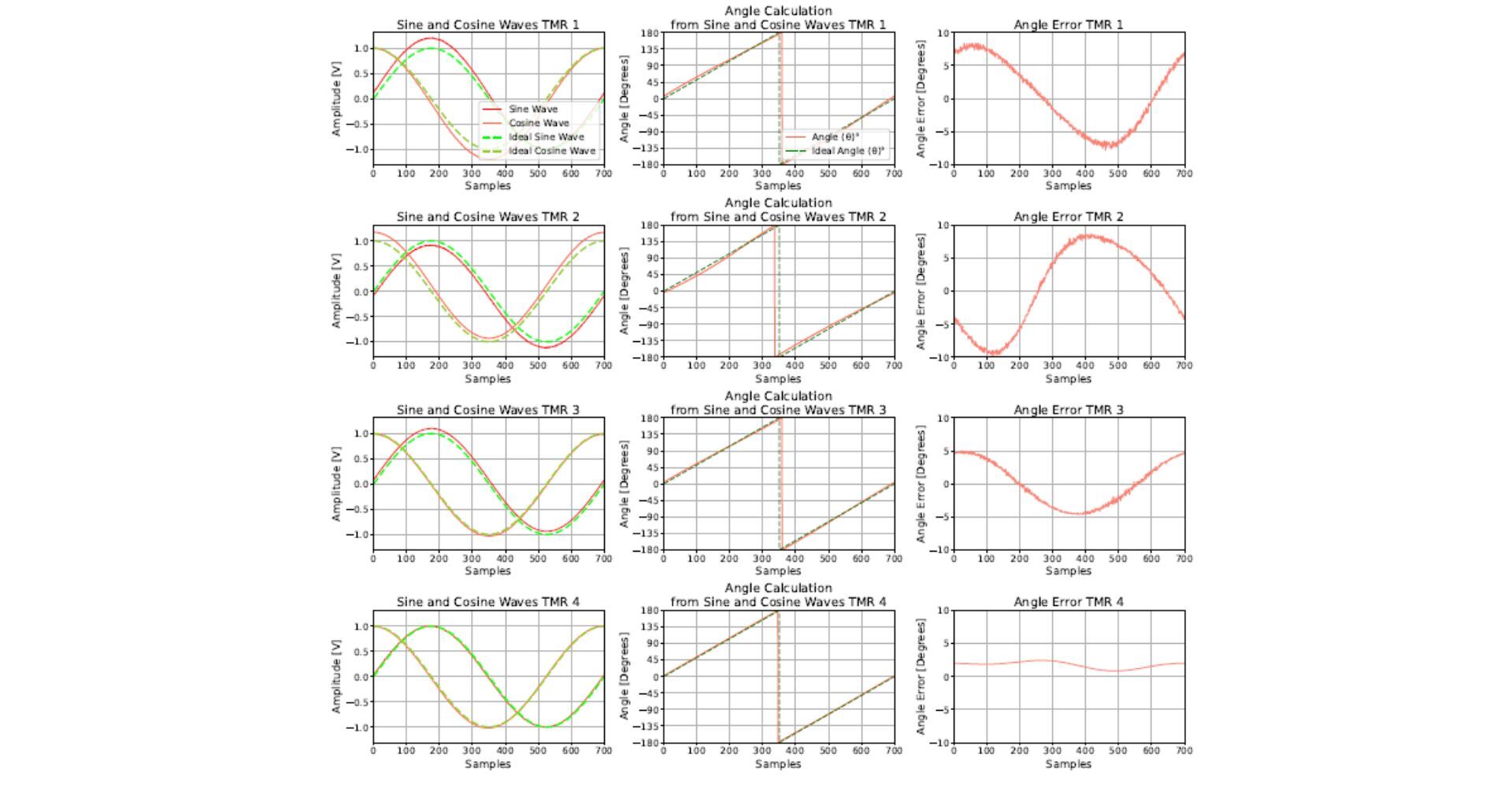
In safety-critical industries—from automotive steering to robotic joint control—the failure of a low-cost sensor isn't just a maintenance headache; it’s a system-level hazard. While traditional engineering relies on high-precision, expensive hardware, a new paradigm is emerging: **Self-X architectures**.
Developed by **Elena Gerken** and **Andreas König** from the [Rheinland-Pfälzische Technische Universität](https://rptu.de/en) Kaiserslautern-Landau, this approach shifts the focus from "perfect hardware" to "intelligent algorithms". By leveraging nature-inspired principles like self-monitoring and self-repair, we can now extract sub-degree precision from arrays of imperfect, redundant sensors.
## The Architecture: A Biological Blueprint for Silicon
Technical Self-X systems emulate biological organisms by autonomously detecting and responding to internal and external changes. Instead of a single high-accuracy sensor that demands a stable, permanent installation, this methodology utilizes a small array of homogeneous, low-cost sensors.
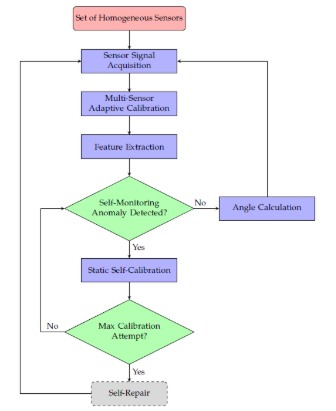
*Block diagram of the proposed Self-X architecture.*
As shown in the architecture above, the system doesn't just "average" the data. It follows a sophisticated hierarchical path:
1. **Adaptive Self-Calibration:** Fuses data from multiple sensors into a unified dataset.
2. **Self-Monitoring:** Inspired by the human immune system, it compares real-time measurements against pre-learned "self" patterns (Positive Selection Algorithm).
3. **Self-Repair:** If an anomaly is detected, the system escalates from software-level recalibration (ellipse fitting) to hardware-level switching or algorithmic parameter updates.
## Addressing the "Real World": TMR Sensor Fault Injection
To validate the proposed architecture under controlled conditions, the researchers utilized **Tunnel Magnetoresistance (TMR)** sensors, which are the backbone of modern angular decoders. In a lab environment, they built a precision displacement stage to inject the exact faults that kill sensor reliability in the field.
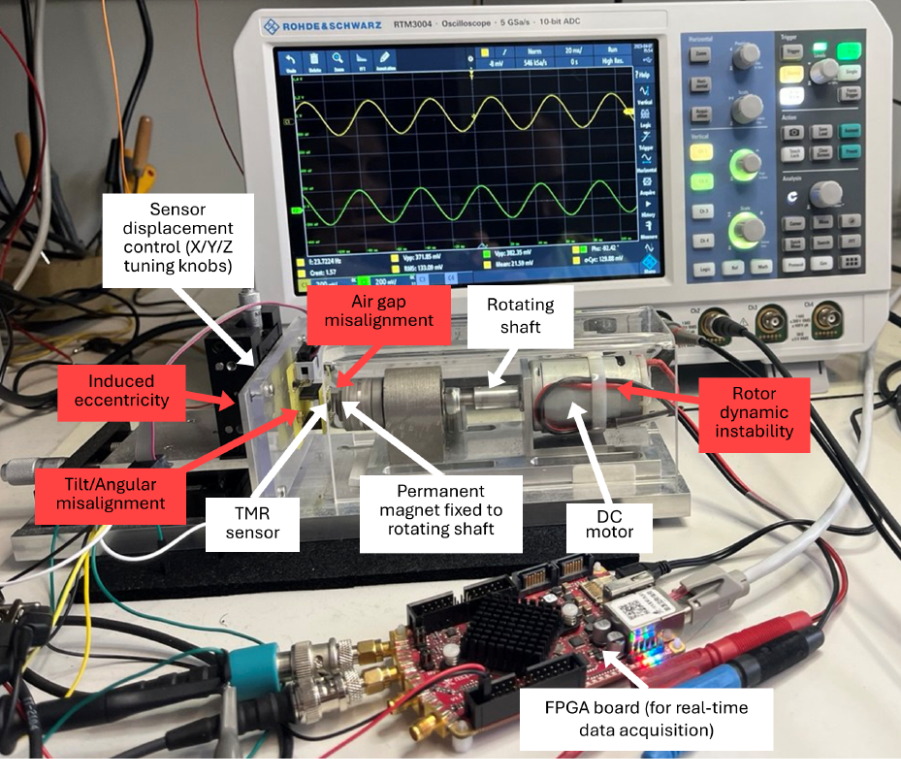
*Experimental setup with fault injection capability*
For an engineer, the value here is in the granularity of the fault modeling. The system accounts for:
- **Mechanical Failures:** Induced eccentricity, air gap misalignment, and rotor dynamic instability.
- **Circuit Failures:** Quantization inaccuracies, impedance mismatches, and even shorts in tunnel junctions.
- **Single Sensor MAE:** up to 5.6°
- **Four-Sensor Self-X MAE:** as low as 0.111°
- **Reduced Maintenance:** Autonomous recalibration eliminates the need for manual site visits.
- **Scalability:** Low-cost sensor arrays are more cost-effective than single high-end components.
- **Safety:** The "immune system" approach to anomaly detection ensures that faults are flagged before they lead to critical system failure.
These faults manifest as distorted **Lissajous patterns**, turning what should be a perfect circle into an offset, jagged ellipse.
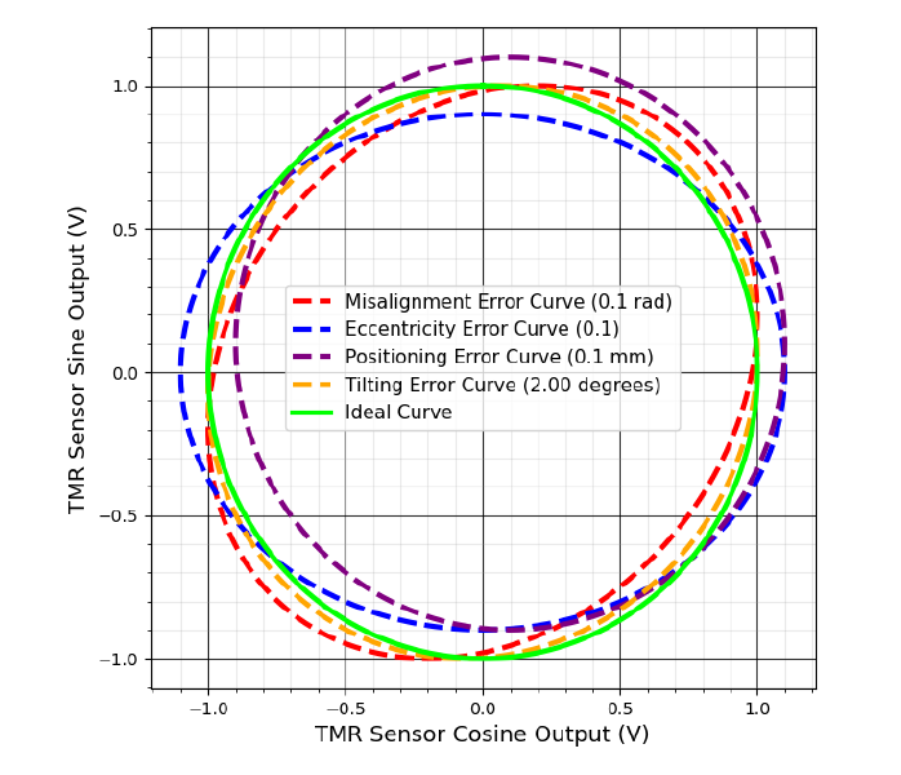
*Graphical representation of distorted TMR sensor Lissajous patterns*
## The Core Engine: Multidimensional Mapping
The "secret sauce" of the Gerken-König approach is the shift from simple data fusion to **Dimensionality Reduction (DR)**. Simple averaging fails to correct systematic errors like phase misalignment or offset drift.
Multidimensional mapping projects high-dimensional sensor data into a lower-dimensional space, effectively filtering out systematic distortions while retaining the most informative features.
| **Method** | **Best For...** | **Implementation Difficulty** |
| --- | --- | --- |
| **PCA (Principal Component Analysis)** | Identifying greatest variance directions. | Easy |
| **Factor Analysis (FA)** | Modeling latent factors in measurement. | Medium |
| **Marcus Roos’ Method (MR)** | Offset and magnetic field correction using SVD. | Medium |
## Results: The Power of Four
The quantitative results of this Self-X approach are striking. By applying Factor Analysis to an array of four redundant sensors, the **Mean Absolute Error (MAE)** was reduced by over **80%**.
This confirms that even if individual low-cost sensors are plagued by noise and mechanical tilt, the collective "virtual sensor" remains robust.
**Why This Matters for Your Industry**
If you are designing for Industry 4.0, the goal is no longer just high performance; it's **high availability with low overhead**. This Self-X framework allows for:
- **Reduced Maintenance:** Autonomous recalibration eliminates the need for manual site visits.
- **Scalability:** Low-cost sensor arrays are more cost-effective than single high-end components.
- **Safety:** The "immune system" approach to anomaly detection ensures that faults are flagged before they lead to critical system failure.
**Read the full study:** [Enhancing Reliability in Redundant Homogeneous Sensor Arrays with Self-X and Multidimensional Mapping](https://doi.org/10.3390/s25133841)
---
**FAQ: Self-X Sensor Architectures**
**What is a Self-X sensor architecture?**It is a biomimetic design approach where sensor systems autonomously perform "X" functions—such as self-calibration, self-monitoring, and self-repair—without human intervention, inspired by biological immune systems.
**How does dimensionality reduction improve sensor reliability?**Simple averaging of redundant sensors doesn't eliminate systematic errors like tilt or phase shift. Multidimensional mapping (e.g., Factor Analysis or PCA) extracts the most relevant features while filtering out noise and distortions caused by mechanical or circuit failures.
---
**Why are TMR sensors used in safety-critical applications?**Tunnel Magnetoresistance (TMR) sensors offer high sensitivity and a high signal-to-noise ratio for angular and position decoding. However, they are sensitive to mechanical misalignments, making them ideal candidates for the robustness provided by Self-X software layers.
---
**What is the "Positive Selection Algorithm" in sensor monitoring?**It is a self-monitoring technique where the system learns the patterns of "normal" sensor behavior (the "self"). Any incoming data that deviates significantly from these learned patterns is flagged as an anomaly or a fault.
### About the Red Pitaya Team
The Red Pitaya Technical Editorial Team is a cross-functional group of technical communicators and product specialists. By synthesizing insights from our hardware developers and global research partners, we provide verified, high-value content that bridges the gap between open-source innovation and industrial-grade precision.
Our mission is to make advanced instrumentation accessible to engineers, researchers, and educators worldwide.
##### Categories
- [academia (47)](https://content.redpitaya.com/blog/tag/academia)
##### Recent Posts
- [](https://content.redpitaya.com/blog/non-invasive-gerd-detection-radiofrequency-spectrophotometry)
[Non-Invasive GERD Detection: Continuous Esophageal Monitoring via Radiofrequency Spectrophotometry](https://content.redpitaya.com/blog/non-invasive-gerd-detection-radiofrequency-spectrophotometry)
September 29, 2026
- [](https://content.redpitaya.com/blog/open-source-mri-console-ocra-marcos-red-pitaya)
[How a $500 Open-Source MRI Console Sparked a Global Research Ecosystem](https://content.redpitaya.com/blog/open-source-mri-console-ocra-marcos-red-pitaya)
September 22, 2026
- [](https://content.redpitaya.com/blog/zephyr-rtos-nordic-logic-analyzer-workshop-eestec-ljubljana)
[Probing the Wire: Red Pitaya & Zephyr RTOS Workshop with EESTEC](https://content.redpitaya.com/blog/zephyr-rtos-nordic-logic-analyzer-workshop-eestec-ljubljana)
September 17, 2026
##### Subscribe to our newsletter

An open-source solution for hobbyists, professors,
radio amateurs and industrial clients.
**Red Pitaya**
Velika pot 21,
5250 Solkan
Slovenia, Europe
Phone: +386 30 322 719
Email: [info@redpitaya.com](mailto:info@redpitaya.com)
**Red Pitaya US**
TX, Dallas - Downtown Republic Center
325 N. St. Paul Street
Suite 3100
Dallas, Texas, 75202
United States of America
IMPORTANT: This address does not accept RMAs
Phone: (888) 637-2706
Email: [US.office@redpitaya.com](mailto:US.office@redpitaya.com)
- Customer Service
- [Customer Support](https://redpitaya.com/customer-support/)
- [Shipping & Returns](https://redpitaya.com/shipping-returns/)
- [Contact us](https://redpitaya.com/contact-us/)
- [Cookie Policy](https://redpitaya.com/cookie-policy/)
- SLO
- [O nas](https://redpitaya.com/o-nas/)
- [Pogoji poslovanja](https://redpitaya.com/pogoji-poslovanja/)
- [Politika zasebnosti](https://redpitaya.com/politika-zasebnosti/)
- [Politika piškotkov](https://redpitaya.com/politika-piskotkov/)
##### Follow Us
#### Subscribe to our newsletter
Get notified about new SW features & updates, news about latest community projects & events and new Red Pitaya products & discounts
[Subscribe](https://go.redpitaya.com/cs/c/?cta_guid=36ccbdc0-0344-49c4-aa91-aa67cf437c09&signature=AAH58kHkxFYTAKU-ILQzHI1jlrdI_co0RA&placement_guid=a24cb732-1dfb-4d0a-8c52-aa6851ce9102&click=556cfaee-eee4-48e4-95e7-c483a4f78883&hsutk=537e15e740555d2fd6a1c1ad931d2b6f&canon=https%3A%2F%2Fredpitaya.com%2Fabout-us%2F&utm_referrer=https%3A%2F%2Fredpitaya.com%2Fcompare%2F&portal_id=7715357&redirect_url=APefjpGj5Dm9poAAzHFGh4S6pJ-2TvNzBdwZZlfbr7toxfw-epFUtzEHOKToHx0i2TYYr39srj9aSERdntJBh8lJqoSXL-pUF2gwhYvOW6IMm28hQVmhYML2AIbbIRrr3YaoyJkZQ0iRxq-uHlFt66i3_8XpQpXT_M2zF9fS7t0f6hlBjGBJ7X_aXDrhBwXcEAqwoWWleG4uxonSGOR-BBp3tpKcySXYELTGHeGn5Yo61r3xrFvqFP5P6BxVwxTi51_ceW9uBzOMvA1rYz4BsIhLSF8n4bhcHqJTvhibH_laJrjDNdEUUrU&__hstc=72355340.537e15e740555d2fd6a1c1ad931d2b6f.1635738083317.1635738083317.1635746314170.2&__hssc=72355340.5.1635746314170&__hsfp=530052575&contentType=standard-page)
**Red Pitaya** 2025 All Rights Reserved.
- [Privacy Policy](https://redpitaya.com/privacy-policy/)
- [Terms of Use](https://redpitaya.com/terms-of-use/)
```json
{
"@context" : "https://schema.org",
"@type" : "BlogPosting",
"author" : {
"@type" : "Person",
"name" : "Red Pitaya Technical Editorial Team",
"url" : "https://content.redpitaya.com/blog/author/red-pitaya-technical-editorial-team"
},
"dateModified" : "2026-02-17T08:15:00.417Z",
"datePublished" : "2026-02-10T08:15:00.000Z",
"headline" : "Self-X Architectures: Beyond Simple Redundancy for Reliable Sensor Arrays",
"image" : [ "https://content.redpitaya.com/hubfs/blog%20featured%20image%20-%202026-02-05T151019.503.jpg" ],
"mainEntityOfPage" : {
"@id" : "https://content.redpitaya.com/blog/yourdomain.com/self-x-architecture-redundant-sensor-arrays",
"@type" : "WebPage"
},
"publisher" : {
"@type" : "Organization",
"logo" : {
"@type" : "ImageObject",
"url" : "https://content.redpitaya.com/hubfs/Red-pitaya-logo.jpg"
},
"name" : "Red Pitaya d.o.o."
}
}
```