---
title: "Students Build AI-Powered Predictive Maintenance System with Red Pitaya: 98% Accuracy in Equipment Failure Prediction"
description: A student team built a 98%-accurate AI predictive maintenance system using Red Pitaya, showing how affordable FPGA and ML tools can rival costly industrial solutions.
image: https://content.redpitaya.com/hubfs/blog%20featured%20image%20(85).jpg
---
[](https://redpitaya.com/)
[](https://redpitaya.com/)
- Products
- [STEMlab 125-14 Gen 2](https://redpitaya.com/stemlab-125-14-gen2/)
- [STEMlab 125-14](https://redpitaya.com/stemlab-125-14/)
- [SIGNALlab 250-12](https://redpitaya.com/signallab-250-12/)
- [SDRlab 122-16](https://redpitaya.com/sdrlab-122-16/)
- [STEMlab TI (Texas Instruments)](https://redpitaya.com/stemlab-ti-texas-instruments/)
- [Multi-channel Solutions](https://redpitaya.com/multi-channel-solutions/)
- [Accessories](https://redpitaya.com/accessories/)
- [Applications](https://redpitaya.com/applications/)
- Documentation
- [Technical Documentation](https://redpitaya.com/documentation/)
- [Teaching materials](https://redpitaya.com/teaching-materials/)
- [Student projects](https://redpitaya.com/student-projects/)
- [User forum](https://forum.redpitaya.com/)
- [About](https://redpitaya.com/about-us/)
- [History](https://redpitaya.com/history/)
- [Distributors](https://redpitaya.com/distibutors-red-pitaya/)
- [Blog](https://content.redpitaya.com/blog)
[Shop](https://redpitaya.com/shop/)
- [ACADEMIA](https://redpitaya.com/academia/)
- [RADIO AMATEURS](https://redpitaya.com/radio-amateurs/)
- [Home](https://redpitaya.com/)
- Products
- [STEMlab 125-10](https://redpitaya.com/stemlab-125-10/)
- [STEMlab 125-14](https://redpitaya.com/stemlab-125-14/)
- [SIGNALlab 250-12](https://redpitaya.com/signallab-250-12/)
- [SDRlab 122-16](https://redpitaya.com/sdrlab-122-16/)
- [Accessories](https://redpitaya.com/accessories/)
- [Applications](https://redpitaya.com/applications/)
- [Resources](https://redpitaya.com/documentation/)
- [Shop](https://redpitaya.com/shop/)
- [About](https://redpitaya.com/about-us/)
- [Blog](https://content.redpitaya.com/blog)
- [Compare](https://redpitaya.com/compare/)
- [Login / Register](https://redpitaya.com/my-account/)
### Red Pitaya Blog
[Home](https://redpitaya.com) » [Academia](https://content.redpitaya.com/blog/tag/academia) »
[Academia](https://content.redpitaya.com/blog/tag/academia)
# Students Build AI-Powered Predictive Maintenance System with Red Pitaya: 98% Accuracy in Equipment Failure Prediction
- Posted by  [Red Pitaya Technical Editorial Team](https://redpitaya.com/Red-Pitaya-Blog-team/) , December 2, 2025
.jpg)
*How Five Engineering Students Created an Affordable Industrial IoT Solution Using FPGA and Machine Learning*
*Team AOHW25\_694* | *AMD Open Hardware Competition 2025*
## ***"This bearing has 2 weeks and 3 days of life remaining."***
That's not a guess—it's the precise prediction from an AI-powered predictive maintenance system built entirely by university students using a credit-card-sized Red Pitaya board. What would have cost tens of thousands in industrial monitoring equipment now runs on hardware costing a fraction of that price.
## The $100 Million Problem: When Industrial Equipment Fails
Every year, unplanned equipment downtime costs industrial manufacturers billions of dollars. A single bearing failure can shut down an entire production line. Traditional maintenance approaches fall into two costly extremes:
1. **Replace parts too early** – waste money on components with useful life remaining
2. **Replace parts too late**
– risk catastrophic failures, safety hazards, and emergency downtime
Predictive maintenance promises a solution: monitor equipment in real-time and predict failures before they happen. But there's a catch—enterprise systems cost $50,000-$200,000+ per installation, pricing out small manufacturers and educational institutions.
Five engineering students from Alabama A&M University asked a simple question: *Why does it have to be so expensive?*
## Meet the Team: Building the Future of Industrial IoT
Tatenda Joseph, Solomon Agyire, John Adeyemo, Sunday Ochigbo, and Mauyon Wusu—five students supervised by Dr. Raziq Yaqub—combined FPGA signal processing, machine learning, and smart sensor design to create an affordable alternative to enterprise predictive maintenance systems.
Their weapon of choice? The Red Pitaya STEMlab 125-14, an open-source measurement platform that replaces an entire rack of traditional lab equipment with a single palm-sized board featuring:
1. Xilinx Zynq-7010 FPGA + ARM processor
2. 14-bit ADC sampling at 125 MS/s
3. Real-time signal processing capabilities
4. Open-source software ecosystem
The result? A system that achieved 98.82% accuracy in predicting bearing failures—rivaling commercial solutions at a fraction of the cost.
## How It Works: From Vibration to Prediction in Milliseconds
The system architecture elegantly combines edge and cloud processing to achieve real-time predictions while maintaining flexibility and affordability.
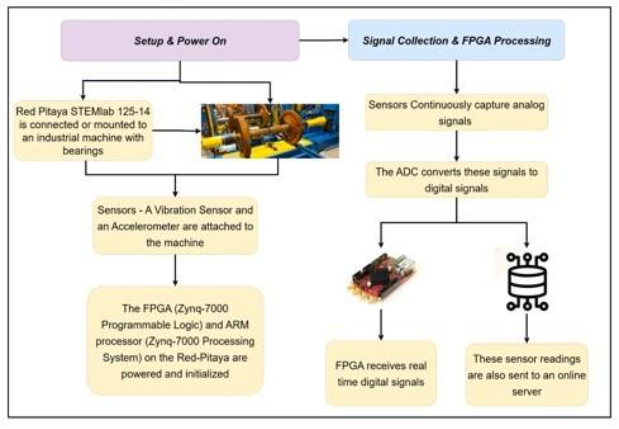
*Figure 1: Complete system architecture showing signal flow from industrial equipment through Red Pitaya to cloud prediction*
Step 1: Sensing the Invisible Signs of Failure
Bearings don't fail suddenly—they degrade gradually, broadcasting subtle warning signs through changes in vibration patterns. The team attached two types of sensors to monitor these signatures:
1. **ADXL335 3-axis accelerometer** – captures g-force changes across three dimensions
2. **Piezoelectric vibration sensor** – detects high-frequency vibration patterns invisible to accelerometers
These sensors connect directly to Red Pitaya's analog inputs, which continuously digitize the signals at up to 1,000 samples per second with 14-bit precision.
Step 2: FPGA-Accelerated Signal Processing
Here's where Red Pitaya's Zynq SoC architecture shines. The FPGA fabric handles high-speed analog-to-digital conversion while the dual-core ARM processor extracts eight critical features from the raw signals:
1. **RMS (Root Mean Square)** – overall vibration energy
2. **Peak-to-Peak** – maximum vibration range
3. **Kurtosis** – measures outliers indicating shock events
4. **Crest Factor** – early warning indicator for developing faults
5. **Entropy** – signal randomness and complexity
6. **Skewness** – distribution asymmetry
7. **Mean & Standard Deviation** – baseline and variability
Each feature captures a different physical aspect of bearing degradation. For example, as wear progresses, the crest factor (peak-to-RMS ratio) increases because impacts become more pronounced before overall energy rises—providing an early warning system.
Step 3: Machine Learning Prediction Engine
The extracted features feed into a Random Forest Regressor trained on NASA's IMS Bearing Dataset—2,155 samples of real bearing degradation data from run-to-failure laboratory tests.
**Why Random Forest?** The team chose this algorithm for three critical reasons:
1. **Accuracy** – handles non-linear relationships between vibration patterns and failure progression
2. **Interpretability** – reveals which features matter most (critical for engineering validation)
3. **Regression capability** – predicts continuous RUL values, not just "faulty/healthy" classification
The model doesn't just say "bearing will fail soon"—it outputs precise predictions: "2 weeks 3 days of operational life remaining." This specificity transforms maintenance from reactive to strategic.
Step 4: Real-Time Dashboard and Alerts
All predictions stream to a web dashboard accessible from any device on the network. Maintenance teams see:
1. Current RUL estimate in readable time format
2. Real-time vibration waveforms
3. Feature trends over time
4. Historical degradation curves
The entire processing pipeline—from sensor reading to dashboard update—completes in real-time, providing continuous health monitoring without expensive SCADA integration.
## The Numbers Don't Lie: 98.82% Accuracy
Model performance metrics tell the story:
1. **R² = 0.9882** – the model explains 98.82% of variance in bearing lifetime
2. **MAE = 35.36 time units** – average prediction error equivalent to less than one day
3. **96 features processed** – comprehensive multi-sensor analysis
Feature importance analysis revealed surprising insights: standard deviation alone accounts for ~70% of predictive power in certain test scenarios. This makes physical sense—as bearings wear, vibration becomes increasingly erratic before catastrophic failure.

*Figure 2: Scatter plots demonstrate 98.82% accuracy - tight clustering along the ideal prediction line shows exceptional model performance across both test datasets*
The scatter plots above show tight clustering along the ideal prediction line—exactly what you want to see in a regression model. Early-life predictions are rock-solid, and even end-of-life predictions (the hardest to get right) maintain high accuracy across both independent test datasets.
## Why This Matters: Democratizing Predictive Maintenance
Breaking the Cost Barrier
Traditional industrial monitoring systems require:
1. $50,000-$200,000+ per installation
2. Proprietary software licenses
3. Specialized integration expertise
4. Ongoing support contracts
This student project runs on:
1. Red Pitaya board (~$500)
2. Commodity sensors (~$50)
3. Open-source software (free)
4. Standard web browser interface (free)
**That's 99% cost reduction** while maintaining enterprise-grade accuracy. Small manufacturers, educational institutions, and developing economies can now access predictive maintenance technology previously reserved for Fortune 500 companies.
From Proof-of-Concept to Production
The system architecture naturally scales from single-machine monitoring to factory-wide deployment:
1. **Single installation** – monitor critical equipment
2. **Multi-sensor arrays** – one Red Pitaya can monitor multiple bearings
3. **Distributed networks** – multiple boards report to centralized server
4. **Cloud integration** – aggregate data across facilities
No proprietary protocols, no vendor lock-in, no licensing headaches—just standards-based IoT technology that integrates with existing infrastructure.
Beyond Bearings: A Platform for Innovation
While the team focused on bearing monitoring, the fundamental approach applies to virtually any equipment with measurable degradation patterns:
1. **Electric motors** – winding insulation breakdown, rotor bar cracking
2. **Pumps** – impeller wear, cavitation detection
3. **Gearboxes** – tooth wear, lubrication degradation
4. **Compressors** – valve leakage, pressure variations
5. **HVAC systems** – fan imbalance, belt wear
6. **Structural monitoring** – bridge health, building integrity
Each application requires retraining the model on appropriate datasets, but the core technology stack remains identical. This modularity transforms a student project into a genuine platform for industrial innovation.
## Engineering Challenges and Creative Solutions
Challenge #1: Fighting Environmental Noise
**The Problem:** Real industrial environments are electromagnetically noisy. Nearby machinery, power lines, and motors create interference that swamps delicate sensor signals.
**The Solution:** Meticulous calibration protocols. The team spent weeks characterizing their sensors, determining zero-g bias points (1.09V), sensitivity coefficients (0.145 V/g), and optimal shielding configurations. They validated their setup with Arduino before deploying to Red Pitaya, catching issues early.
Challenge #2: Feature Selection Paralysis
**The Problem:** Signal processing literature offers dozens of potential features. Testing all combinations would take months.
**The Solution:** Domain knowledge + empirical testing. The team started with features backed by vibration analysis theory (RMS for energy, kurtosis for shocks, crest factor for early faults), then used feature importance analysis to validate their choices. Standard deviation emerged as the MVP, confirming that increased variability is the strongest failure predictor.
Challenge #3: Real-Time Processing Constraints
**The Problem:** Extract features, run ML inference, update dashboard—all in real-time without dropped samples or processing bottlenecks.
**The Solution:** Smart architecture. Heavy lifting (ADC conversion) happens in FPGA fabric. Feature extraction runs on ARM cores. ML inference offloads to server. This hybrid approach balances edge processing (low latency) with cloud capabilities (complex models) without overloading any single component.
Challenge #4: Making Predictions Actionable
**The Problem:** "RUL = 342 time units" means nothing to a maintenance technician who needs to order replacement parts.
**The Solution:** Convert predictions to calendar time. The system automatically translates model outputs into readable estimates: "2 weeks 3 days remaining." Small detail, massive usability improvement—now technicians can actually plan maintenance windows and procurement schedules.
# The Road Ahead: Future Enhancements
The team identified several high-value improvements for version 2.0:
Full Edge Deployment
Port the complete ML pipeline onto Red Pitaya's ARM core using model quantization. This eliminates cloud dependency, reduces latency to milliseconds, and enables offline operation—critical for remote installations or security-sensitive environments.
Frequency-Domain Analysis
Add FFT (Fast Fourier Transform) and spectral entropy features. Bearing defects create characteristic frequency peaks corresponding to defect dimensions and shaft rotation rates—frequency analysis can identify specific failure modes (outer race, inner race, ball defects) that time-domain features miss.
Intelligent Alert System
Implement threshold-based notifications integrated with email, SMS, and SCADA systems. When RUL drops below critical levels (e.g., \<7 days), automatically alert maintenance teams with actionable information: which bearing, estimated failure date, recommended action.
Historical Analytics and Trend Mining
Enable local data logging for long-term analysis. Track RUL patterns across equipment lifecycles to optimize replacement schedules, identify problematic operating conditions, and validate maintenance strategies with hard data.
Multi-Equipment Monitoring
Leverage Red Pitaya's multiple analog inputs to simultaneously monitor 4+ bearings with a single board. Combined with multiplexing, one unit could theoretically monitor dozens of measurement points—making factory-wide deployment economically feasible.
## Key Takeaways for Students and Engineers
This project offers several important lessons:
1. Advanced Technology Doesn't Require Advanced Budgets
FPGA signal processing, machine learning, IoT connectivity—technologies once requiring enterprise resources now run on affordable development platforms. Red Pitaya proves that professional-grade instrumentation fits in your pocket and your budget.
1. Domain Knowledge Amplifies Data Science
The team's success came from understanding bearing physics, not just throwing data at algorithms. Knowing that crest factor indicates early faults or that kurtosis captures shock events guided feature selection and model interpretation.
1. Hybrid Architectures Solve Real-World Constraints
Edge processing for speed, cloud for complex inference—the team didn't dogmatically pursue "pure edge AI" when hybrid made more sense. Pragmatic engineering beats architectural purity.
1. Usability Matters as Much as Accuracy
Converting "RUL = 342" to "2 weeks 3 days" seems trivial but transforms user experience. Great engineering considers human factors, not just technical metrics.
1. Open-Source Platforms Enable Innovation
Red Pitaya's open ecosystem—from hardware schematics to software APIs—let the team focus on their ML innovation instead of fighting proprietary limitations. Open platforms democratize capability.
## Conclusion: From Classroom to Industry
Team AOHW25\_694 didn't just complete a class project—they built a genuine solution to a multi-billion-dollar industrial problem. Their real-time AI-based fault detection system demonstrates that:
1. **Predictive maintenance doesn't require enterprise budgets**
2. **FPGA platforms like Red Pitaya make professional instrumentation accessible**
3. **Machine learning can achieve 98%+ accuracy on real industrial datasets**
4. **Student innovation can compete with commercial solutions**
More importantly, they've created a template others can follow. The GitHub repository, detailed documentation, and open architecture mean this isn't a one-off research project—it's a starting point for countless variations and improvements.
For small manufacturers struggling with maintenance costs, this represents a viable path to Industry 4.0 adoption. For students learning embedded systems and ML, this shows how classroom concepts translate to real-world applications. For the broader engineering community, this proves that innovation doesn't require massive resources—just creativity, solid fundamentals, and the right tools.
*The future of industrial monitoring isn't in expensive proprietary systems—it's in open, affordable platforms that put advanced capabilities in everyone's hands.*
## Technical Specifications
Hardware
1. **Platform:** Red Pitaya STEMlab 125-14
2. **Processor:** Dual-core ARM Cortex-A9 @ 866 MHz
3. **FPGA:** Xilinx Zynq-7010 (28,000 logic cells, 80 DSP slices)
4. **ADC:** 14-bit, 125 MS/s, ±1V range
5. **Memory:** 512 MB DDR3 RAM
6. **Sensors:** ADXL335 accelerometer (±3g), piezoelectric vibration sensor
Software
1. **Languages:** Python, JavaScript
2. **ML Framework:** scikit-learn (Random Forest Regressor)
3. **Data Processing:** NumPy, pandas, SciPy
4. **Visualization:** Matplotlib, Seaborn
5. **Development:** Google Colab, Arduino IDE (prototyping)
Model Performance
1. **Accuracy:** R² = 0.9882 (98.82%)
2. **Error:** MAE = 35.36 time units
3. **Dataset:** NASA IMS (2,155 samples, 96 features)
4. **Features:** 8 time-domain (RMS, Peak, Entropy, Kurtosis, Crest, Mean, Skewness, StdDev)
## Resources and Links
**Project Repository:**
[github.com/tatendajoes/AMD-Hardware-Competition-2025](https://github.com/tatendajoes/AMD-Hardware-Competition-2025)
**Dataset:** NASA IMS Bearing Dataset (available on Kaggle)
**Hardware:** Red Pitaya STEMlab 125-14
**Competition:** AMD Open Hardware 2025 - Adaptive Computing Track
**Team:** Tatenda Joseph, Solomon Agyire, John Adeyemo, Sunday Ochigbo, Mauyon Wusu
**Supervisor:** Dr. Raziq Yaqub, Alabama A&M University
### About the Red Pitaya Team
The Red Pitaya Technical Editorial Team is a cross-functional group of technical communicators and product specialists. By synthesizing insights from our hardware developers and global research partners, we provide verified, high-value content that bridges the gap between open-source innovation and industrial-grade precision.
Our mission is to make advanced instrumentation accessible to engineers, researchers, and educators worldwide.
##### Categories
- [academia (47)](https://content.redpitaya.com/blog/tag/academia)
##### Recent Posts
- [](https://content.redpitaya.com/blog/experimenting-with-red-pitaya-stemlab-gen-2-book)
[What’s Inside Experimenting with Red Pitaya STEMlab Gen 2?](https://content.redpitaya.com/blog/experimenting-with-red-pitaya-stemlab-gen-2-book)
October 20, 2026
- [](https://content.redpitaya.com/blog/red-pitaya-input-impedance-50-ohm-high-z)
[Why Is My Signal Voltage Doubled? Understanding Red Pitaya Input Impedance & 50 ΩTermination](https://content.redpitaya.com/blog/red-pitaya-input-impedance-50-ohm-high-z)
October 12, 2026
- [](https://content.redpitaya.com/blog/red-pitaya-copilot-instrument-development)
[Red Pitaya Copilot: How to Build Custom FPGA Instruments with AI Assistance](https://content.redpitaya.com/blog/red-pitaya-copilot-instrument-development)
October 12, 2026
##### Subscribe to our newsletter

An open-source solution for hobbyists, professors,
radio amateurs and industrial clients.
**Red Pitaya**
Velika pot 21,
5250 Solkan
Slovenia, Europe
Phone: +386 30 322 719
Email: [info@redpitaya.com](mailto:info@redpitaya.com)
**Red Pitaya US**
TX, Dallas - Downtown Republic Center
325 N. St. Paul Street
Suite 3100
Dallas, Texas, 75202
United States of America
IMPORTANT: This address does not accept RMAs
Phone: (888) 637-2706
Email: [US.office@redpitaya.com](mailto:US.office@redpitaya.com)
- Customer Service
- [Customer Support](https://redpitaya.com/customer-support/)
- [Shipping & Returns](https://redpitaya.com/shipping-returns/)
- [Contact us](https://redpitaya.com/contact-us/)
- [Cookie Policy](https://redpitaya.com/cookie-policy/)
- SLO
- [O nas](https://redpitaya.com/o-nas/)
- [Pogoji poslovanja](https://redpitaya.com/pogoji-poslovanja/)
- [Politika zasebnosti](https://redpitaya.com/politika-zasebnosti/)
- [Politika piškotkov](https://redpitaya.com/politika-piskotkov/)
##### Follow Us
#### Subscribe to our newsletter
Get notified about new SW features & updates, news about latest community projects & events and new Red Pitaya products & discounts
[Subscribe](https://go.redpitaya.com/cs/c/?cta_guid=36ccbdc0-0344-49c4-aa91-aa67cf437c09&signature=AAH58kHkxFYTAKU-ILQzHI1jlrdI_co0RA&placement_guid=a24cb732-1dfb-4d0a-8c52-aa6851ce9102&click=556cfaee-eee4-48e4-95e7-c483a4f78883&hsutk=537e15e740555d2fd6a1c1ad931d2b6f&canon=https%3A%2F%2Fredpitaya.com%2Fabout-us%2F&utm_referrer=https%3A%2F%2Fredpitaya.com%2Fcompare%2F&portal_id=7715357&redirect_url=APefjpGj5Dm9poAAzHFGh4S6pJ-2TvNzBdwZZlfbr7toxfw-epFUtzEHOKToHx0i2TYYr39srj9aSERdntJBh8lJqoSXL-pUF2gwhYvOW6IMm28hQVmhYML2AIbbIRrr3YaoyJkZQ0iRxq-uHlFt66i3_8XpQpXT_M2zF9fS7t0f6hlBjGBJ7X_aXDrhBwXcEAqwoWWleG4uxonSGOR-BBp3tpKcySXYELTGHeGn5Yo61r3xrFvqFP5P6BxVwxTi51_ceW9uBzOMvA1rYz4BsIhLSF8n4bhcHqJTvhibH_laJrjDNdEUUrU&__hstc=72355340.537e15e740555d2fd6a1c1ad931d2b6f.1635738083317.1635738083317.1635746314170.2&__hssc=72355340.5.1635746314170&__hsfp=530052575&contentType=standard-page)
**Red Pitaya** 2025 All Rights Reserved.
- [Privacy Policy](https://redpitaya.com/privacy-policy/)
- [Terms of Use](https://redpitaya.com/terms-of-use/)
```json
{
"@context" : "https://schema.org",
"@type" : "BlogPosting",
"author" : {
"@type" : "Person",
"name" : "Red Pitaya Technical Editorial Team",
"url" : "https://content.redpitaya.com/blog/author/red-pitaya-technical-editorial-team"
},
"dateModified" : "2026-01-28T12:30:26.485Z",
"datePublished" : "2025-12-02T08:00:01.000Z",
"headline" : "Students Build AI-Powered Predictive Maintenance System with Red Pitaya: 98% Accuracy in Equipment Failure Prediction",
"image" : [ "https://content.redpitaya.com/hubfs/blog%20featured%20image%20(85).jpg" ],
"mainEntityOfPage" : {
"@id" : "https://content.redpitaya.com/blog/student-ai-predictive-maintenance-red-pitaya",
"@type" : "WebPage"
},
"publisher" : {
"@type" : "Organization",
"logo" : {
"@type" : "ImageObject",
"url" : "https://content.redpitaya.com/hubfs/Red-pitaya-logo.jpg"
},
"name" : "Red Pitaya d.o.o."
}
}
```