---
title: "Compact RF Sawtooth Generator: Redefining Beam Bunching Efficiency for Particle Accelerators"
description: Boost beam bunching efficiency to 71% with a compact SoC-FPGA RF sawtooth generator. Learn how IQ control and multi-harmonic synthesis replace bulky analog LLRF.
image: https://content.redpitaya.com/hubfs/blog%20featured%20image%20-%202026-02-03T145329.662.jpg
---
[](https://redpitaya.com/)
[](https://redpitaya.com/)
- Products
- [STEMlab 125-14 Gen 2](https://redpitaya.com/stemlab-125-14-gen2/)
- [STEMlab 125-14](https://redpitaya.com/stemlab-125-14/)
- [SIGNALlab 250-12](https://redpitaya.com/signallab-250-12/)
- [SDRlab 122-16](https://redpitaya.com/sdrlab-122-16/)
- [STEMlab TI (Texas Instruments)](https://redpitaya.com/stemlab-ti-texas-instruments/)
- [Multi-channel Solutions](https://redpitaya.com/multi-channel-solutions/)
- [Accessories](https://redpitaya.com/accessories/)
- [Applications](https://redpitaya.com/applications/)
- Documentation
- [Technical Documentation](https://redpitaya.com/documentation/)
- [Teaching materials](https://redpitaya.com/teaching-materials/)
- [Student projects](https://redpitaya.com/student-projects/)
- [User forum](https://forum.redpitaya.com/)
- [About](https://redpitaya.com/about-us/)
- [History](https://redpitaya.com/history/)
- [Distributors](https://redpitaya.com/distibutors-red-pitaya/)
- [Blog](https://content.redpitaya.com/blog)
[Shop](https://redpitaya.com/shop/)
- [ACADEMIA](https://redpitaya.com/academia/)
- [RADIO AMATEURS](https://redpitaya.com/radio-amateurs/)
- [Home](https://redpitaya.com/)
- Products
- [STEMlab 125-10](https://redpitaya.com/stemlab-125-10/)
- [STEMlab 125-14](https://redpitaya.com/stemlab-125-14/)
- [SIGNALlab 250-12](https://redpitaya.com/signallab-250-12/)
- [SDRlab 122-16](https://redpitaya.com/sdrlab-122-16/)
- [Accessories](https://redpitaya.com/accessories/)
- [Applications](https://redpitaya.com/applications/)
- [Resources](https://redpitaya.com/documentation/)
- [Shop](https://redpitaya.com/shop/)
- [About](https://redpitaya.com/about-us/)
- [Blog](https://content.redpitaya.com/blog)
- [Compare](https://redpitaya.com/compare/)
- [Login / Register](https://redpitaya.com/my-account/)
### Red Pitaya Blog
[Home](https://redpitaya.com) » [Case study](https://content.redpitaya.com/blog/tag/case-study) »
[Case study](https://content.redpitaya.com/blog/tag/case-study)
# Compact RF Sawtooth Generator: Redefining Beam Bunching Efficiency for Particle Accelerators
- Posted by  [Red Pitaya Technical Editorial Team](https://redpitaya.com/Red-Pitaya-Blog-team/) , March 3, 2026
In particle accelerator facilities, the difference between a successful nuclear physics experiment and a failed run often comes down to **beam bunching efficiency**. While single-frequency sine wave cavities are standard, they suffer from a poor bunching efficiency of roughly 31%.
To push this efficiency to **71% and beyond**, accelerator engineers turn to sawtooth waveforms. However, traditional analog sawtooth generators are bulky, rigid, and prone to component obsolescence.
This implementation, developed by **Ashish Sharma, Subrat Kar, and Bhuban Kumar Sahu** from the Indian Institute of Technology (IIT) Delhi and the Inter-University Accelerator Centre (IUAC), presents a **compact, wideband, and fully reconfigurable** embedded instrument designed to generate stable RF sawtooth waveforms. By utilizing an SoC-FPGA (System-on-Chip Field Programmable Gate Array), this design handles complex signal processing and feedback control in a single hardware footprint.
### The Physics of the Sawtooth: Multi-Harmonic Synthesis
A perfect sawtooth waveform consists of a long linear ramp followed by a near-instantaneous fall time. In the RF regime, this is approximated by combining multiple sub-harmonics—specifically the **first, second, and third harmonics**—with precise amplitude and phase control.
The proposed system regulates and combines three signals (typically 12.125, 24.25, and 36.375 MHz) to drive a **Multi-Harmonic Buncher (MHB)**. The resulting waveform translates to:
- x(t) = A₀ cos(ω₀t + φ₀) + A₁ cos(2ω₀t + φ₁) + A₂ cos(3ω₀t + φ₂)
- **Independent control** over the amplitude (Aₙ) and phase (**φₙ**) of each harmonic.
- **Deterministic timing** achieved by hosting the entire control logic within the FPGA fabric.
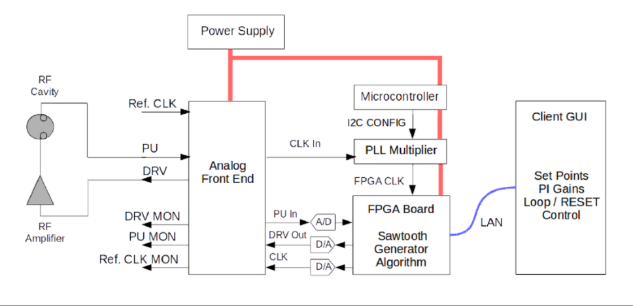 
*Overall block design of the proposed RF sawtooth generator instrument*
### Architecture: FPGA-Driven IQ Control
Unlike previous digital designs that required fixed, difficult-to-source sampling clocks, this architecture uses a commercial **Si5356-based fractional PLL multiplier**. This allows the 125 MHz system clock to synchronize with *any* external reference signal, providing unprecedented frequency agility.
#### Digital Down-Conversion (DDC) and Filtering
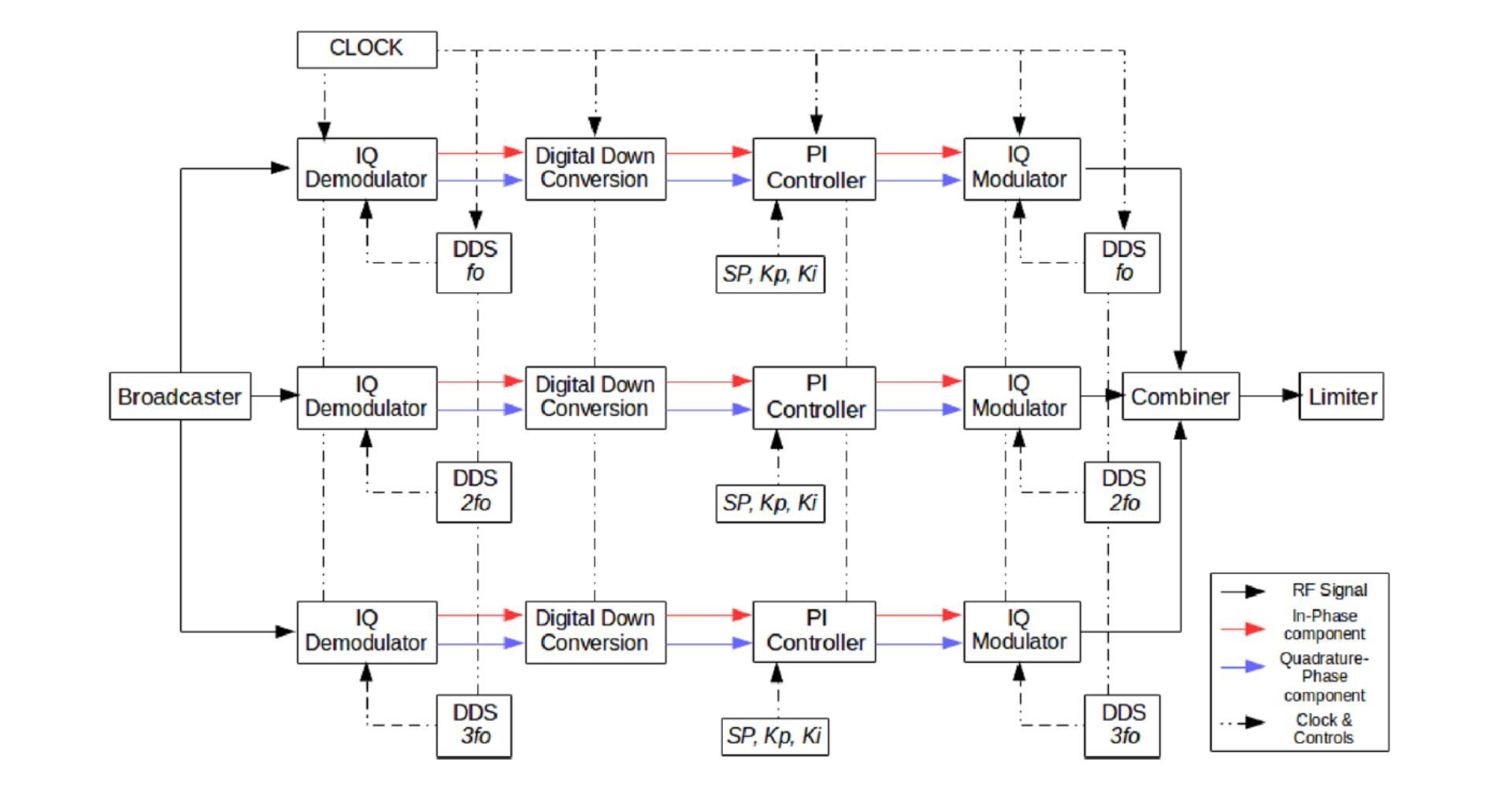
To stabilize the beam, the feedback signal from the RF cavities is processed through parallel chains:
1. **IQ Demodulation:** The high-frequency feedback is product-modulated into In-Phase (I) and Quadrature-Phase (Q) baseband components.
2. **Resource-Optimized Filtering:** Instead of computationally heavy high-cutoff FIR filters, the system employs **Cascaded-Integrator Comb (CIC) decimation filters**. These downsample the rate from 125 MHz to 1.25 MHz, saving vital FPGA DSP resources.
3. **Digital PI Control:** Six independent Proportional-Integral (PI) loops regulate the IQ components, eliminating steady-state error without the latency of CORDIC-based amplitude/phase conversions.
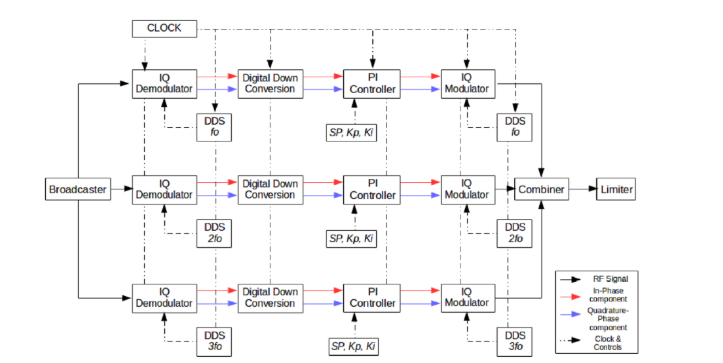 
*FPGA algorithm block design showing internal signal processing chains*
### Remote Operation and "Networked" Hardware
For modern accelerator labs, manual tuning at a rack is no longer practical. This instrument runs a **TCP/IP-based server** directly on the ARM processor part of the SoC-FPGA.
Engineers can interface with the device using a **Python Qt-based GUI**, allowing for:
- **Real-time gain tuning** and set-point adjustments.
- **Integrator RESET switches** to activate/deactivate control loops on the fly.
- **Remote monitoring** over Ethernet, suitable for large-scale facilities like the Pelletron or High-Current Injector accelerators at IUAC.
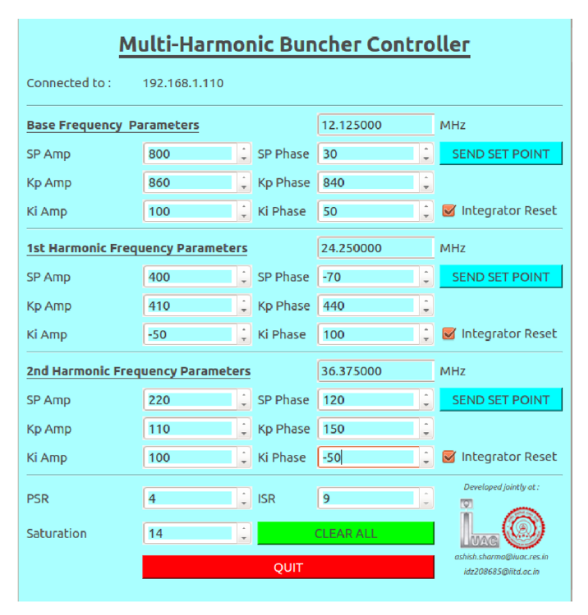 
*Python Qt-based graphical user interface for remote control*
### FAQ: RF Sawtooth Generation & Particle Accelerators
**Why is a sawtooth waveform better than a sine wave for beam bunching?**
A sine wave only provides linear velocity modulation for a small fraction of the beam, leading to poor bunching efficiency (~31%). A sawtooth waveform’s linear ramp acts on a larger portion of the continuous ion beam, significantly increasing the efficiency to approximately 71% by ensuring more particles arrive at the focus point simultaneously.
**What are the advantages of using an SoC-FPGA over traditional analog electronics?**
Analog systems are bulky and frequency-selective, meaning you need different hardware for different experimental frequencies. The SoC-FPGA approach is reconfigurable via software, handles all feedback loops digitally (avoiding component drift), and is compact enough to fit into a standard 19-inch rack-mountable box.
**How does the system maintain phase stability across different harmonics?**
The system uses **Digital Down-Conversion (DDC)** to extract baseband IQ components. By regulating the I and Q components simultaneously through PI controllers, the loop inherently maintains phase synchronization ($2n\\pi$) without needing external analog phase rotators.
**Is this design portable to other FPGA platforms?**
Yes. While developed on the [Red Pitaya STEMLab 125-14](https://redpitaya.com/stemlab-125-14/) (Xilinx Zynq 7010), the modular Verilog and AXI-interface structure make the digital signal processing (DSP) logic portable to other Xilinx or Intel FPGA platforms with appropriate ADC/DAC front-ends.
---
### Technical Summary & Publication Credits
This research provides a cost-effective, high-performance alternative to proprietary LLRF (Low-Level RF) systems.
**Key Specifications:**
- **FPGA Device:** Xilinx Zynq 7010z (Red Pitaya 125-14)
- **ADC/DAC:** 14-bit, 125 MSPS (Input) / 250 MSPS (Output)
- **Control Interface:** AXI-based memory-mapped IO with Python backend
**Authors:** Ashish Sharma, Subrat Kar, and Bhuban Kumar Sahu.
Read the full research paper [Compact embedded RF sawtooth waveform generator for particle accelerator applications](https://doi.org/10.1063/5.0247233).
### About the Red Pitaya Team
The Red Pitaya Technical Editorial Team is a cross-functional group of technical communicators and product specialists. By synthesizing insights from our hardware developers and global research partners, we provide verified, high-value content that bridges the gap between open-source innovation and industrial-grade precision.
Our mission is to make advanced instrumentation accessible to engineers, researchers, and educators worldwide.
##### Categories
- [academia (47)](https://content.redpitaya.com/blog/tag/academia)
##### Recent Posts
- [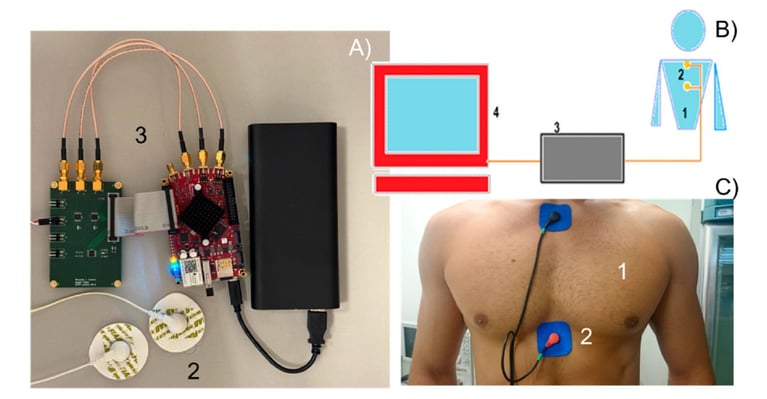](https://content.redpitaya.com/blog/non-invasive-gerd-detection-radiofrequency-spectrophotometry)
[Non-Invasive GERD Detection: Continuous Esophageal Monitoring via Radiofrequency Spectrophotometry](https://content.redpitaya.com/blog/non-invasive-gerd-detection-radiofrequency-spectrophotometry)
September 29, 2026
- [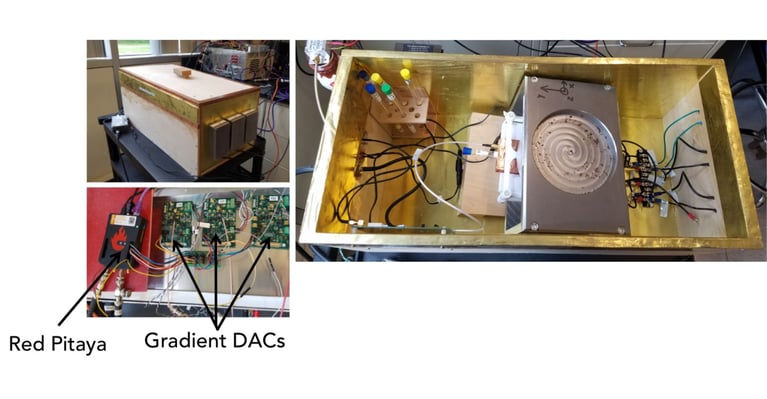](https://content.redpitaya.com/blog/open-source-mri-console-ocra-marcos-red-pitaya)
[How a $500 Open-Source MRI Console Sparked a Global Research Ecosystem](https://content.redpitaya.com/blog/open-source-mri-console-ocra-marcos-red-pitaya)
September 22, 2026
- [](https://content.redpitaya.com/blog/zephyr-rtos-nordic-logic-analyzer-workshop-eestec-ljubljana)
[Probing the Wire: Red Pitaya & Zephyr RTOS Workshop with EESTEC](https://content.redpitaya.com/blog/zephyr-rtos-nordic-logic-analyzer-workshop-eestec-ljubljana)
September 17, 2026
##### Subscribe to our newsletter

An open-source solution for hobbyists, professors,
radio amateurs and industrial clients.
**Red Pitaya**
Velika pot 21,
5250 Solkan
Slovenia, Europe
Phone: +386 30 322 719
Email: [info@redpitaya.com](mailto:info@redpitaya.com)
**Red Pitaya US**
TX, Dallas - Downtown Republic Center
325 N. St. Paul Street
Suite 3100
Dallas, Texas, 75202
United States of America
IMPORTANT: This address does not accept RMAs
Phone: (888) 637-2706
Email: [US.office@redpitaya.com](mailto:US.office@redpitaya.com)
- Customer Service
- [Customer Support](https://redpitaya.com/customer-support/)
- [Shipping & Returns](https://redpitaya.com/shipping-returns/)
- [Contact us](https://redpitaya.com/contact-us/)
- [Cookie Policy](https://redpitaya.com/cookie-policy/)
- SLO
- [O nas](https://redpitaya.com/o-nas/)
- [Pogoji poslovanja](https://redpitaya.com/pogoji-poslovanja/)
- [Politika zasebnosti](https://redpitaya.com/politika-zasebnosti/)
- [Politika piškotkov](https://redpitaya.com/politika-piskotkov/)
##### Follow Us
#### Subscribe to our newsletter
Get notified about new SW features & updates, news about latest community projects & events and new Red Pitaya products & discounts
[Subscribe](https://go.redpitaya.com/cs/c/?cta_guid=36ccbdc0-0344-49c4-aa91-aa67cf437c09&signature=AAH58kHkxFYTAKU-ILQzHI1jlrdI_co0RA&placement_guid=a24cb732-1dfb-4d0a-8c52-aa6851ce9102&click=556cfaee-eee4-48e4-95e7-c483a4f78883&hsutk=537e15e740555d2fd6a1c1ad931d2b6f&canon=https%3A%2F%2Fredpitaya.com%2Fabout-us%2F&utm_referrer=https%3A%2F%2Fredpitaya.com%2Fcompare%2F&portal_id=7715357&redirect_url=APefjpGj5Dm9poAAzHFGh4S6pJ-2TvNzBdwZZlfbr7toxfw-epFUtzEHOKToHx0i2TYYr39srj9aSERdntJBh8lJqoSXL-pUF2gwhYvOW6IMm28hQVmhYML2AIbbIRrr3YaoyJkZQ0iRxq-uHlFt66i3_8XpQpXT_M2zF9fS7t0f6hlBjGBJ7X_aXDrhBwXcEAqwoWWleG4uxonSGOR-BBp3tpKcySXYELTGHeGn5Yo61r3xrFvqFP5P6BxVwxTi51_ceW9uBzOMvA1rYz4BsIhLSF8n4bhcHqJTvhibH_laJrjDNdEUUrU&__hstc=72355340.537e15e740555d2fd6a1c1ad931d2b6f.1635738083317.1635738083317.1635746314170.2&__hssc=72355340.5.1635746314170&__hsfp=530052575&contentType=standard-page)
**Red Pitaya** 2025 All Rights Reserved.
- [Privacy Policy](https://redpitaya.com/privacy-policy/)
- [Terms of Use](https://redpitaya.com/terms-of-use/)
```json
{
"@context" : "https://schema.org",
"@type" : "BlogPosting",
"author" : {
"@type" : "Person",
"name" : "Red Pitaya Technical Editorial Team",
"url" : "https://content.redpitaya.com/blog/author/red-pitaya-technical-editorial-team"
},
"dateModified" : "2026-03-03T08:45:00.795Z",
"datePublished" : "2026-03-03T08:45:00.000Z",
"headline" : "Compact RF Sawtooth Generator: Redefining Beam Bunching Efficiency for Particle Accelerators",
"image" : [ "https://content.redpitaya.com/hubfs/blog%20featured%20image%20-%202026-02-03T145329.662.jpg" ],
"mainEntityOfPage" : {
"@id" : "https://content.redpitaya.com/blog/fpga-rf-sawtooth-generator-particle-accelerators",
"@type" : "WebPage"
},
"publisher" : {
"@type" : "Organization",
"logo" : {
"@type" : "ImageObject",
"url" : "https://content.redpitaya.com/hubfs/Red-pitaya-logo.jpg"
},
"name" : "Red Pitaya d.o.o."
}
}
```