


Traditionally, radar and communication have been treated as two distinct silos, each requiring its own dedicated hardware. However, a groundbreaking paper from the Fraunhofer Institute for High Frequency Physics and Radar Techniques (FHR) and the Fraunhofer Institute for Reliability and Microintegration (IZM) reveals a smarter path forward.
By utilizing Commercial Off-The-Shelf (COTS) automotive radar transceivers, researchers have successfully demonstrated a method for simultaneous radar sensing and low-bandwidth data transmission without adding extra communication hardware.
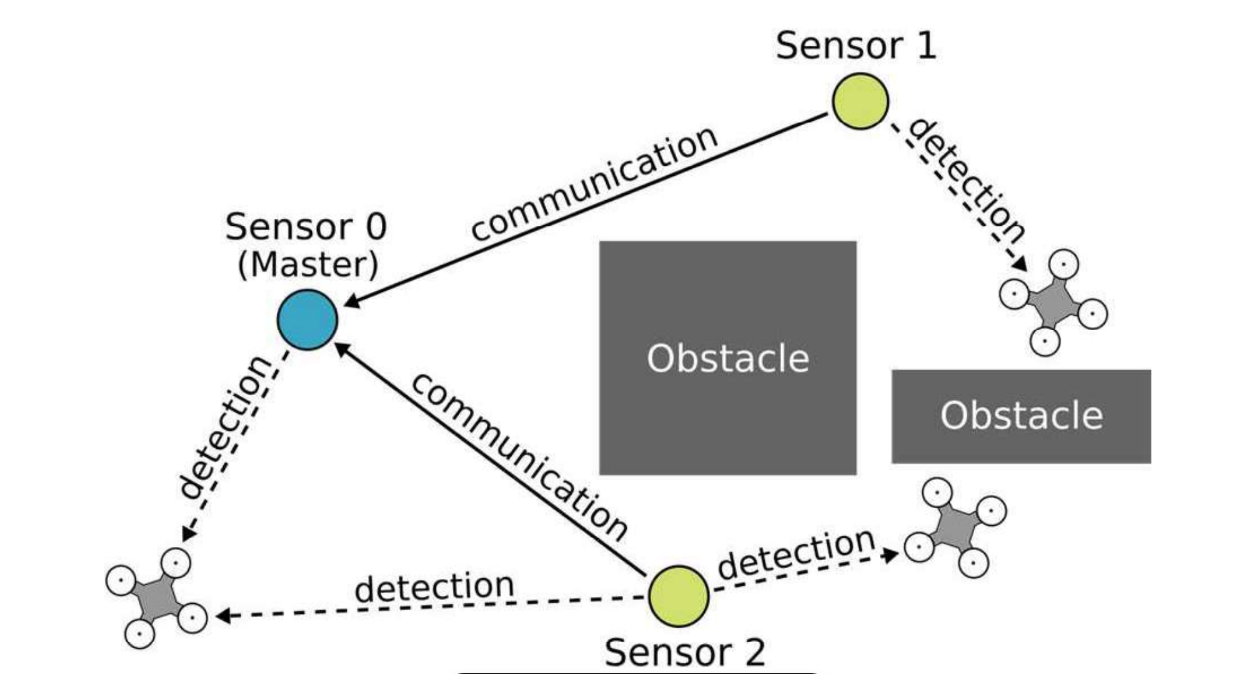 Improoved coverage of a surveillance area through communicating radar systems
The Vision: A Coordinated Radar Ecosystem
As millimeter-wave sensors become smaller and more affordable, they are being integrated into everything from public security systems to industrial production. The Fraunhofer team suggests that by embedding data transmission directly into the radar channel, we can create a coordinated network of sensors.
A primary application for this is Unmanned Aerial System Traffic Management (UTM). Within the AKIRA-UTM research project, this technology is being used to improve surveillance coverage by allowing individual radar units to share detection data in real-time.
How It Works: Modulation of the FMCW Ramp
The experimental system uses the Texas Instruments AWR2243, a single-chip FMCW radar transceiver. The team established a half-duplex link using a clever synchronization and modulation scheme:
- Slope Modulation: Data symbols are encoded into the radar signal by modulating the slope of the FMCW ramp.
- Active and Passive Modes: Radars alternate between modes. The active radar transmits a modulated waveform, while the passive radar receives and decodes the data.
- No External Sync Needed: The system uses a "master-slave" architecture. Slaves track the master's signal and synchronize their internal timing to enable bidirectional communication.
- Clock Drift Correction: Because clock differences are temperature-dependent and non-stationary, the system uses the Random Sample Consensus (RANSAC) algorithm to continuously estimate and update clock offsets.
- FPGA Power: Leveraging its underlying Zynq SoC architecture, Red Pitaya's Programmable Logic (PL) executes the most demanding operations, such as fast convolution and peak detection. This ensures the ultra-low latency required for real-time signal processing.
- Linux Integration: The Linux environment on the Processing System (PS) handles the stable control of the AWR2243 chip via the mmwavelink-API and manages the overall system logic.
- Precision Triggering: To capture chirps accurately at high repetition frequencies, the system utilizes a hardware-based trigger module seamlessly integrated into the PL and clocked by the AWR2243’s internal 40 MHz reference.
Hardware Implementation with Red Pitaya at its Core
A crucial component enabling this simultaneous radar sensing and communication is the Red Pitaya, built on the AMD/Xilinx Zynq SoC architecture. This combination of flexibility and processing power replaces the need for separate radio and radar equipment by handling both domains within a single, compact unit:
- FPGA Power: Leveraging its underlying Zynq SoC architecture, Red Pitaya's Programmable Logic (PL) executes the most demanding operations, such as fast convolution and peak detection. This ensures the ultra-low latency required for real-time signal processing.
- Linux Integration: The Linux environment on the Processing System (PS) handles the stable control of the AWR2243 chip via the mmwavelink-API and manages the overall system logic.
- Precision Triggering: To capture chirps accurately at high repetition frequencies, the system utilizes a hardware-based trigger module seamlessly integrated into the PL and clocked by the AWR2243’s internal 40 MHz reference.
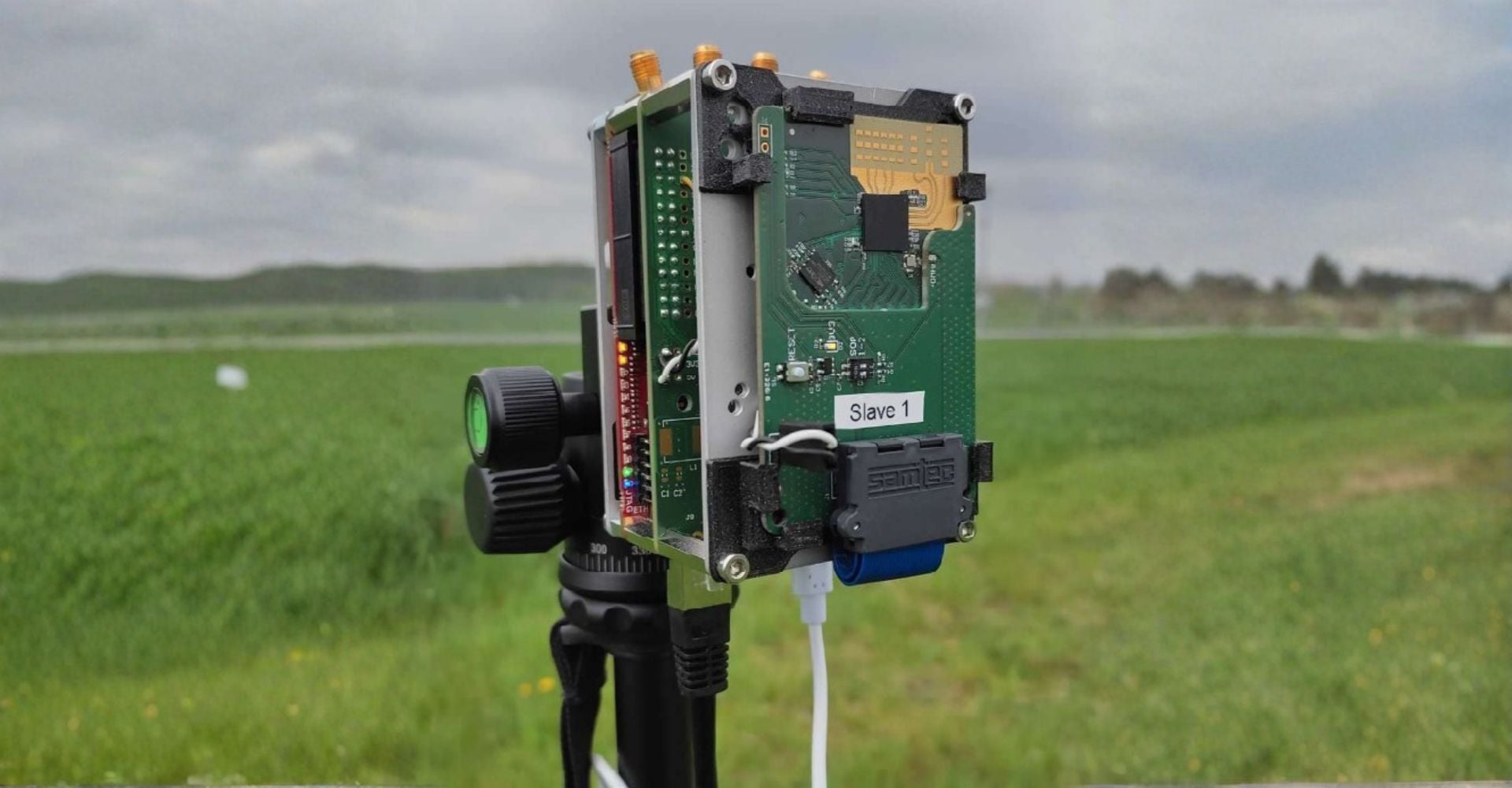
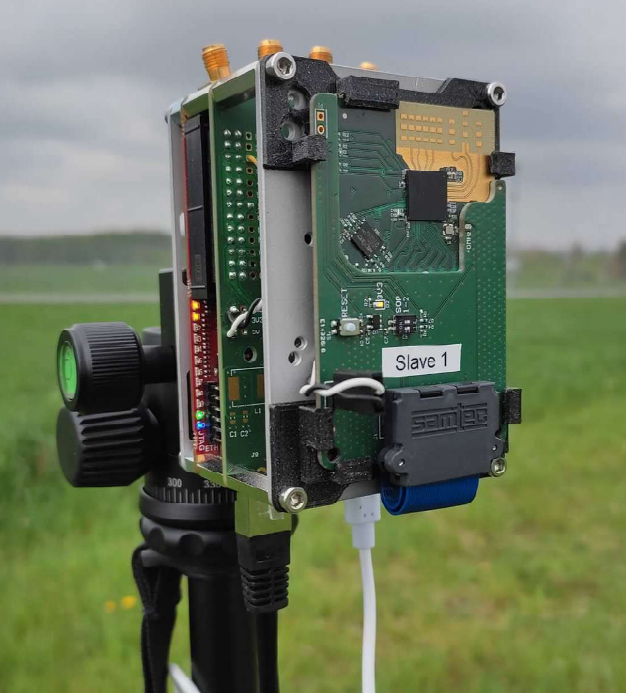 Radar unit with AWR443 and Red Pitaya
The Results: Miles Ahead of Detection Ranges
The team successfully achieved a total data rate of 5.12 kbit/s shared across a network of one master and three slave radars.
Bit Error Ratio (BER) Performance:
|
Range |
Bit Error Ratio |
|
150 m |
0 |
|
330 m |
7.8 x 10⁻⁶ |
|
580 m |
3.8 x 10⁻⁴ |
|
720 m |
4.4 x 10⁻² |
Significantly, the communication range achieved (up to 720 meters) greatly exceeds the typical target detection range for this class of radar. This allows sensors in a network to access target data from volumes far beyond their individual sensing capabilities.
The Future of "RadCom"
The Fraunhofer team plans to expand this research by increasing bitrates through more transmitter ramp slopes and expanding range via beamforming on the receiver antenna array. By reducing SWaP-C (Size, Weight, Power, and Cost), this integrated "RadCom" approach paves the way for smarter, more connected autonomous ecosystems.
Frequently Asked Questions (FAQ)
What is COTS automotive radar hardware?
COTS (Commercial Off-The-Shelf) hardware refers to mass-produced, readily available chips like the TI AWR2243 used in car safety systems for blind-spot detection and collision avoidance.
Can these radars still detect targets while communicating?
Yes. The parameters of the active radar are chosen so that range and doppler measurements remain unaffected regardless of which ramp slope is transmitted for communication.
Why is clock synchronization so difficult in radar networks?
Individual radar units have their own crystal oscillators which drift differently based on temperature. Without precise synchronization, the received signal can fall outside the narrow IF bandwidth of the receiver.
What is the benefit of embedding communication in radar?
It optimizes SWaP-C (Size, Weight, Power, and Cost) by removing the need for a separate radio and antenna system to coordinate data between sensors.
Recent Posts
-
-
 September 22, 2026
 -
 September 17, 2026