



In high-voltage factory acceptance testing (FAT) and on-site asset diagnostics, partial discharge (PD) testing is one of the key methods used to evaluate insulation quality. In IEC 60270-based measurements, the apparent charge value, commonly expressed as QIEC or PD level, is often used as a commercial acceptance criterion in contracts. In a HIGHVOLT x Red Pitaya webinar, typical examples were given for high-voltage extruded cables, where PD levels may need to remain below 10 pC, and for high-voltage test transformers, where a typical value may be below 20 pC. Exceeding such contractual limits can result in a failed test, delayed delivery, and significant financial consequences.
Figure 1. HIGHVOLT webinar: “Partial discharge measurements with Red Pitaya devices.
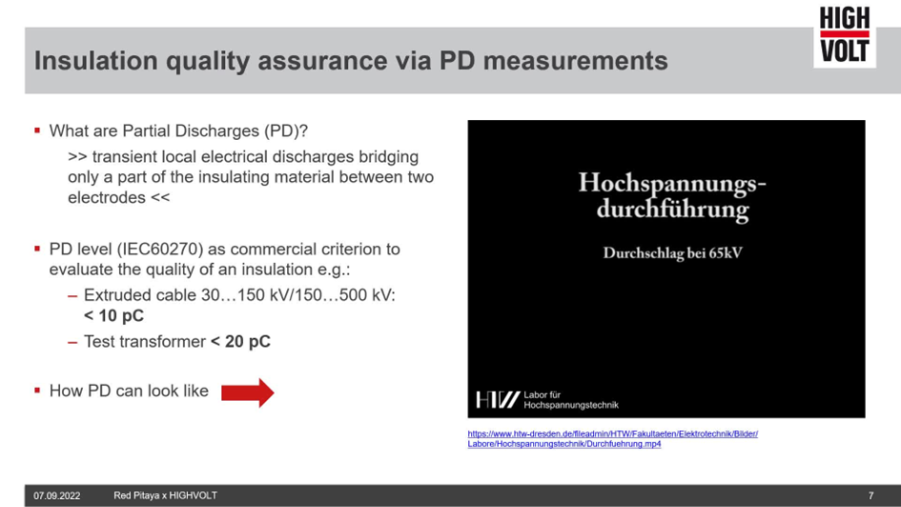
Figure 2. HIGHVOLT presentation slide showing IEC 60270-based PD level examples: <10 pC for HV extruded cables and <20 pC for HV test transformers.
Yet, senior testing engineers face a practical measurement-comparability challenge: two different standard-compliant PD measuring instruments can yield significantly different apparent charge (QIEC) values for the exact same discharge source. To expose and quantify the impact of these standard-allowed degrees of freedom, the engineering team at HIGHVOLT developed a custom, open-architecture PD measurement system built on the Red Pitaya STEMlab 125-14 platform. Their findings demonstrate why the industry can benefit from moving beyond fixed-function, closed-source instruments toward transparent, deterministic, FPGA-based processing.
The Engineering Challenge Within IEC 60270-Compliant Systems
The IEC 60270 standard defines the framework for PD evaluation, but it leaves several signal-processing parameters open to implementation. Bandwidth selection, filtering behavior, pulse resolution, pulse-train response, integration timeframes, and evaluation logic can vary between instrument implementations.
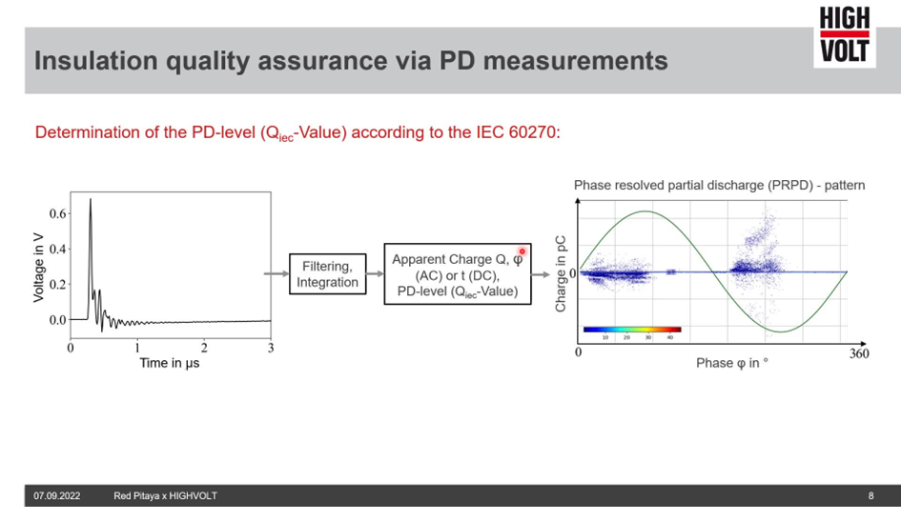
Figure 3. Simplified IEC 60270 evaluation chain: filtering, integration, apparent-charge calculation, and PRPD pattern generation.
During factory or laboratory testing, this lack of transparency can introduce significant measurement uncertainty. Christoph Steiner, Measuring Devices Design Engineer at HIGHVOLT, isolated this exact pain point during an industry-wide technical presentation.
In the webinar, he explained that the QIEC value is a function of several parameters. Some of these, such as the actual partial discharge current and signal propagation path, cannot be controlled. Others, however, can be varied within the allowed ranges of the IEC 60270 standard. Using an artificial PD source attached to multiple commercial PD measuring devices, HIGHVOLT showed that varying these parameters within the allowed ranges of the standard produced more than 20% variation in the measured QIEC value. In the worst case, this means that parameter selection could influence whether a high-voltage test is interpreted as successful or unsuccessful.
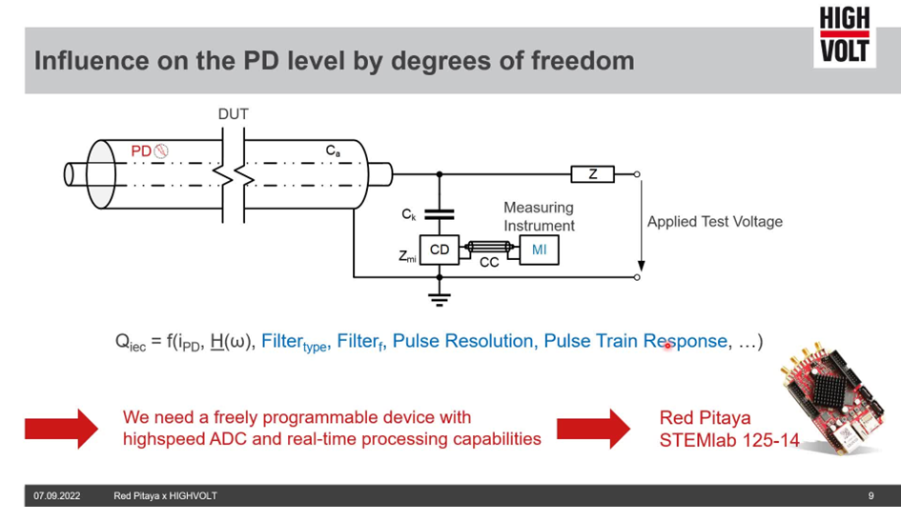
Figure 4. HIGHVOLT slide illustrating how the measured QIEC value depends on physical and signal-processing parameters, motivating the need for a freely programmable device.
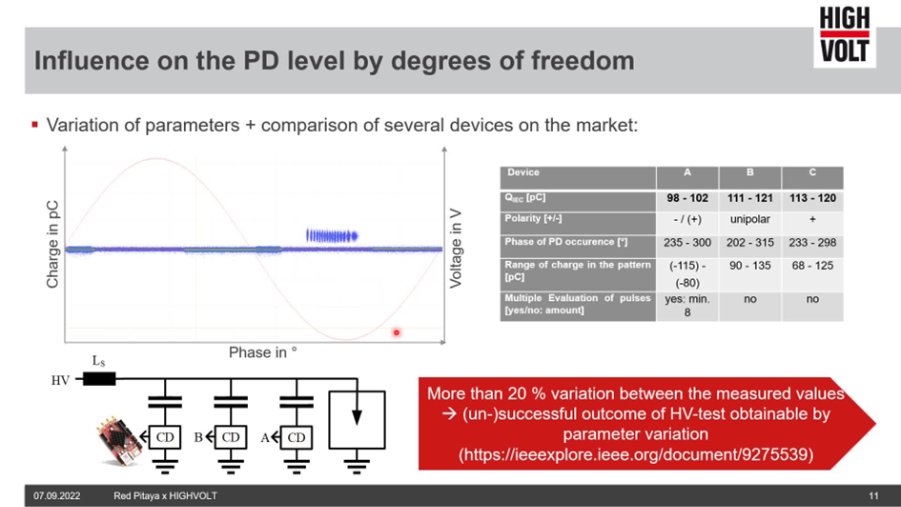
Figure 5. Comparison measurement slide showing more than 20% variation in measured QIEC values when parameters are varied within the allowed ranges of the standard.
To map out these variations, HIGHVOLT required complete visibility over the acquisition chain - something traditional commercial instruments, which often treat the processing layer as proprietary black-box intellectual property, make difficult to access.
Why HIGHVOLT Shifted to an Open FPGA Architecture
Partial discharges are local, very fast, transient electrical discharges that bridge only part of the insulation between two electrodes. Measuring these events requires high-speed data acquisition coupled with deterministic processing after suitable analog coupling and signal conditioning.
By shifting to the STEMlab 125-14, HIGHVOLT implemented the PD measurement sequence according to the standard on a flexible hardware platform. The real-time execution chain was implemented using the device’s programmable logic (PL) and processing system (PS):
- Deterministic High-Speed Digitization: Capturing transient PD-related signals via dual 125 MS/s, 14-bit ADC channels.
- Hardware-Level Digital Filtering: Implementing filtering after digitization within the programmable logic of the device.
- Real-Time Apparent Charge Extraction: Processing the digitized timeframe to estimate the apparent charge value.
- Phase-Resolved Partial Discharge (PRPD) Extraction: Combining charge information with phase information from the applied AC test voltage to generate phase-resolved PD patterns.
- Remote Data Transfer via TCP: Utilizing the Zynq Processing System (PS) to transfer raw and processed measurement information via TCP to an external workstation for visualization and evaluation.
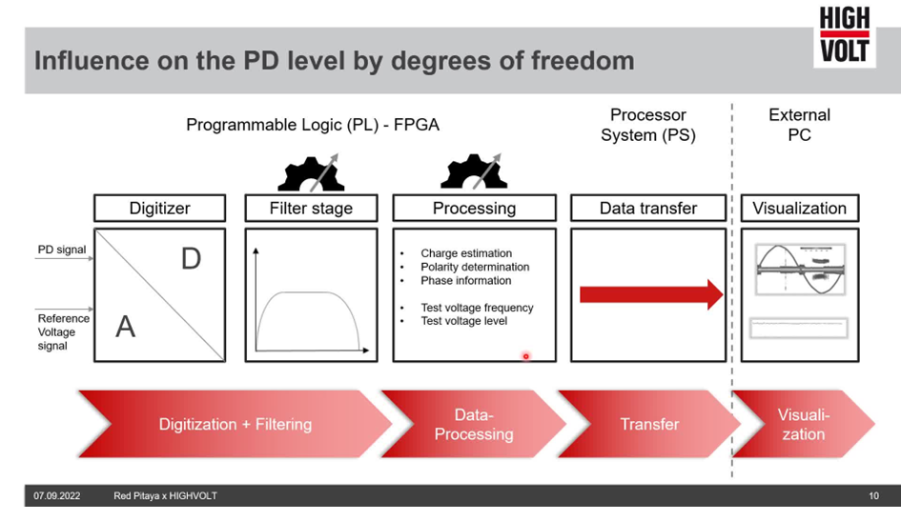
Figure 6. Red Pitaya-based PD measurement architecture: digitization, filtering, FPGA processing, TCP data transfer, and external visualization.
Complete Parameter Control at Run Time
The primary advantage for HIGHVOLT was not just the STEMlab’s raw processing performance, but the transparency and flexibility of the measurement chain. Unlike proprietary benchtop instruments, the Red Pitaya-based implementation allowed HIGHVOLT engineers to dynamically adjust processing parameters during runtime and during active measurements.
This allowed the team to pinpoint how specific signal-processing choices alter the resulting phase-charge patterns and QIEC values. Furthermore, remote operation over TCP allowed the measurement setup to be physically separated from the operator’s control station. In high-voltage laboratories, this separation is an important safety and usability advantage. Where formal galvanic isolation is required, the isolation method must be implemented and verified at the complete system level.
The Technical Consensus: Versatility, Real-Time Processing, and Robustness
Beyond the flexibility of the FPGA fabric, high-voltage test environments present harsh conditions for measurement electronics. Rapid voltage breakdowns and PD activity can generate strong electromagnetic disturbances, making system robustness an important practical requirement.
Throughout the testing phase in HIGHVOLT’s high-voltage laboratory environment, the STEMlab 125-14 demonstrated the robustness needed for this type of development work. In the webinar summary, HIGHVOLT highlighted the real-time processing capabilities, high resolution, bandwidth, robustness, performance-to-price ratio, versatility, fast prototyping potential, remote-control capability, and community support of the Red Pitaya platform.
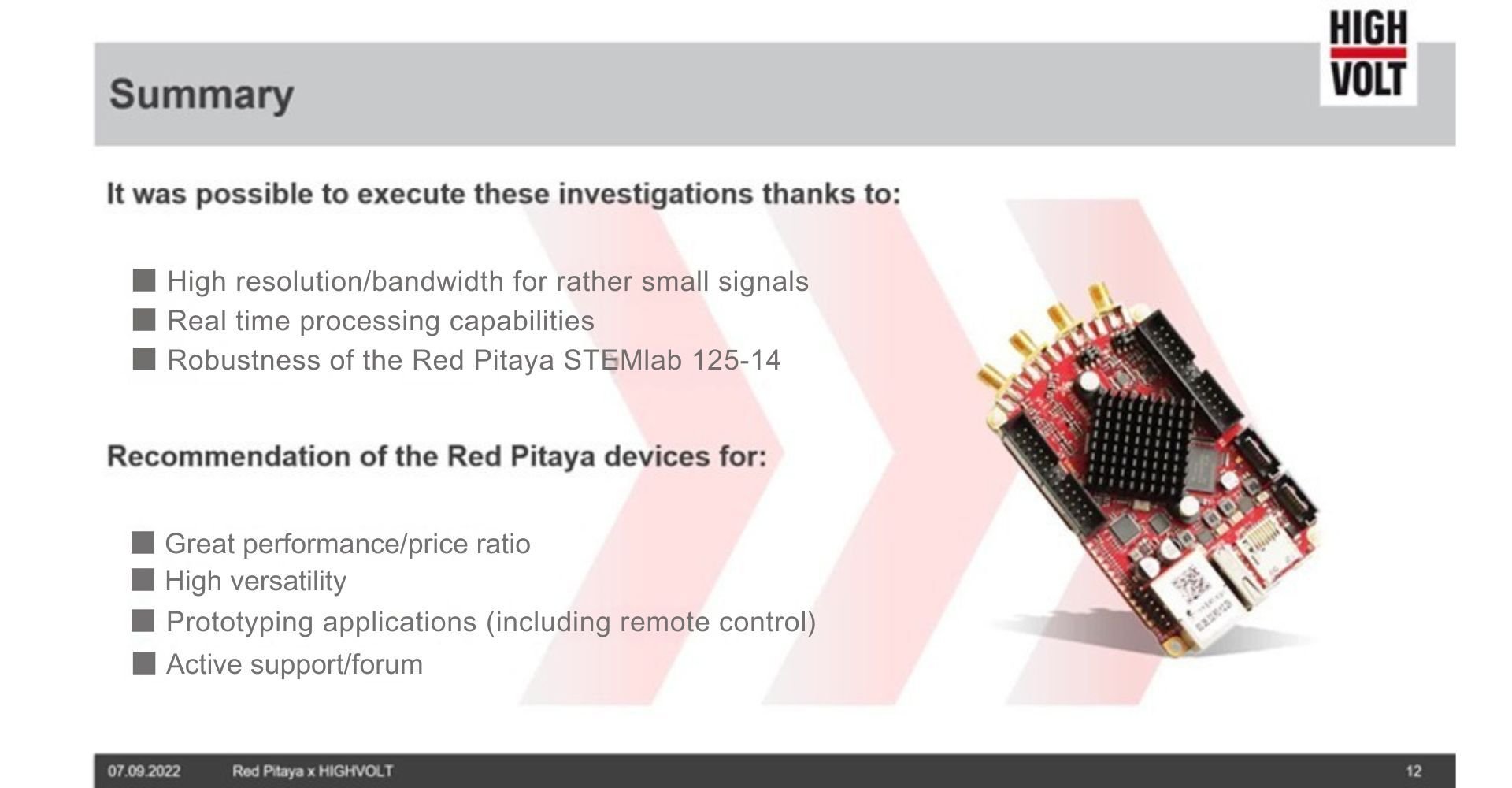
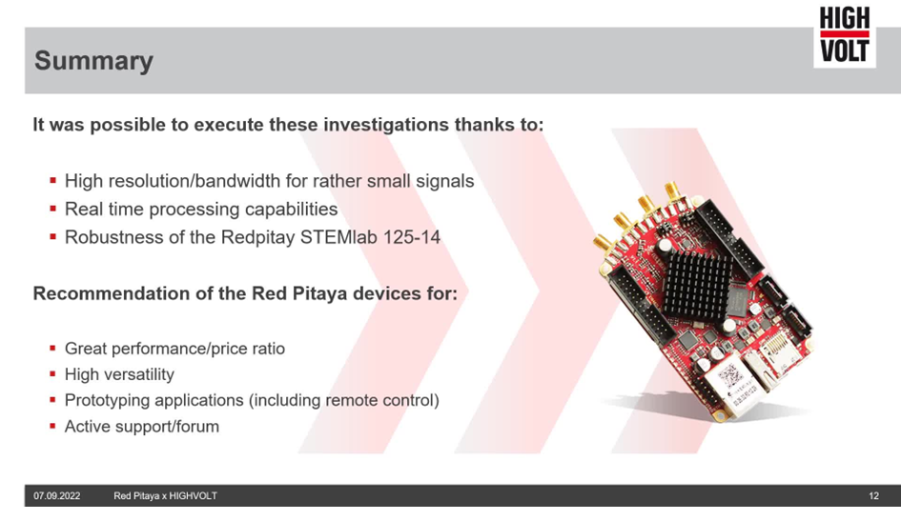 Figure 7. HIGHVOLT summary slide highlighting Red Pitaya’s real-time processing, high resolution/bandwidth, robustness, price-performance ratio, versatility, remote-control capability, and support community.
For laboratories, system integrators, and HV equipment manufacturers looking to transition from rigid, high-cost benchtop hardware toward customized test and measurement workflows, the Red Pitaya platform delivers:
- Real-Time FPGA Processing: Processing acquired ADC data directly in programmable logic for deterministic measurement behavior.
- Rapid Prototyping Toward OEM Deployment: Supporting development from laboratory validation toward integrated measurement solutions and OEM-oriented implementations.
- Open Software Stack: Supporting integration into existing engineering workflows using common programming environments such as C, C++, Python, and automated laboratory control software.
Watch the Technical Deep Dive
To review the measurement concept, parameter sensitivity, comparison measurements, and Red Pitaya-based implementation, access the full presentation.
Watch the HIGHVOLT x Red Pitaya PD Measurement Webinar
Technical FAQ for Diagnostic Engineers
How do standard-compliant parameters introduce a 20% variance in PD readings?
IEC 60270-based measurements contain several degrees of freedom that can influence the resulting QIEC value. These include filtering behavior, selected frequency ranges, pulse resolution, pulse-train response, and integration or evaluation logic. In the HIGHVOLT webinar, varying such parameters within the allowed ranges of the standard produced more than 20% variation in the measured QIEC value.
Why is FPGA-based processing useful for PRPD generation?
Partial discharges are fast, transient phenomena that require deterministic signal processing. An FPGA can process incoming ADC data streams directly in hardware, making it suitable for real-time filtering, apparent-charge estimation, and phase-related evaluation. This is especially useful when the signal-processing chain must be transparent, repeatable, and adjustable during measurement development.
Can the Red Pitaya STEMlab 125-14 be integrated directly into industrial testing workflows?
Yes. The HIGHVOLT webinar demonstrates that the STEMlab 125-14 can be used as a flexible platform for specialized partial discharge measurement development. For commercial deployments, Red Pitaya also offers OEM-oriented options and engineering support, allowing projects to move from laboratory prototypes toward integrated test systems.
Recent Posts
-
-
 September 22, 2026
 -
 September 17, 2026