---
title: PWM Audio Analysis with FPGA + Red Pitaya Gen 2
description: Analyze PWM audio signals with Red Pitaya Gen2. See how resolution impacts spectrum, filtering, and Class-D amplifier design.
image: https://content.redpitaya.com/hubfs/blog%20featured%20image%20-%202026-05-05T152338.466.jpg
---
[](https://redpitaya.com/)
[](https://redpitaya.com/)
- Products
- [STEMlab 125-14 Gen 2](https://redpitaya.com/stemlab-125-14-gen2/)
- [STEMlab 125-14](https://redpitaya.com/stemlab-125-14/)
- [SIGNALlab 250-12](https://redpitaya.com/signallab-250-12/)
- [SDRlab 122-16](https://redpitaya.com/sdrlab-122-16/)
- [STEMlab TI (Texas Instruments)](https://redpitaya.com/stemlab-ti-texas-instruments/)
- [Multi-channel Solutions](https://redpitaya.com/multi-channel-solutions/)
- [Accessories](https://redpitaya.com/accessories/)
- [Applications](https://redpitaya.com/applications/)
- Documentation
- [Technical Documentation](https://redpitaya.com/documentation/)
- [Teaching materials](https://redpitaya.com/teaching-materials/)
- [Student projects](https://redpitaya.com/student-projects/)
- [User forum](https://forum.redpitaya.com/)
- [About](https://redpitaya.com/about-us/)
- [History](https://redpitaya.com/history/)
- [Distributors](https://redpitaya.com/distibutors-red-pitaya/)
- [Blog](https://content.redpitaya.com/blog)
[Shop](https://redpitaya.com/shop/)
- [ACADEMIA](https://redpitaya.com/academia/)
- [RADIO AMATEURS](https://redpitaya.com/radio-amateurs/)
- [Home](https://redpitaya.com/)
- Products
- [STEMlab 125-10](https://redpitaya.com/stemlab-125-10/)
- [STEMlab 125-14](https://redpitaya.com/stemlab-125-14/)
- [SIGNALlab 250-12](https://redpitaya.com/signallab-250-12/)
- [SDRlab 122-16](https://redpitaya.com/sdrlab-122-16/)
- [Accessories](https://redpitaya.com/accessories/)
- [Applications](https://redpitaya.com/applications/)
- [Resources](https://redpitaya.com/documentation/)
- [Shop](https://redpitaya.com/shop/)
- [About](https://redpitaya.com/about-us/)
- [Blog](https://content.redpitaya.com/blog)
- [Compare](https://redpitaya.com/compare/)
- [Login / Register](https://redpitaya.com/my-account/)
### Red Pitaya Blog
[Home](https://redpitaya.com) » [Case study](https://content.redpitaya.com/blog/tag/case-study) »
[Case study](https://content.redpitaya.com/blog/tag/case-study)
# PWM Audio Analysis with FPGA + Red Pitaya Gen 2
- Posted by  [Red Pitaya Technical Editorial Team](https://redpitaya.com/Red-Pitaya-Blog-team/) , May 12, 2026
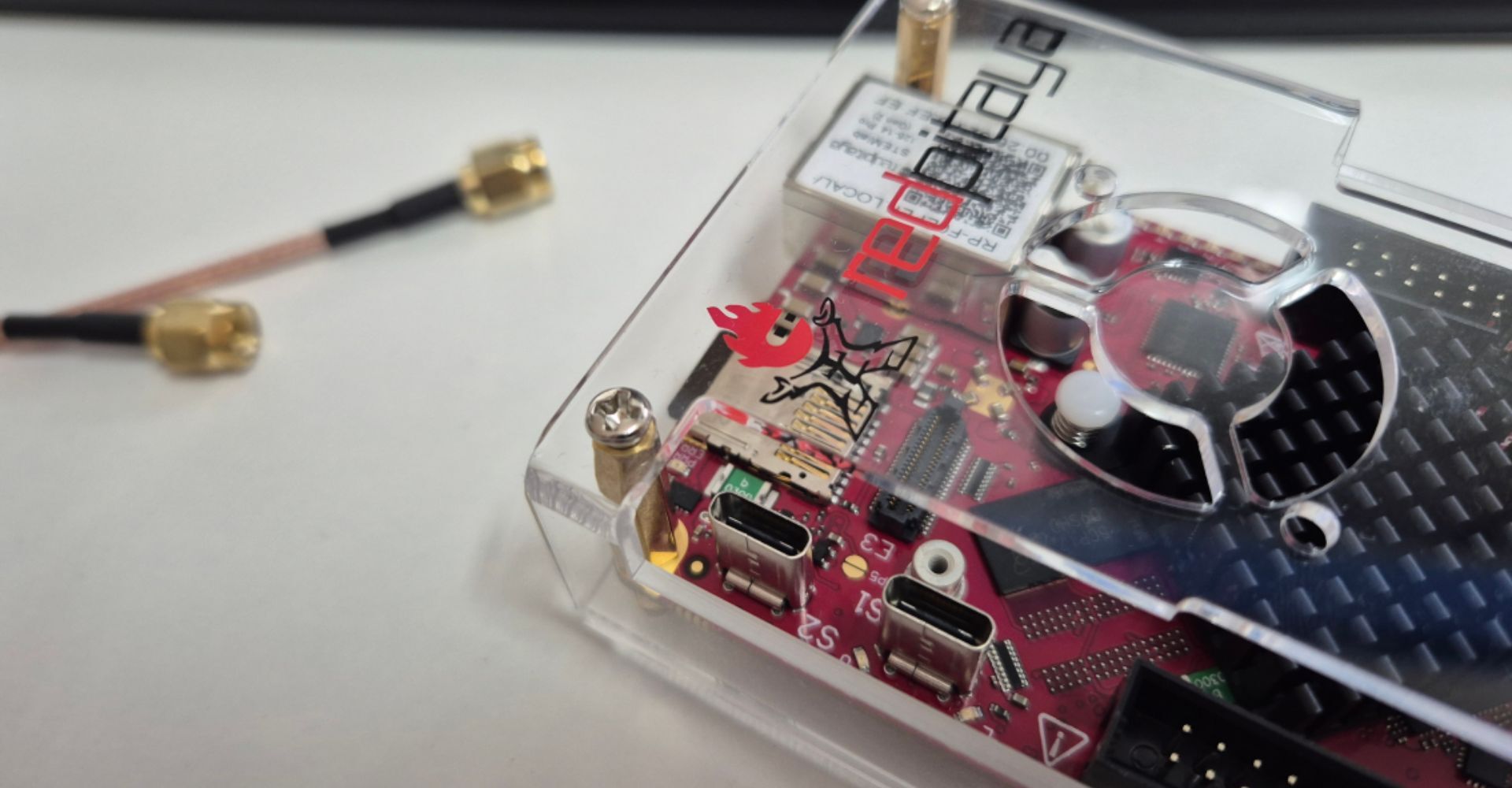
***A practical look at spectrum behavior in Class-D–style signals***
Engineers working with audio DSP or power electronics already know the trade-offs in PWM-based systems. What this project does well is make those trade-offs measurable—using real hardware, not just simulation.
In a recent experiment published by [**Pablo Trujillo (ControlPaths)**](https://controlpaths.com/2026/03/15/red-pitaya-gen2-audio-pwm-signal/), Red Pitaya [**STEMlab 125-14 PRO Gen 2**](https://redpitaya.com/stemlab-125-14-gen2) is used as a spectrum analyzer to evaluate how PWM modulation affects an audio signal across different resolutions. The setup combines FPGA signal generation with high-speed analog measurement, offering a compact but capable test bench for real-world validation.
## The Setup: FPGA-Generated PWM, Measured in Hardware
The experiment pairs two platforms:
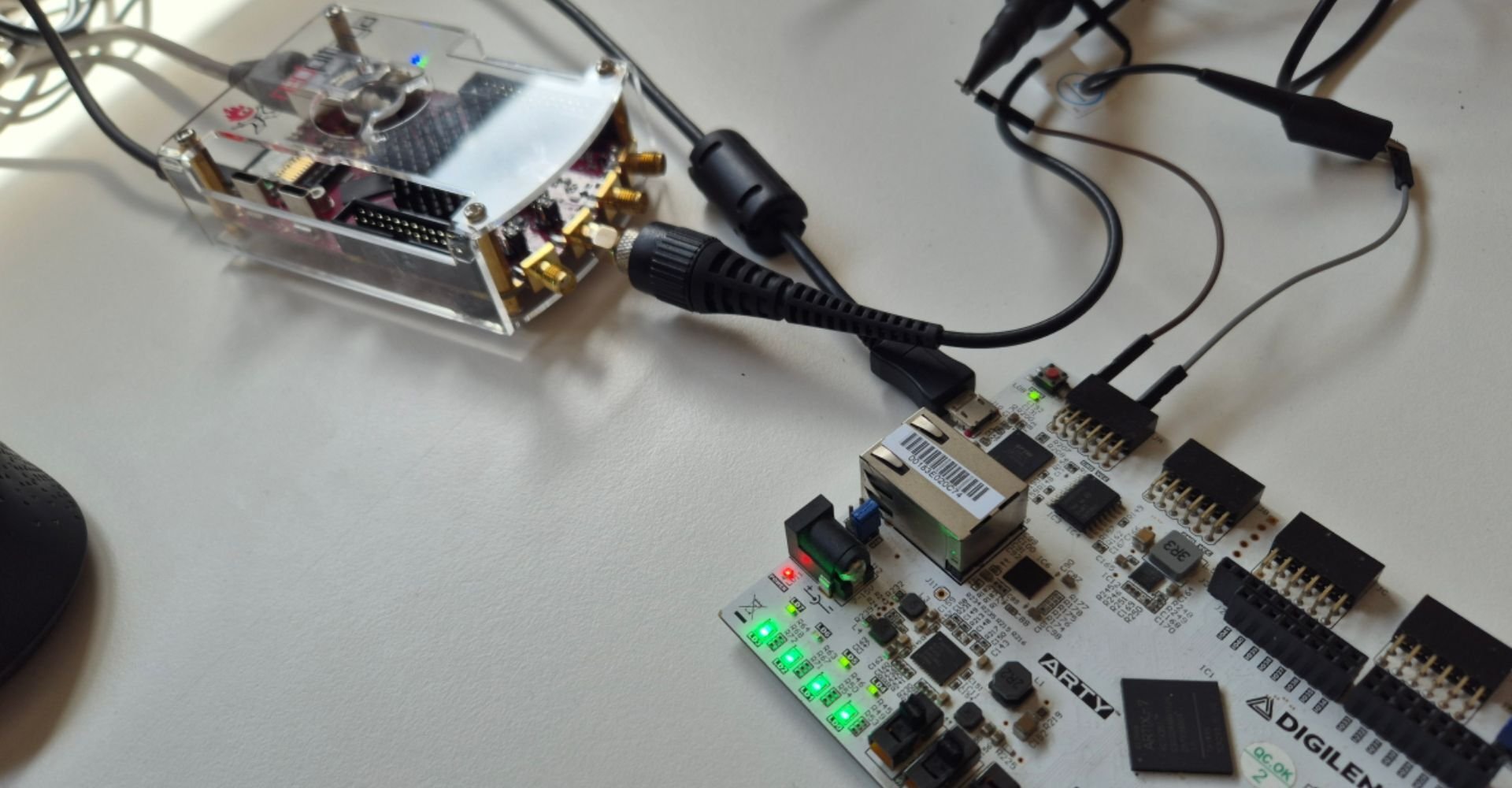
- Red Pitaya STEMlab 125-14 PRO Gen 2 → used for acquisition and spectral analysis
- Digilent Arty A7 → generates the PWM audio signal
A simple Verilog-based PWM modulator runs at 100 MHz on the FPGA, encoding a 3.9 kHz sine wave. The resulting signal is then captured and analyzed using Red Pitaya’s built-in spectrum analyzer.
This approach is notable because it replaces a traditional lab stack (signal generator + spectrum analyzer) with a single, software-defined instrument that is remotely accessible and FPGA-reconfigurable.
## What’s Actually Being Tested?
The core question is familiar to anyone designing Class-D amplifiers:
**How does PWM resolution affect spectral distribution—and what does that mean for filtering and audio quality?**
PWM encoding introduces a carrier frequency and harmonic structure that must be filtered out to recover clean audio. The position of that carrier depends directly on resolution:
- 8-bit → ~390 kHz carrier
- 9-bit → ~195 kHz
- 10-bit → ~97 kHz
Higher resolution improves amplitude granularity, but compresses the spectral spacing—bringing switching artifacts closer to the audio band.
## What the Measurements Show
Using Red Pitaya as a spectrum analyzer makes the trade-offs immediately visible:
- **8-bit PWM**
- Carrier far from audio band
- Easier filtering
- Lower amplitude resolution
- **9-bit PWM**
- Balanced compromise
- Harmonics begin entering mid-frequency range
- **10-bit PWM**
- Better resolution (1024 levels)
- Carrier dangerously close to audio band
- Requires higher-order filtering (LC, multi-stage)
The key takeaway is not theoretical—it is measurable:
**Resolution and filtering complexity are tightly coupled design parameters.**
Time-domain observations reinforce this. Lower carrier frequencies (higher resolution) introduce visible distortion after reconstruction, especially if filtering is insufficient.
## Why Red Pitaya Gen 2 Matters Here
This type of experiment highlights where Red Pitaya STEMlab Gen 2 fits in an engineering workflow:
- Combines **oscilloscope, spectrum analyzer, and signal generator** in one device
- Provides **125 MS/s ADC/DAC** for mid-frequency analog work
- Enables **FPGA-level customization** for DSP pipelines
- Supports **SCPI, Python, and browser-based control**
For DSP, embedded, or FPGA engineers, it effectively bridges the gap between development board and lab instrumentation.
## Practical Implications for Engineers
If you are working on:
- Class-D amplifier design
- Audio DSP pipelines
- FPGA-based signal processing
- Mixed-signal validation
this experiment reinforces a few operational realities:
- Simulation alone is insufficient for PWM systems
- Spectral verification must include real switching artifacts
- Hardware-in-the-loop testing exposes filter limitations early
- Tooling flexibility (FPGA + measurement) reduces iteration time
## Read the Full Technical Breakdown
This summary only covers the key insights. The original article goes deeper into:
- Verilog PWM implementation
- Spectrum plots across resolutions
- FPGA workflow and deployment
- Detailed measurement methodology
Read the full article here:
[Red Pitaya Gen 2: Analysis of an audio signal modulated using PWM | controlpaths.com](https://controlpaths.com/2026/03/15/red-pitaya-gen2-audio-pwm-signal/)
---
## FAQ
### **What is PWM audio modulation used for?**
Primarily in Class-D amplifiers, where efficiency is achieved by switching instead of linear amplification.
### **Why does PWM resolution affect frequency spectrum?**
Because resolution determines the division of the system clock, directly setting the carrier frequency and harmonic spacing.
### **Can Red Pitaya replace a spectrum analyzer?**
For many applications up to ~50 MHz bandwidth, yes. It provides sufficient resolution and flexibility for embedded and DSP work.
### **Why not just simulate PWM behavior?**
Simulation cannot capture analog effects such as switching noise, non-ideal filtering, and real hardware constraints.
### **Is this relevant beyond audio systems?**
Yes. The same principles apply to motor control, power electronics, and any PWM-based control system.
### About the Red Pitaya Team
The Red Pitaya Technical Editorial Team is a cross-functional group of technical communicators and product specialists. By synthesizing insights from our hardware developers and global research partners, we provide verified, high-value content that bridges the gap between open-source innovation and industrial-grade precision.
Our mission is to make advanced instrumentation accessible to engineers, researchers, and educators worldwide.
##### Categories
- [academia (47)](https://content.redpitaya.com/blog/tag/academia)
##### Recent Posts
- [](https://content.redpitaya.com/blog/non-invasive-gerd-detection-radiofrequency-spectrophotometry)
[Non-Invasive GERD Detection: Continuous Esophageal Monitoring via Radiofrequency Spectrophotometry](https://content.redpitaya.com/blog/non-invasive-gerd-detection-radiofrequency-spectrophotometry)
September 29, 2026
- [](https://content.redpitaya.com/blog/open-source-mri-console-ocra-marcos-red-pitaya)
[How a $500 Open-Source MRI Console Sparked a Global Research Ecosystem](https://content.redpitaya.com/blog/open-source-mri-console-ocra-marcos-red-pitaya)
September 22, 2026
- [](https://content.redpitaya.com/blog/zephyr-rtos-nordic-logic-analyzer-workshop-eestec-ljubljana)
[Probing the Wire: Red Pitaya & Zephyr RTOS Workshop with EESTEC](https://content.redpitaya.com/blog/zephyr-rtos-nordic-logic-analyzer-workshop-eestec-ljubljana)
September 17, 2026
##### Subscribe to our newsletter

An open-source solution for hobbyists, professors,
radio amateurs and industrial clients.
**Red Pitaya**
Velika pot 21,
5250 Solkan
Slovenia, Europe
Phone: +386 30 322 719
Email: [info@redpitaya.com](mailto:info@redpitaya.com)
**Red Pitaya US**
TX, Dallas - Downtown Republic Center
325 N. St. Paul Street
Suite 3100
Dallas, Texas, 75202
United States of America
IMPORTANT: This address does not accept RMAs
Phone: (888) 637-2706
Email: [US.office@redpitaya.com](mailto:US.office@redpitaya.com)
- Customer Service
- [Customer Support](https://redpitaya.com/customer-support/)
- [Shipping & Returns](https://redpitaya.com/shipping-returns/)
- [Contact us](https://redpitaya.com/contact-us/)
- [Cookie Policy](https://redpitaya.com/cookie-policy/)
- SLO
- [O nas](https://redpitaya.com/o-nas/)
- [Pogoji poslovanja](https://redpitaya.com/pogoji-poslovanja/)
- [Politika zasebnosti](https://redpitaya.com/politika-zasebnosti/)
- [Politika piškotkov](https://redpitaya.com/politika-piskotkov/)
##### Follow Us
#### Subscribe to our newsletter
Get notified about new SW features & updates, news about latest community projects & events and new Red Pitaya products & discounts
[Subscribe](https://go.redpitaya.com/cs/c/?cta_guid=36ccbdc0-0344-49c4-aa91-aa67cf437c09&signature=AAH58kHkxFYTAKU-ILQzHI1jlrdI_co0RA&placement_guid=a24cb732-1dfb-4d0a-8c52-aa6851ce9102&click=556cfaee-eee4-48e4-95e7-c483a4f78883&hsutk=537e15e740555d2fd6a1c1ad931d2b6f&canon=https%3A%2F%2Fredpitaya.com%2Fabout-us%2F&utm_referrer=https%3A%2F%2Fredpitaya.com%2Fcompare%2F&portal_id=7715357&redirect_url=APefjpGj5Dm9poAAzHFGh4S6pJ-2TvNzBdwZZlfbr7toxfw-epFUtzEHOKToHx0i2TYYr39srj9aSERdntJBh8lJqoSXL-pUF2gwhYvOW6IMm28hQVmhYML2AIbbIRrr3YaoyJkZQ0iRxq-uHlFt66i3_8XpQpXT_M2zF9fS7t0f6hlBjGBJ7X_aXDrhBwXcEAqwoWWleG4uxonSGOR-BBp3tpKcySXYELTGHeGn5Yo61r3xrFvqFP5P6BxVwxTi51_ceW9uBzOMvA1rYz4BsIhLSF8n4bhcHqJTvhibH_laJrjDNdEUUrU&__hstc=72355340.537e15e740555d2fd6a1c1ad931d2b6f.1635738083317.1635738083317.1635746314170.2&__hssc=72355340.5.1635746314170&__hsfp=530052575&contentType=standard-page)
**Red Pitaya** 2025 All Rights Reserved.
- [Privacy Policy](https://redpitaya.com/privacy-policy/)
- [Terms of Use](https://redpitaya.com/terms-of-use/)
```json
{
"@context" : "https://schema.org",
"@type" : "BlogPosting",
"author" : {
"@type" : "Person",
"name" : "Red Pitaya Technical Editorial Team",
"url" : "https://content.redpitaya.com/blog/author/red-pitaya-technical-editorial-team"
},
"dateModified" : "2026-05-12T08:15:00.912Z",
"datePublished" : "2026-05-12T08:15:00.000Z",
"headline" : "PWM Audio Analysis with FPGA + Red Pitaya Gen 2",
"image" : [ "https://content.redpitaya.com/hubfs/blog%20featured%20image%20-%202026-05-05T152338.466.jpg" ],
"mainEntityOfPage" : {
"@id" : "https://content.redpitaya.com/blog/red-pitaya-gen2-pwm-audio-spectrum-analysis",
"@type" : "WebPage"
},
"publisher" : {
"@type" : "Organization",
"logo" : {
"@type" : "ImageObject",
"url" : "https://content.redpitaya.com/hubfs/Red-pitaya-logo.jpg"
},
"name" : "Red Pitaya d.o.o."
}
}
```