---
title: How Oklahoma State University Uses Red Pitaya to Measure Radiation in Space, Stratosphere, and Sky
description: How Oklahoma State University uses Red Pitaya STEMlab to measure radiation on the ISS, high-altitude balloons, and future commercial aircraft.
image: https://content.redpitaya.com/hubfs/blog%20featured%20image%20-%202026-04-24T141722.163.jpg
---
[](https://redpitaya.com/)
[](https://redpitaya.com/)
- Products
- [STEMlab 125-14 Gen 2](https://redpitaya.com/stemlab-125-14-gen2/)
- [STEMlab 125-14](https://redpitaya.com/stemlab-125-14/)
- [SIGNALlab 250-12](https://redpitaya.com/signallab-250-12/)
- [SDRlab 122-16](https://redpitaya.com/sdrlab-122-16/)
- [STEMlab TI (Texas Instruments)](https://redpitaya.com/stemlab-ti-texas-instruments/)
- [Multi-channel Solutions](https://redpitaya.com/multi-channel-solutions/)
- [Accessories](https://redpitaya.com/accessories/)
- [Applications](https://redpitaya.com/applications/)
- Documentation
- [Technical Documentation](https://redpitaya.com/documentation/)
- [Teaching materials](https://redpitaya.com/teaching-materials/)
- [Student projects](https://redpitaya.com/student-projects/)
- [User forum](https://forum.redpitaya.com/)
- [About](https://redpitaya.com/about-us/)
- [History](https://redpitaya.com/history/)
- [Distributors](https://redpitaya.com/distibutors-red-pitaya/)
- [Blog](https://content.redpitaya.com/blog)
[Shop](https://redpitaya.com/shop/)
- [ACADEMIA](https://redpitaya.com/academia/)
- [RADIO AMATEURS](https://redpitaya.com/radio-amateurs/)
- [Home](https://redpitaya.com/)
- Products
- [STEMlab 125-10](https://redpitaya.com/stemlab-125-10/)
- [STEMlab 125-14](https://redpitaya.com/stemlab-125-14/)
- [SIGNALlab 250-12](https://redpitaya.com/signallab-250-12/)
- [SDRlab 122-16](https://redpitaya.com/sdrlab-122-16/)
- [Accessories](https://redpitaya.com/accessories/)
- [Applications](https://redpitaya.com/applications/)
- [Resources](https://redpitaya.com/documentation/)
- [Shop](https://redpitaya.com/shop/)
- [About](https://redpitaya.com/about-us/)
- [Blog](https://content.redpitaya.com/blog)
- [Compare](https://redpitaya.com/compare/)
- [Login / Register](https://redpitaya.com/my-account/)
### Red Pitaya Blog
[Home](https://redpitaya.com) » [Blog](https://content.redpitaya.com/blog/tag/blog), [Case study](https://content.redpitaya.com/blog/tag/case-study) »
[Blog](https://content.redpitaya.com/blog/tag/blog), [Case study](https://content.redpitaya.com/blog/tag/case-study)
# How Oklahoma State University Uses Red Pitaya to Measure Radiation in Space, Stratosphere, and Sky
- Posted by  [Red Pitaya Technical Editorial Team](https://redpitaya.com/Red-Pitaya-Blog-team/) , April 28, 2026
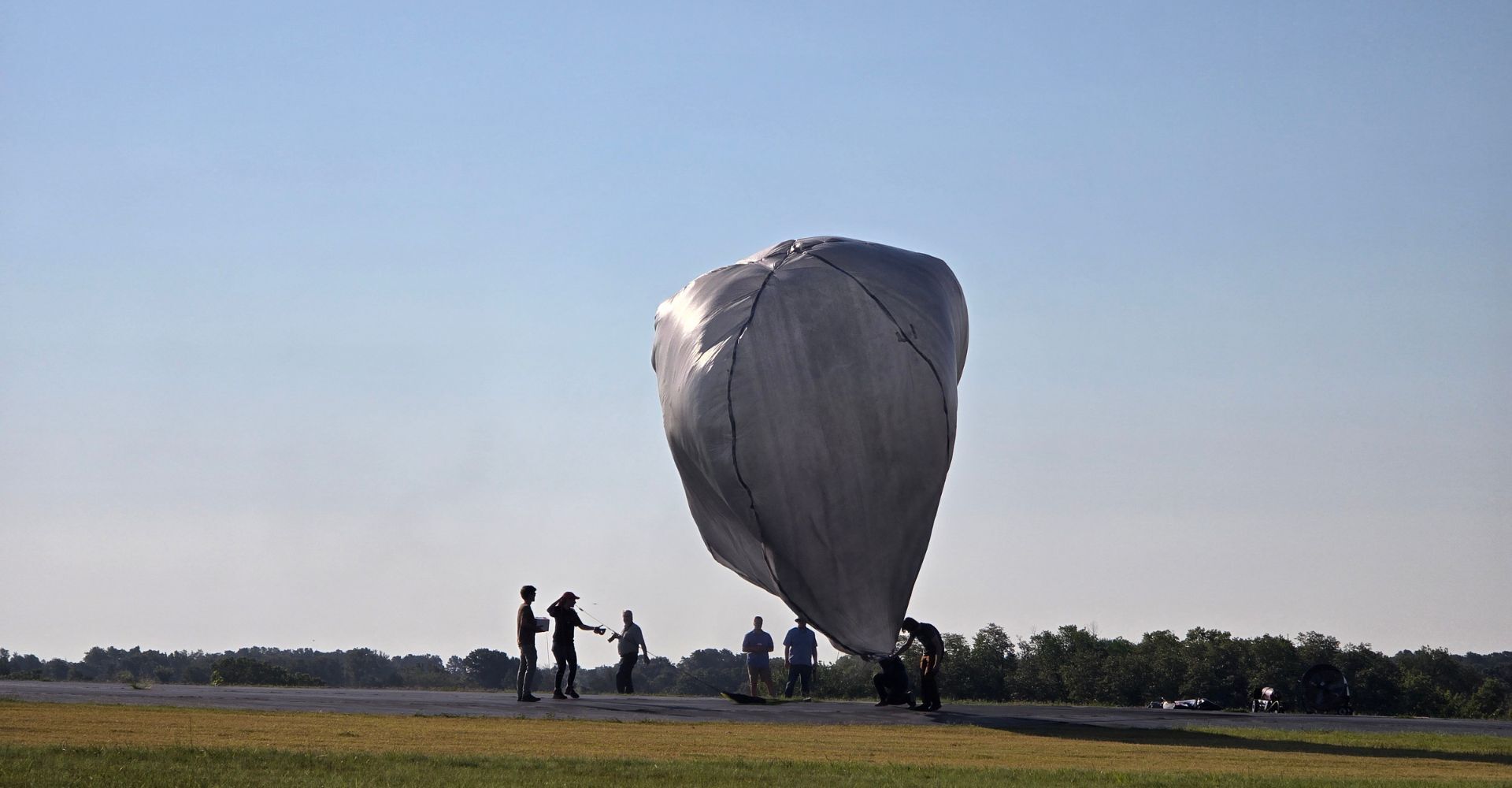
The E.V. Benton Radiation Physics Laboratory at Oklahoma State University has built a radiation dosimetry program that spans the International Space Station, DIY solar balloons at 21 km altitude, and upcoming commercial aircraft deployments — all built around the Red Pitaya STEMlab 125-14 as its core spectrometer**.**
## What is the E.V. Benton Radiation Physics Laboratory?
The **E.V. Benton Radiation Physics Laboratory** is a research group within the Department of Physics at Oklahoma State University (OSU) in Stillwater, Oklahoma. Led by Professor Eric Benton, the lab studies ionizing radiation in extreme environments including low Earth orbit, the upper atmosphere, and high-altitude aviation. The lab develops compact, affordable radiation dosimeters capable of measuring dose equivalent for tissue, with a particular focus on protecting astronauts, aviation crews, and passengers.
The lab’s three core instruments are:
- **SpaceTED** (Space Tissue Equivalent Dosimeter): designed for deployment on the International Space Station and spacecraft
- **AirTED** (Atmospheric ionizing radiation Tissue Equivalent Dosimeter): designed for high-altitude research aircraft
- **AirSiD** (Atmospheric Ionizing Radiation Silicon Dosimeter): a lightweight, battery-powered dosimeter designed for high-altitude balloon flights and future commercial aircraft deployment
- **Two Red Pitaya STEMlab 125-14 boards**, operating as multi-channel analyzers
- A Tissue Equivalent Proportional Counter (TEPC) for measuring high-LET radiation including secondary neutrons
- A Silicon PIN photodiode for detecting lower-LET radiation (gamma rays, electrons, positrons)
- A Raspberry Pi for timestamping and data logging
- A Red Pitaya-based 1024-channel spectrometer
- A 3-axis accelerometer
- Temperature and pressure sensors
- A Silicon PIN photodiode sensitive to electrons, positrons, x-rays, muons, and relativistic protons
All three instruments use the **Red Pitaya STEMlab 125-14** as their multi-channel analyzer, converting conditioned analog signals from radiation detectors into digital spectra for real-time analysis.
## Why Red Pitaya? The Case for Affordable Instrumentation
Traditional spectrometer systems capable of the measurements the Benton lab requires typically cost upward of $5,000 per unit. For a research program that needs instruments on many different platforms simultaneously, including aircraft operating on a per-flight basis, that cost makes scaling impossible.
Professor Benton had been looking for an affordable multi-channel analyzer solution for more than 20 years before finding Red Pitaya. The STEMlab 125-14 met the key requirements: low cost, open software platform, existing community libraries for signal acquisition, and 14-bit ADC resolution at 125 MS/s suitable for the pulse shapes coming from radiation detectors.
Critically, the existing Red Pitaya software ecosystem meant the lab’s physics graduate students, who are not electrical engineers or embedded programmers, could adapt existing code rather than build a spectrometer from scratch.
*“Using Red Pitaya, we were able to just jump right in and get something working. It’s been a steady progress rather than a very frustrating experience.”* — Professor Eric Benton, Oklahoma State University
## SpaceTED: One Year on the International Space Station
**SpaceTED** is a compact, self-contained Tissue Equivalent Proportional Counter (TEPC) approximately the size of a small shoebox (25.5 x 15.5 x 12.5 cm). Its core components include:
SpaceTED was launched aboard **SpaceX CRS-29 on November 10, 2023** and deployed inside the ISS. It completed approximately one year of continuous operation in space, concluding in November 2024.
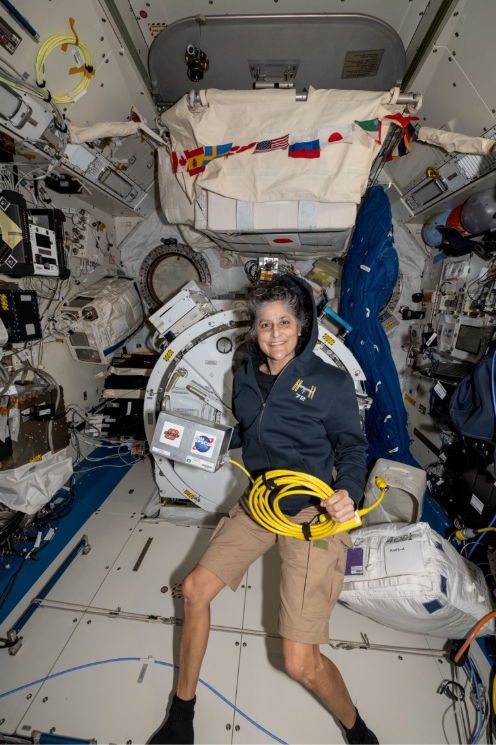 

*Astronaut Sunita Williams holding the SpaceTED device abourd the ISS*
*Credit: NASA*
Astronauts aboard the ISS periodically downloaded SpaceTED’s data for transmission to the OSU team on the ground. The collected dataset is currently being analyzed to characterize how radiation levels vary with the ISS’s orbital position and solar activity.
The transition to the [**STEMlab 125-14 4-Input**](https://redpitaya.com/4-input/) board is also underway. Where SpaceTED currently uses two separate boards running in parallel, the 4-Input board would consolidate that into a single unit, reducing power consumption and physical footprint for future missions.
## AirSiD: High-Altitude Solar Balloon Flights over Oklahoma
***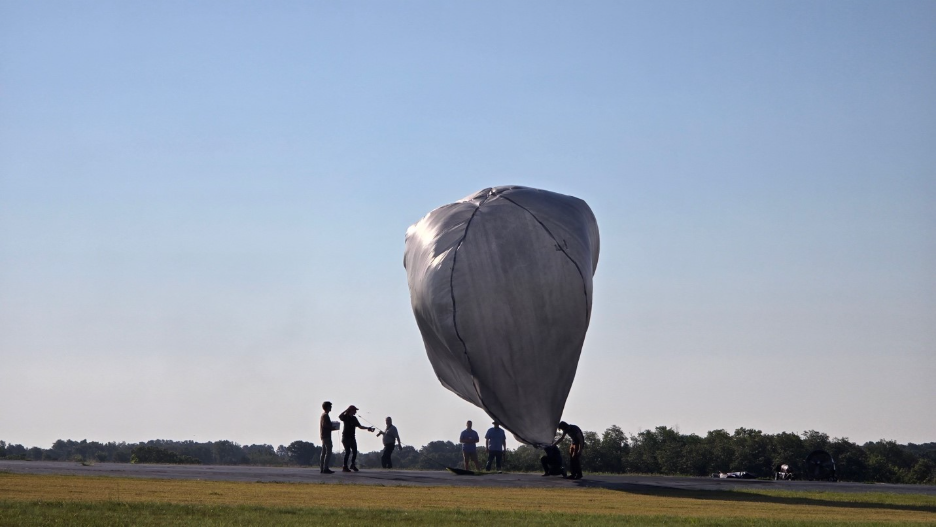** *
*Heliotrope solar balloon take-off*
*Credit: E.V. Benton Radiation Lab*
While SpaceTED was designed to the specifications needed to operate in space, AirSiD was designed to operate in the atmosphere, specifically on high altitude solar balloons that float at altitudes of approximately 15 to 21 km.
### What is AirSiD?
AirSiD is a lightweight (1.2 kg) battery-powered radiation dosimeter containing:
### How the balloon flights work
The balloon program uses an unconventional approach that reflects the lab’s low-cost philosophy. The balloons themselves are handbuilt from painters’ plastic sheeting and clear packing tape, then darkened with charcoal. This creates a solar thermal balloon: as sunlight heats the trapped air during the day, the balloon rises. As temperatures fall at night, it descends. No helium, no complex inflation systems.
The payload, which weighs up to 2.3 kg, carries GPS, a radio transponder, a cut-down mechanism, and a parachute for recovery. The entire flight is monitored via geofencing. Flights typically reach altitudes of approximately 70,000 ft (21 km), can last up to 12 hours, and drift up to several hundred kilometers before recovery.
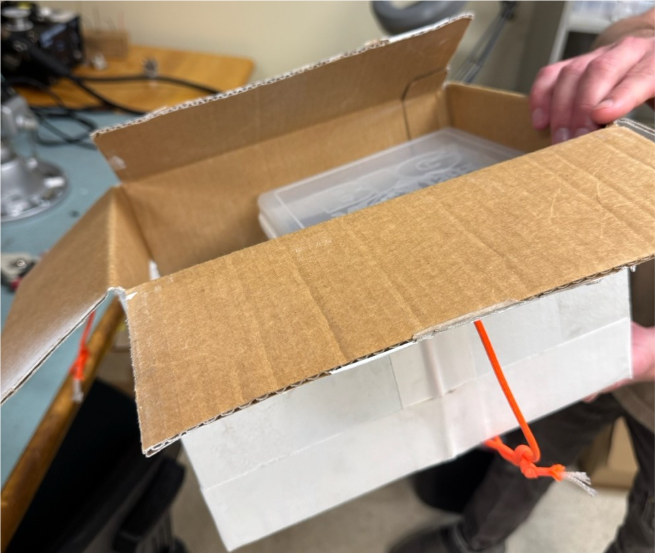

*The payload housing is a cardboard box painted white for thermal management.*
The OSU team has now completed multiple AirSiD balloon flights over central Oklahoma, generating atmospheric radiation profiles across altitude and time.
## Upcoming: Radiation Monitoring on Commercial Aircraft
The next deployment environment for AirSiD is commercial aviation. Aviation crew and frequent passengers represent one of the highest-exposure groups for atmospheric ionizing radiation outside of spaceflight, as aircraft regularly operate at altitudes where the secondary cosmic ray flux is elevated compared to ground level.
The Benton lab is currently in discussions with airline partners to mount AirSiD units on commercial flights. This program has not yet launched.
## Hardware Durability: Surviving a Rocket Malfunction
During instrument testing, one of the lab’s detectors was flown as a payload on a rocket test that ended in a malfunction and a hard landing. The Red Pitaya board survived intact and continued functioning.
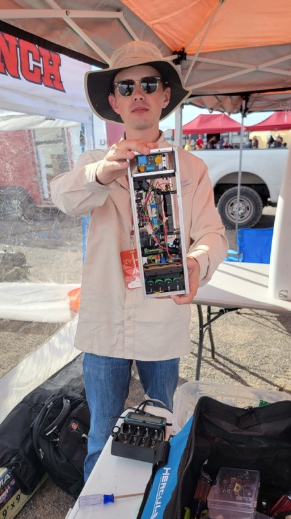 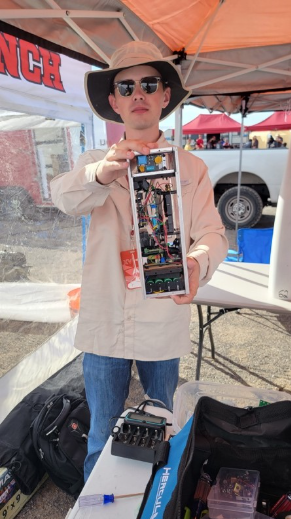

*Graduate student Garrett Thronton with the rocket payload*
*Credit: E.V. Benton Radiation Lab*
Combined with a full year of continuous operation in the radiation environment of low Earth orbit, this incident offers practical evidence of the STEMlab 125-14’s durability in demanding conditions.
## Student Development: Physics Students Building Space-Grade Instruments
A recurring theme in the Benton lab’s work is that the technical development has been carried out largely by physics graduate and undergraduate students, not dedicated instrumentation engineers. The open Red Pitaya software stack, existing community libraries for signal acquisition, and active support forum all lowered the barrier to entry substantially.
One undergraduate student in the lab has now built a working gamma-ray spectrometer using a sodium iodide scintillator, at a fraction of the cost of comparable commercial systems. The Red Pitaya handles the multi-channel analyzer function; a laptop displays the resulting spectra. Commercial equivalents start at approximately $5,000.
Professor Benton draws a direct parallel to the broader history of the Raspberry Pi as a platform that began in education and expanded into serious research and commercial applications. He sees Red Pitaya following the same trajectory, with the added capability of fast analog-to-digital and digital-to-analog conversion that makes it suited to sensor-interfacing challenges the Raspberry Pi cannot address.
## The Low-Budget Research Philosophy
Professor Benton describes a shift in perspective that came through years of competing in a field dominated by well-funded national labs and large university programs. Early in his career he envied the resources those groups had. Over time, he came to see constraint as a productive force.
The DIY solar balloon, the cardboard payload housing, the off-the-shelf Red Pitaya boards: these are not compromises forced by insufficient funding. They are an engineering philosophy: build instruments that are good enough, cheap enough to replicate, and accessible enough for students to develop and iterate.
*“It opens the door to smaller laboratories at smaller universities that have had a difficult time competing. I think Red Pitaya is going to go this way. It’s the future.”* — Professor Eric Benton
## Quick Facts: Red Pitaya in the Benton Lab
| **Field** | **Detail** |
| --- | --- |
| **Institution** | Oklahoma State University, Department of Physics |
| **Lab** | E.V. Benton Radiation Physics Laboratory |
| **Principal Investigator** | Professor Eric Benton |
| **Red Pitaya boards used** | STEMlab 125-14 (2x per SpaceTED); STEMlab 125-14 4-Input (in testing) |
| **Role of Red Pitaya** | Multi-channel analyzer / spectrometer for radiation pulse acquisition |
| **Deployment environments** | International Space Station, high-altitude solar balloons, rockets |
| **SpaceTED ISS launch** | SpaceX CRS-29, November 1, 2023 |
| **SpaceTED ISS end** | November 2024 |
| **Balloon altitude** | ~70,000 ft / ~21 km |
| **NASA funding** | EPSCoR award |
---
## Frequently Asked Questions
### **What is Red Pitaya used for in radiation research?**
Red Pitaya STEMlab 125-14 boards are used as multi-channel analyzers (also called spectrometers) in radiation dosimetry instruments. They convert analog pulses from radiation detectors, such as tissue equivalent proportional counters and silicon PIN photodiodes, into digital spectra for real-time analysis and data logging.
### **Has Red Pitaya been used on the International Space Station?**
Yes. Two Red Pitaya STEMlab 125-14 boards were part of the SpaceTED radiation dosimeter developed by Oklahoma State University. SpaceTED was deployed inside the Japanese Experiment Module of the ISS from November 2023 to approximately November 2024.
### **Can Red Pitaya be used as a spectrometer?**
Yes. The 14-bit ADC at 125 MS/s makes the STEMlab 125-14 suitable for pulse-height analysis in spectroscopy applications. The OSU Radiation Physics Laboratory used it as a multi-channel analyzer for both space and atmospheric radiation detection.
### **How does Red Pitaya compare to dedicated spectrometer hardware?**
Commercial multi-channel analyzers for radiation spectroscopy typically cost $5,000 or more. The Red Pitaya STEMlab 125-14 delivers comparable functionality for scientific and educational applications at significantly lower cost, with the added advantage of an open software platform that researchers can adapt to their specific requirements.
### **What is AirSiD?**
AirSiD (Atmospheric Ionizing Radiation Silicon Dosimeter) is a compact, battery-powered radiation dosimeter developed by OSU’s Benton Lab. It uses a Red Pitaya-based spectrometer and is deployed on DIY solar-thermal balloons for atmospheric radiation profiling at altitudes up to approximately 21 km.
**Related article:** [From Space to Skies: Innovative Radiation Dosimeters Enhance Human Safety](https://content.redpitaya.com/blog/innovative-radiation-dosimeters-enhance-human-safety)
### About the Red Pitaya Team
The Red Pitaya Technical Editorial Team is a cross-functional group of technical communicators and product specialists. By synthesizing insights from our hardware developers and global research partners, we provide verified, high-value content that bridges the gap between open-source innovation and industrial-grade precision.
Our mission is to make advanced instrumentation accessible to engineers, researchers, and educators worldwide.
##### Categories
- [academia (47)](https://content.redpitaya.com/blog/tag/academia)
##### Recent Posts
- [](https://content.redpitaya.com/blog/non-invasive-gerd-detection-radiofrequency-spectrophotometry)
[Non-Invasive GERD Detection: Continuous Esophageal Monitoring via Radiofrequency Spectrophotometry](https://content.redpitaya.com/blog/non-invasive-gerd-detection-radiofrequency-spectrophotometry)
September 29, 2026
- [](https://content.redpitaya.com/blog/open-source-mri-console-ocra-marcos-red-pitaya)
[How a $500 Open-Source MRI Console Sparked a Global Research Ecosystem](https://content.redpitaya.com/blog/open-source-mri-console-ocra-marcos-red-pitaya)
September 22, 2026
- [](https://content.redpitaya.com/blog/zephyr-rtos-nordic-logic-analyzer-workshop-eestec-ljubljana)
[Probing the Wire: Red Pitaya & Zephyr RTOS Workshop with EESTEC](https://content.redpitaya.com/blog/zephyr-rtos-nordic-logic-analyzer-workshop-eestec-ljubljana)
September 17, 2026
##### Subscribe to our newsletter

An open-source solution for hobbyists, professors,
radio amateurs and industrial clients.
**Red Pitaya**
Velika pot 21,
5250 Solkan
Slovenia, Europe
Phone: +386 30 322 719
Email: [info@redpitaya.com](mailto:info@redpitaya.com)
**Red Pitaya US**
TX, Dallas - Downtown Republic Center
325 N. St. Paul Street
Suite 3100
Dallas, Texas, 75202
United States of America
IMPORTANT: This address does not accept RMAs
Phone: (888) 637-2706
Email: [US.office@redpitaya.com](mailto:US.office@redpitaya.com)
- Customer Service
- [Customer Support](https://redpitaya.com/customer-support/)
- [Shipping & Returns](https://redpitaya.com/shipping-returns/)
- [Contact us](https://redpitaya.com/contact-us/)
- [Cookie Policy](https://redpitaya.com/cookie-policy/)
- SLO
- [O nas](https://redpitaya.com/o-nas/)
- [Pogoji poslovanja](https://redpitaya.com/pogoji-poslovanja/)
- [Politika zasebnosti](https://redpitaya.com/politika-zasebnosti/)
- [Politika piškotkov](https://redpitaya.com/politika-piskotkov/)
##### Follow Us
#### Subscribe to our newsletter
Get notified about new SW features & updates, news about latest community projects & events and new Red Pitaya products & discounts
[Subscribe](https://go.redpitaya.com/cs/c/?cta_guid=36ccbdc0-0344-49c4-aa91-aa67cf437c09&signature=AAH58kHkxFYTAKU-ILQzHI1jlrdI_co0RA&placement_guid=a24cb732-1dfb-4d0a-8c52-aa6851ce9102&click=556cfaee-eee4-48e4-95e7-c483a4f78883&hsutk=537e15e740555d2fd6a1c1ad931d2b6f&canon=https%3A%2F%2Fredpitaya.com%2Fabout-us%2F&utm_referrer=https%3A%2F%2Fredpitaya.com%2Fcompare%2F&portal_id=7715357&redirect_url=APefjpGj5Dm9poAAzHFGh4S6pJ-2TvNzBdwZZlfbr7toxfw-epFUtzEHOKToHx0i2TYYr39srj9aSERdntJBh8lJqoSXL-pUF2gwhYvOW6IMm28hQVmhYML2AIbbIRrr3YaoyJkZQ0iRxq-uHlFt66i3_8XpQpXT_M2zF9fS7t0f6hlBjGBJ7X_aXDrhBwXcEAqwoWWleG4uxonSGOR-BBp3tpKcySXYELTGHeGn5Yo61r3xrFvqFP5P6BxVwxTi51_ceW9uBzOMvA1rYz4BsIhLSF8n4bhcHqJTvhibH_laJrjDNdEUUrU&__hstc=72355340.537e15e740555d2fd6a1c1ad931d2b6f.1635738083317.1635738083317.1635746314170.2&__hssc=72355340.5.1635746314170&__hsfp=530052575&contentType=standard-page)
**Red Pitaya** 2025 All Rights Reserved.
- [Privacy Policy](https://redpitaya.com/privacy-policy/)
- [Terms of Use](https://redpitaya.com/terms-of-use/)
```json
{
"@context" : "https://schema.org",
"@type" : "BlogPosting",
"author" : {
"@type" : "Person",
"name" : "Red Pitaya Technical Editorial Team",
"url" : "https://content.redpitaya.com/blog/author/red-pitaya-technical-editorial-team"
},
"dateModified" : "2026-04-28T08:15:00.729Z",
"datePublished" : "2026-04-28T08:15:00.000Z",
"headline" : "How Oklahoma State University Uses Red Pitaya to Measure Radiation in Space, Stratosphere, and Sky",
"image" : [ "https://content.redpitaya.com/hubfs/blog%20featured%20image%20-%202026-04-24T141722.163.jpg" ],
"mainEntityOfPage" : {
"@id" : "https://content.redpitaya.com/blog/red-pitaya-radiation-measurement-iss-balloon-oklahoma-state-university",
"@type" : "WebPage"
},
"publisher" : {
"@type" : "Organization",
"logo" : {
"@type" : "ImageObject",
"url" : "https://content.redpitaya.com/hubfs/Red-pitaya-logo.jpg"
},
"name" : "Red Pitaya d.o.o."
}
}
```