---
title: "Portable Engineering Labs: How SMU Transforms Hands-On ECE Education with Red Pitaya"
description: How SMU enables anytime, anywhere hands-on engineering education using portable Red Pitaya labs across the ECE curriculum.
image: https://content.redpitaya.com/hubfs/blog%20featured%20image%20-%202026-01-14T141654.077.jpg
---
[](https://redpitaya.com/)
[](https://redpitaya.com/)
- Products
- [STEMlab 125-14 Gen 2](https://redpitaya.com/stemlab-125-14-gen2/)
- [STEMlab 125-14](https://redpitaya.com/stemlab-125-14/)
- [SIGNALlab 250-12](https://redpitaya.com/signallab-250-12/)
- [SDRlab 122-16](https://redpitaya.com/sdrlab-122-16/)
- [STEMlab TI (Texas Instruments)](https://redpitaya.com/stemlab-ti-texas-instruments/)
- [Multi-channel Solutions](https://redpitaya.com/multi-channel-solutions/)
- [Accessories](https://redpitaya.com/accessories/)
- [Applications](https://redpitaya.com/applications/)
- Documentation
- [Technical Documentation](https://redpitaya.com/documentation/)
- [Teaching materials](https://redpitaya.com/teaching-materials/)
- [Student projects](https://redpitaya.com/student-projects/)
- [User forum](https://forum.redpitaya.com/)
- [About](https://redpitaya.com/about-us/)
- [History](https://redpitaya.com/history/)
- [Distributors](https://redpitaya.com/distibutors-red-pitaya/)
- [Blog](https://content.redpitaya.com/blog)
[Shop](https://redpitaya.com/shop/)
- [ACADEMIA](https://redpitaya.com/academia/)
- [RADIO AMATEURS](https://redpitaya.com/radio-amateurs/)
- [Home](https://redpitaya.com/)
- Products
- [STEMlab 125-10](https://redpitaya.com/stemlab-125-10/)
- [STEMlab 125-14](https://redpitaya.com/stemlab-125-14/)
- [SIGNALlab 250-12](https://redpitaya.com/signallab-250-12/)
- [SDRlab 122-16](https://redpitaya.com/sdrlab-122-16/)
- [Accessories](https://redpitaya.com/accessories/)
- [Applications](https://redpitaya.com/applications/)
- [Resources](https://redpitaya.com/documentation/)
- [Shop](https://redpitaya.com/shop/)
- [About](https://redpitaya.com/about-us/)
- [Blog](https://content.redpitaya.com/blog)
- [Compare](https://redpitaya.com/compare/)
- [Login / Register](https://redpitaya.com/my-account/)
### Red Pitaya Blog
[Home](https://redpitaya.com) » [Academia](https://content.redpitaya.com/blog/tag/academia) »
[Academia](https://content.redpitaya.com/blog/tag/academia)
# Portable Engineering Labs: How SMU Transforms Hands-On ECE Education with Red Pitaya
- Posted by  [Red Pitaya Technical Editorial Team](https://redpitaya.com/Red-Pitaya-Blog-team/) , January 15, 2026
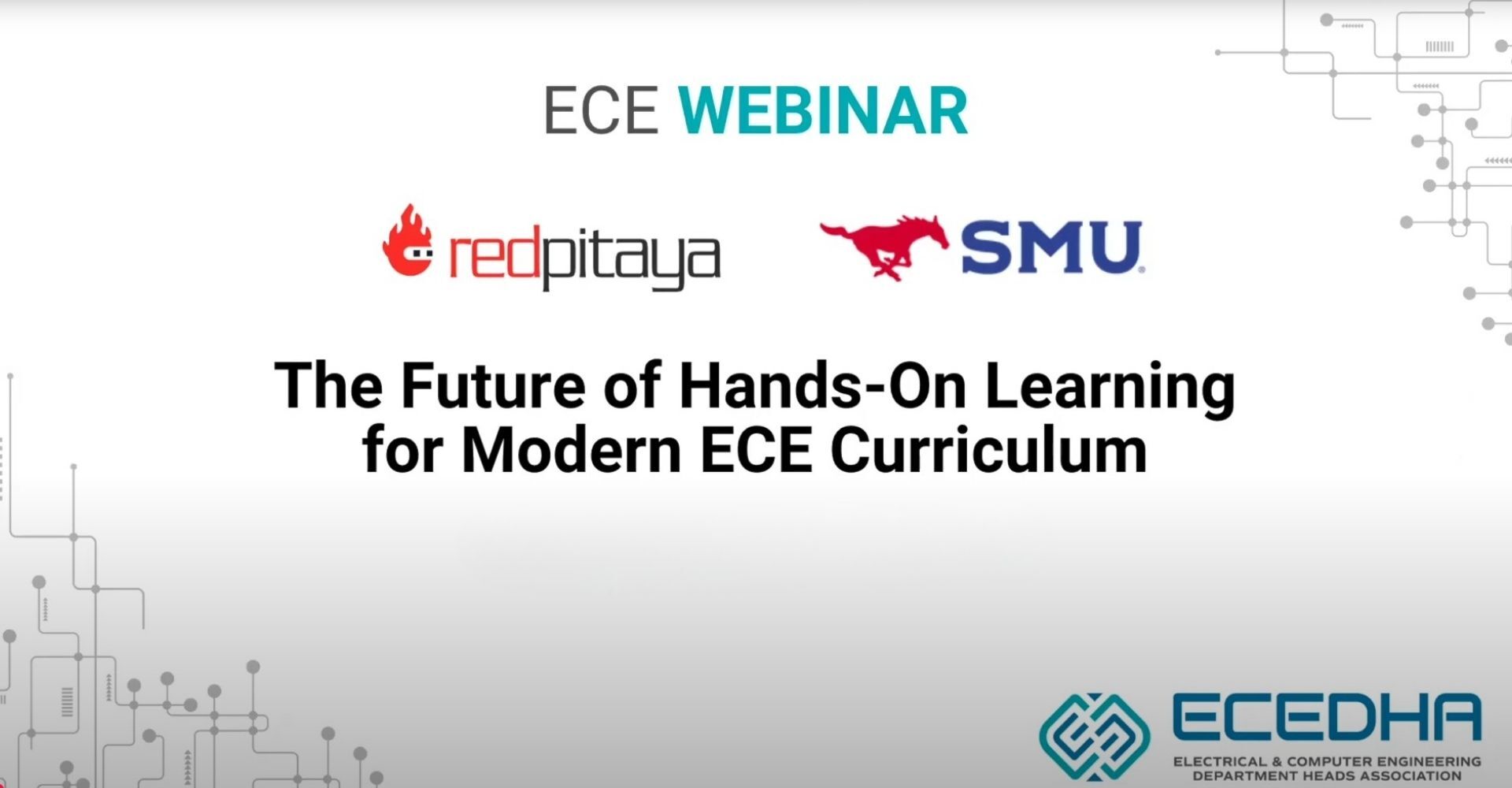
*Students bring a complete engineering workbench home in their backpacks—transforming “anytime, anywhere” from a slogan into a systematic approach to hands-on learning.*
On November 19, 2025, ECEDHA hosted a comprehensive [webinar](https://www.ecedha.org/Meetings/ECE-Webinar-Future-of-Hands-On-Learning-for-Modern-ECE-Curriculum) featuring Southern Methodist University’s Electrical and Computer Engineering department, showcasing their innovative approach to modernizing ECE education. The session brought together four distinct voices—department leadership, faculty, graduate lab instructors, and undergraduate students—each offering unique insights into how portable, software-defined instrumentation is reshaping engineering education.
## The Challenge: Three Critical Gaps
Dr. Mahesh Krishnamurthy, SMU’s ECE Department Chair, opened with a frank assessment of traditional ECE lab education circa 2020. His team identified three fundamental problems:
**Scalability limits**
High costs of ownership, space-intensive setups, and infrastructure misaligned with evolving learning practices made traditional labs difficult to expand or modernize.
**Limited flexibility**
Equipment tethered to physical locations restricted student learning to scheduled lab hours, preventing the iterative experimentation that characterizes real engineering practice.
**Continuity gaps**
Classroom theory and lab practice remained siloed, with modeling and simulation failing to connect meaningfully to hands-on skills. Students lacked pathways for continuous skill development between formal lab sessions.
## The LABtop™ Vision: From Knowledge to Competence
SMU’s response centers on what they call LABtop™—a systematic approach that mirrors how laptops democratized access to knowledge by making computation portable and personal.
“Just as laptops enabled students to learn, compute, and create anywhere,” Dr. Krishnamurthy explained, “LABtop™ brings portable, personalized engineering practice directly to students, enabling them to experiment, analyze, and prototype anywhere.”
The initiative follows a deliberate progression:
- **Build knowledge** through personalized learning powered by AI and flexible access to resources
- **Build skill** with portable, personalized engineering practice at students’ fingertips
- **Build competence** by applying skills to solve real-world challenges, lead with vision, and shape the future
## From Theory to Practice: The Signals & Systems Transformation
Dr. Prasanna Rangarajan, Associate Professor and Chair of SMU’s Lab Committee, detailed how this vision manifests in the Signals & Systems course—a sophomore-level class that historically struggled with abstraction and the theory–practice divide.
**The core challenge**
Students first encounter concepts such as time-domain analysis, frequency spectra, sampling, quantization, convolution, and filtering. Without immediate practical reinforcement, these topics can remain overwhelming abstractions.
**SMU’s solution**
A three-part integration using Red Pitaya STEMlab boards:
- **In class:** Students grasp convolution principles by emulating the acoustic response of a concert hall in MATLAB
- **In lab:** They immediately apply those principles to characterize an RC filter’s frequency response through hands-on measurement
- **Further exploration:** Take-home assignments allow students to differentiate FIR (running sum) and IIR (resonant) filters using an LTI DSP workbench
This “S&S Trifecta” connects three critical domains—time domain (x\[n\]), transform domain (H(z)), and spectrum (X(e^jω))—through unified tools accessible via Signal Generator, Spectrum Analyzer, and Bode Analyzer apps.
**Key pedagogical benefits include:**
- A 1:1 student-to-hardware ratio, eliminating equipment-sharing bottlenecks
- Active learning that enables experimentation and iteration anytime, anywhere
- Seamless simulation-to-hardware transition via a MATLAB interface
- AI-enhanced learning that shifts focus from syntax to skill development
“Beyond using it in the lab, Red Pitaya gives students the flexibility to use the platform in course projects, senior design experiences, and even to ideate concepts they’re personally interested in,” Dr. Rangarajan noted. “This versatility was critical for our needs.”
## Instructional Reality Check: What Actually Works
Danyal Ahsanullah, a PhD candidate who developed and taught the Signals & Systems lab—earning SMU’s Outstanding Graduate Student Instructor recognition—provided ground-level insights on implementation.
**The COVID advantage**
The transition to Red Pitaya proved invaluable during the pandemic. “We experienced zero disruption during COVID,” Ahsanullah explained. “We could teach in-class and remote students in a hybrid format seamlessly because students had their own hardware.”
**Lab curriculum highlights include:**
- Introduction to MATLAB and Red Pitaya
- Waveform analysis and modulation (AM/FM)
- Frequency response of LTI systems
- Digital filtering implementation
- Comparing FIR vs. IIR filters
- A gentle introduction to nonlinear systems
A critical implementation detail emerged: while Red Pitaya is “versatile with limited measurement precision compared to specialized instruments,” this trade-off is pedagogically sound. Students learn fundamental concepts without being distracted by the complexity of professional-grade equipment.
“We physically create LTI systems on one Red Pitaya and analyze them with another to understand frequency response and temporal behavior,” Ahsanullah explained. “Students measure frequency responses of simple RC filters, then progress to identifying unknown component values—reinforcing the connection between theory and measurement.”
## The Student Perspective: Three Transformative Benefits
Cooper Shapard, an IEEE Student Representative and senior ECE student, currently teaches two labs using Red Pitaya (ECE 1181 – Microcontrollers and Embedded Systems Lab, and ECE 2170 – Signals & Systems Lab). His perspective spans student, instructor, and student leader roles.
**As a student: learning anytime, anywhere**
“Student schedules are unpredictable—the best working times are often when labs are closed,” Shapard noted. “With Red Pitaya, I could get ‘unstuck’ by iterating on my own time, something a traditional three-hour lab slot never allowed.”
**As an instructor: teaching concepts, not buttons**
“Systems work on the go and are individualized,” he explained. “We spend less time on the ‘how’ and more on the ‘why.’ Each student gets their own lab equipment, so they all learn how to use oscilloscopes, function generators, and analyzers themselves—not just watch a lab partner do it.”
Core lab instruction time dropped from three hours to approximately one hour, with students completing deeper exploration independently.
**As a student leader: going beyond the lab**
“This semester, three students requested Red Pitayas for personal projects outside class requirements,” Shapard shared. “It lets us take ideas from initial concept to physical hardware prototype. Those small feedback loops really accelerate learning.”
## Curriculum-Wide Integration: From Freshman to Graduate School
SMU’s Fall 2025 LABtop™ cohort integrates Red Pitaya across the entire ECE curriculum:
- ECE 1181 (Freshman): Microcontrollers and Embedded Systems Lab
- ECE 2170 (Sophomore): Design and Analysis of Signals & Systems Lab
- ECE 5340 (Graduate): Medical Systems Design
- ECE 5365 (Graduate): Adaptive Algorithms for Machine Learning
**Near-term rollout plan:**
- Equip every freshman with LABtop™ hardware and training modules in week one
- Integrate hardware into coursework, labs, student projects, capstone design, and REU experiences
- Award digital badges aligned with learning outcomes and industry-recognized skill sets
- Offer course-specific accessories through the campus bookstore
## Measuring Success: What Changed
Webinar participants consistently emphasized tangible outcomes.
**Institutional benefits:**
- Scalability through budget-friendly hardware
- Space efficiency without large lab renovations
- Alignment with modern, app-driven learning expectations
**Pedagogical benefits:**
- Stronger theory–practice integration
- Continuous skill development across semesters
- Industry-relevant, hands-on experience from day one
**Student experience:**
- Ownership and agency through personal equipment
- Reduced cognitive load via familiar interfaces
- Career readiness through portfolio-worthy projects
## Looking Forward: Join the Curriculum Collective
SMU’s journey illustrates a key insight: hardware is necessary but insufficient for curriculum transformation. The real challenge lies in developing teaching materials, training assistants, onboarding students, providing technical support, and maintaining equipment at scale.
To address this, Red Pitaya and SMU have partnered to create the **Curriculum Collective**, a community-driven initiative offering:
- Comprehensive, course-specific teaching materials
- Live teaching assistant training (in-person and online)
- Student onboarding programs
- Online office hours for technical support
- Graduation interview workshops
- Equipment replacement planning and long-term support
“We’re excited about what’s ahead,” Dr. Krishnamurthy concluded. “We know we’re just scratching the surface.”
### About the Red Pitaya Team
The Red Pitaya Technical Editorial Team is a cross-functional group of technical communicators and product specialists. By synthesizing insights from our hardware developers and global research partners, we provide verified, high-value content that bridges the gap between open-source innovation and industrial-grade precision.
Our mission is to make advanced instrumentation accessible to engineers, researchers, and educators worldwide.
##### Categories
- [academia (47)](https://content.redpitaya.com/blog/tag/academia)
##### Recent Posts
- [](https://content.redpitaya.com/blog/non-invasive-gerd-detection-radiofrequency-spectrophotometry)
[Non-Invasive GERD Detection: Continuous Esophageal Monitoring via Radiofrequency Spectrophotometry](https://content.redpitaya.com/blog/non-invasive-gerd-detection-radiofrequency-spectrophotometry)
September 29, 2026
- [](https://content.redpitaya.com/blog/open-source-mri-console-ocra-marcos-red-pitaya)
[How a $500 Open-Source MRI Console Sparked a Global Research Ecosystem](https://content.redpitaya.com/blog/open-source-mri-console-ocra-marcos-red-pitaya)
September 22, 2026
- [](https://content.redpitaya.com/blog/zephyr-rtos-nordic-logic-analyzer-workshop-eestec-ljubljana)
[Probing the Wire: Red Pitaya & Zephyr RTOS Workshop with EESTEC](https://content.redpitaya.com/blog/zephyr-rtos-nordic-logic-analyzer-workshop-eestec-ljubljana)
September 17, 2026
##### Subscribe to our newsletter

An open-source solution for hobbyists, professors,
radio amateurs and industrial clients.
**Red Pitaya**
Velika pot 21,
5250 Solkan
Slovenia, Europe
Phone: +386 30 322 719
Email: [info@redpitaya.com](mailto:info@redpitaya.com)
**Red Pitaya US**
TX, Dallas - Downtown Republic Center
325 N. St. Paul Street
Suite 3100
Dallas, Texas, 75202
United States of America
IMPORTANT: This address does not accept RMAs
Phone: (888) 637-2706
Email: [US.office@redpitaya.com](mailto:US.office@redpitaya.com)
- Customer Service
- [Customer Support](https://redpitaya.com/customer-support/)
- [Shipping & Returns](https://redpitaya.com/shipping-returns/)
- [Contact us](https://redpitaya.com/contact-us/)
- [Cookie Policy](https://redpitaya.com/cookie-policy/)
- SLO
- [O nas](https://redpitaya.com/o-nas/)
- [Pogoji poslovanja](https://redpitaya.com/pogoji-poslovanja/)
- [Politika zasebnosti](https://redpitaya.com/politika-zasebnosti/)
- [Politika piškotkov](https://redpitaya.com/politika-piskotkov/)
##### Follow Us
#### Subscribe to our newsletter
Get notified about new SW features & updates, news about latest community projects & events and new Red Pitaya products & discounts
[Subscribe](https://go.redpitaya.com/cs/c/?cta_guid=36ccbdc0-0344-49c4-aa91-aa67cf437c09&signature=AAH58kHkxFYTAKU-ILQzHI1jlrdI_co0RA&placement_guid=a24cb732-1dfb-4d0a-8c52-aa6851ce9102&click=556cfaee-eee4-48e4-95e7-c483a4f78883&hsutk=537e15e740555d2fd6a1c1ad931d2b6f&canon=https%3A%2F%2Fredpitaya.com%2Fabout-us%2F&utm_referrer=https%3A%2F%2Fredpitaya.com%2Fcompare%2F&portal_id=7715357&redirect_url=APefjpGj5Dm9poAAzHFGh4S6pJ-2TvNzBdwZZlfbr7toxfw-epFUtzEHOKToHx0i2TYYr39srj9aSERdntJBh8lJqoSXL-pUF2gwhYvOW6IMm28hQVmhYML2AIbbIRrr3YaoyJkZQ0iRxq-uHlFt66i3_8XpQpXT_M2zF9fS7t0f6hlBjGBJ7X_aXDrhBwXcEAqwoWWleG4uxonSGOR-BBp3tpKcySXYELTGHeGn5Yo61r3xrFvqFP5P6BxVwxTi51_ceW9uBzOMvA1rYz4BsIhLSF8n4bhcHqJTvhibH_laJrjDNdEUUrU&__hstc=72355340.537e15e740555d2fd6a1c1ad931d2b6f.1635738083317.1635738083317.1635746314170.2&__hssc=72355340.5.1635746314170&__hsfp=530052575&contentType=standard-page)
**Red Pitaya** 2025 All Rights Reserved.
- [Privacy Policy](https://redpitaya.com/privacy-policy/)
- [Terms of Use](https://redpitaya.com/terms-of-use/)
```json
{
"@context" : "https://schema.org",
"@type" : "BlogPosting",
"author" : {
"@type" : "Person",
"name" : "Red Pitaya Technical Editorial Team",
"url" : "https://content.redpitaya.com/blog/author/red-pitaya-technical-editorial-team"
},
"dateModified" : "2026-01-22T08:30:00.051Z",
"datePublished" : "2026-01-15T08:30:00.000Z",
"headline" : "Portable Engineering Labs: How SMU Transforms Hands-On ECE Education with Red Pitaya",
"image" : [ "https://content.redpitaya.com/hubfs/blog%20featured%20image%20-%202026-01-14T141654.077.jpg" ],
"mainEntityOfPage" : {
"@id" : "https://content.redpitaya.com/blog/portable-engineering-labs-hands-on-ece-education",
"@type" : "WebPage"
},
"publisher" : {
"@type" : "Organization",
"logo" : {
"@type" : "ImageObject",
"url" : "https://content.redpitaya.com/hubfs/Red-pitaya-logo.jpg"
},
"name" : "Red Pitaya d.o.o."
}
}
```