This article builds on our previous post, Improved Alpha Spectroscopy with Red Pitaya, which covers the detector, electronics, and acquisition system in detail. Alpha spectroscopy is one of the most precise methods for identifying radioactive isotopes and measuring the energy of the alpha particles they emit.
This project—designed and carried out by Lappetito Lodovico—demonstrates how a Red Pitaya STEMlab board, combined with open-source software, can deliver laboratory-grade alpha spectroscopy on a compact, budget-friendly platform.
Why Alpha Spectroscopy Matters
Alpha spectroscopy enables researchers to distinguish isotopes such as uranium-238, thorium-232, radium-226, and polonium-210 by their unique energy signatures.
Capturing those signatures accurately is essential for applications in nuclear science, environmental monitoring, and educational labs.
Red Pitaya STEMlab as the Core Spectrometer
At the heart of the experiment is a Red Pitaya STEMlab board running a high-speed analog-to-digital converter.
Key components include:
- Multi-Channel Analyzer (MCA) application by Pavel Demin, loaded on a dedicated SD card.
- ROOT data-analysis framework from CERN for post-processing and visualization.
This combination provides fast signal acquisition, FPGA-level processing, and an open architecture that researchers can adapt for different detection setups.
Preparing Ultra-Thin Radioactive Sources
For accurate alpha spectroscopy, sample preparation is critical.
Thick samples cause self-absorption, where alpha particles lose energy before escaping the source.
To reduce this effect, the team produced ultra-thin radioactive layers using chemical deposition techniques on metal substrates.
Sources included trace amounts of uranium, thorium, radium, and polonium.
Capturing and Analyzing the Spectrum
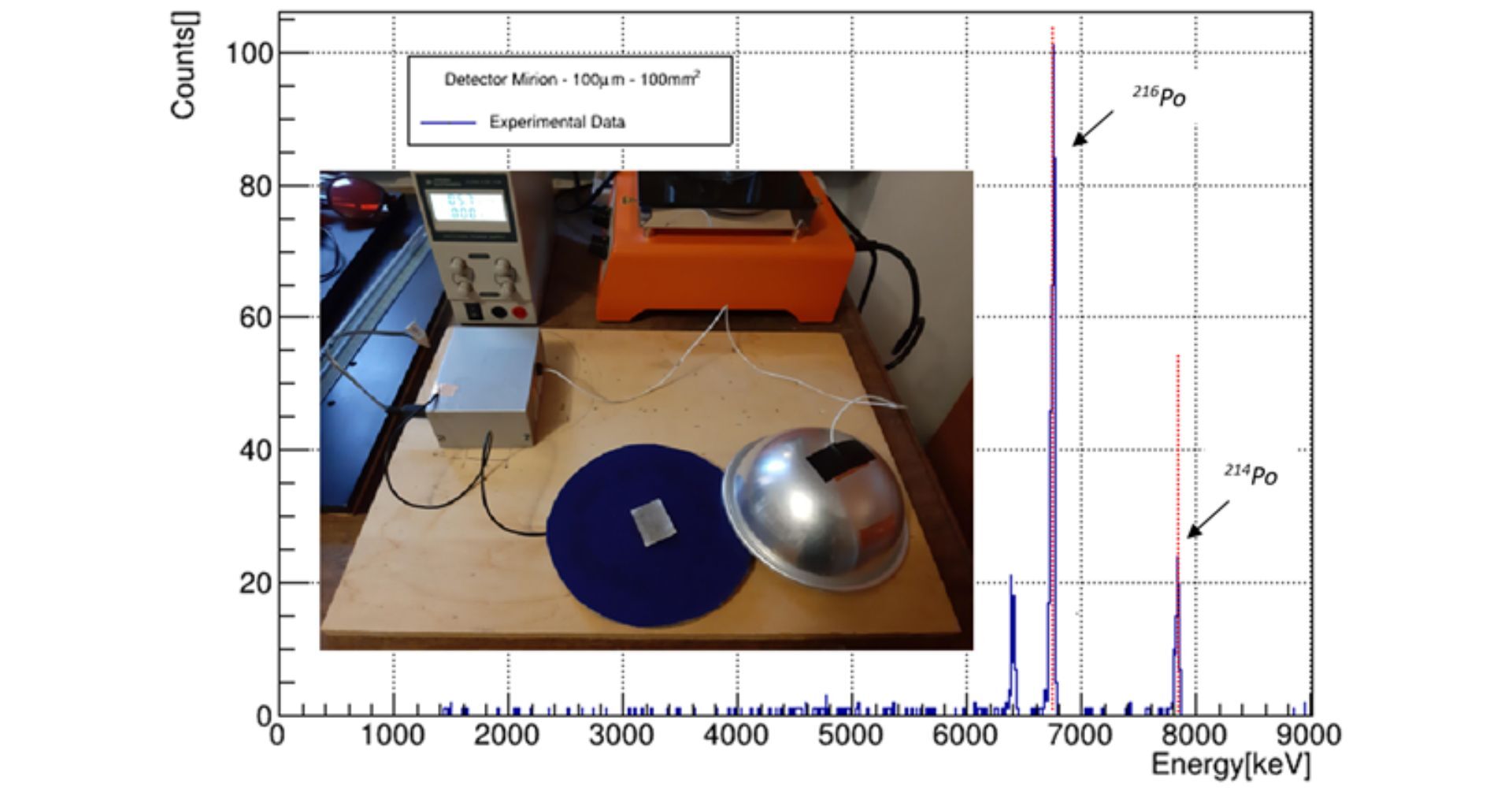
Signals from the detector were routed to the Red Pitaya, digitized in real time, and processed by the MCA application.
The resulting spectra were analyzed with ROOT to identify distinct alpha peaks and calculate energy resolution with remarkable precision, even for low-activity sources.
Key Advantages of the Red Pitaya Approach
- Cost-effective: Achieves high-resolution spectroscopy without expensive commercial spectrometers.
- Open-source flexibility: Users can modify FPGA code and software for specialized experiments.
- Portable and scalable: The small footprint makes it ideal for field studies or teaching labs.
Frequently Asked Questions (FAQ)
What is alpha spectroscopy?
Alpha spectroscopy is a technique for measuring the energy of alpha particles emitted by radioactive isotopes, enabling identification of specific elements such as uranium or radium.
Why use Red Pitaya for nuclear measurements?
Red Pitaya’s STEMlab boards combine high-speed data acquisition with FPGA processing, allowing researchers to build a customizable, cost-effective spectrometer.
Do I need specialized software?
Yes. This project used the Multi-Channel Analyzer (MCA) application by Pavel Demin for real-time acquisition and the ROOT framework from CERN for detailed data analysis.
Is Red Pitaya safe for handling radioactive samples?
The board itself poses no radiation risk. However, users must follow all relevant safety protocols when working with radioactive materials.
Can this setup be used in education?
Absolutely. The affordability and portability of Red Pitaya make it ideal for university labs and training programs in nuclear physics or environmental science.
About the Red Pitaya Team
The Red Pitaya Technical Editorial Team is a cross-functional group of technical communicators and product specialists. By synthesizing insights from our hardware developers and global research partners, we provide verified, high-value content that bridges the gap between open-source innovation and industrial-grade precision.
Our mission is to make advanced instrumentation accessible to engineers, researchers, and educators worldwide.

 September 22, 2026
 September 17, 2026