---
title: "FPGA-Based RF Signal Processing: Exploring the Red Pitaya STEMlab 125-14"
description: Explore RF signal processing with Red Pitaya & Vitis Model Composer. Learn about ADC/DAC performance and MATLAB/Simulink FPGA workflows in this review.
image: https://content.redpitaya.com/hubfs/blog%20featured%20image%20-%202026-03-11T120655.473.jpg
---
[](https://redpitaya.com/)
[](https://redpitaya.com/)
- Products
- [STEMlab 125-14 Gen 2](https://redpitaya.com/stemlab-125-14-gen2/)
- [STEMlab 125-14](https://redpitaya.com/stemlab-125-14/)
- [SIGNALlab 250-12](https://redpitaya.com/signallab-250-12/)
- [SDRlab 122-16](https://redpitaya.com/sdrlab-122-16/)
- [STEMlab TI (Texas Instruments)](https://redpitaya.com/stemlab-ti-texas-instruments/)
- [Multi-channel Solutions](https://redpitaya.com/multi-channel-solutions/)
- [Accessories](https://redpitaya.com/accessories/)
- [Applications](https://redpitaya.com/applications/)
- Documentation
- [Technical Documentation](https://redpitaya.com/documentation/)
- [Teaching materials](https://redpitaya.com/teaching-materials/)
- [Student projects](https://redpitaya.com/student-projects/)
- [User forum](https://forum.redpitaya.com/)
- [About](https://redpitaya.com/about-us/)
- [History](https://redpitaya.com/history/)
- [Distributors](https://redpitaya.com/distibutors-red-pitaya/)
- [Blog](https://content.redpitaya.com/blog)
[Shop](https://redpitaya.com/shop/)
- [ACADEMIA](https://redpitaya.com/academia/)
- [RADIO AMATEURS](https://redpitaya.com/radio-amateurs/)
- [Home](https://redpitaya.com/)
- Products
- [STEMlab 125-10](https://redpitaya.com/stemlab-125-10/)
- [STEMlab 125-14](https://redpitaya.com/stemlab-125-14/)
- [SIGNALlab 250-12](https://redpitaya.com/signallab-250-12/)
- [SDRlab 122-16](https://redpitaya.com/sdrlab-122-16/)
- [Accessories](https://redpitaya.com/accessories/)
- [Applications](https://redpitaya.com/applications/)
- [Resources](https://redpitaya.com/documentation/)
- [Shop](https://redpitaya.com/shop/)
- [About](https://redpitaya.com/about-us/)
- [Blog](https://content.redpitaya.com/blog)
- [Compare](https://redpitaya.com/compare/)
- [Login / Register](https://redpitaya.com/my-account/)
### Red Pitaya Blog
[Home](https://redpitaya.com) » [Case study](https://content.redpitaya.com/blog/tag/case-study) »
[Case study](https://content.redpitaya.com/blog/tag/case-study)
# FPGA-Based RF Signal Processing: Exploring the Red Pitaya STEMlab 125-14
- Posted by  [Red Pitaya Technical Editorial Team](https://redpitaya.com/Red-Pitaya-Blog-team/) , March 17, 2026
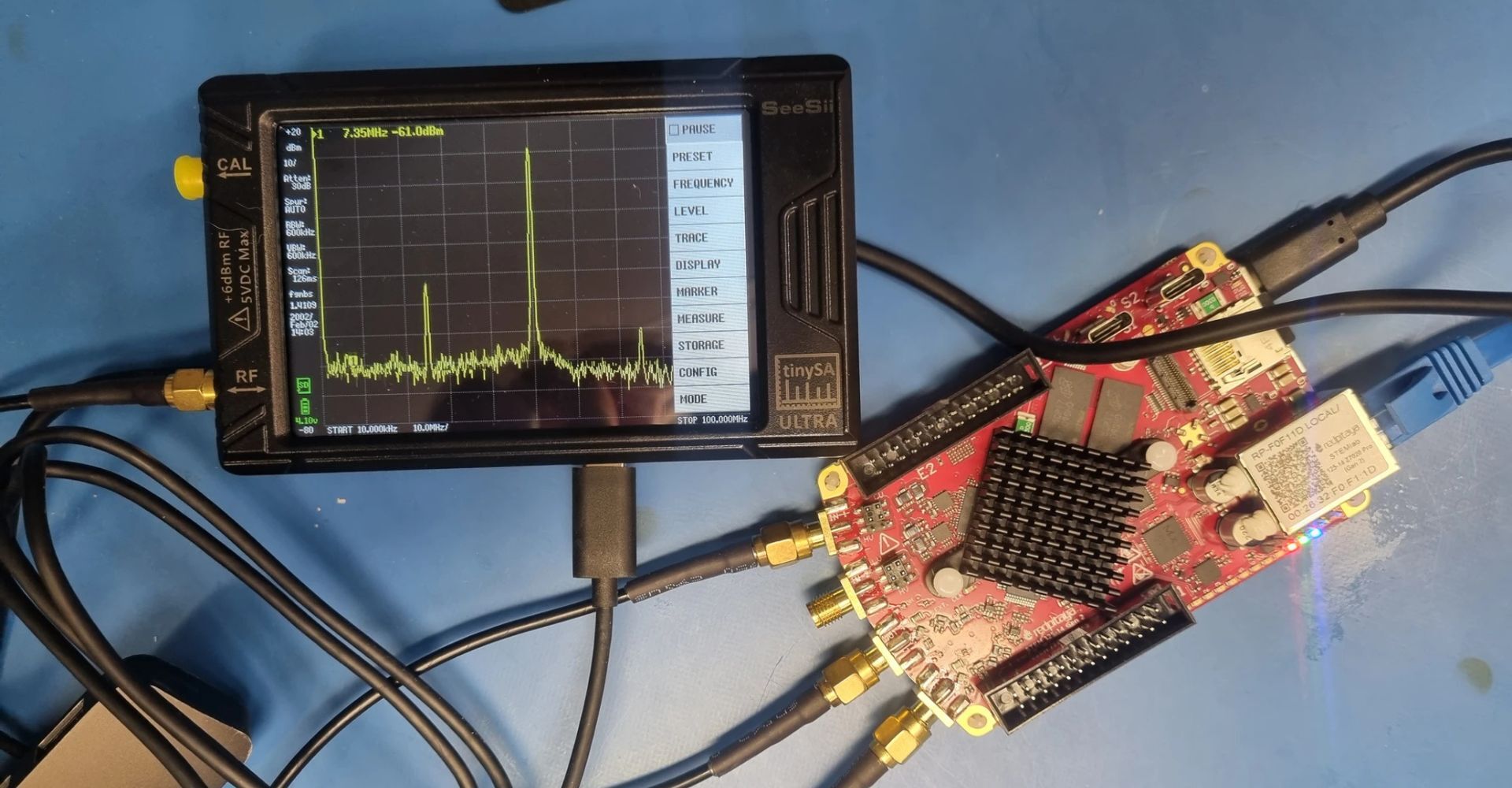
In the world of FPGA and SoC development, tools like Vivado and PetaLinux are industry standards. However, as designs move closer to complex algorithmic modeling, the bridge between **Simulink** and **Programmable Logic** becomes vital.
In a recent deep-dive by the *MicroZed Chronicles*, the focus shifts to a powerful tool for this bridge: **Vitis Model Composer**, and how it integrates with the hardware capabilities of the **Red Pitaya STEMlab 125-14**.
## The Hybrid Workflow: Vitis Model Composer & Simulink
Traditionally, algorithm developers stay in MATLAB/Simulink, while HDL engineers work in Vivado. **Vitis Model Composer** breaks this barrier by providing HDL and HLS blocks directly within Simulink.
This environment is particularly effective for signal processing tasks such as:
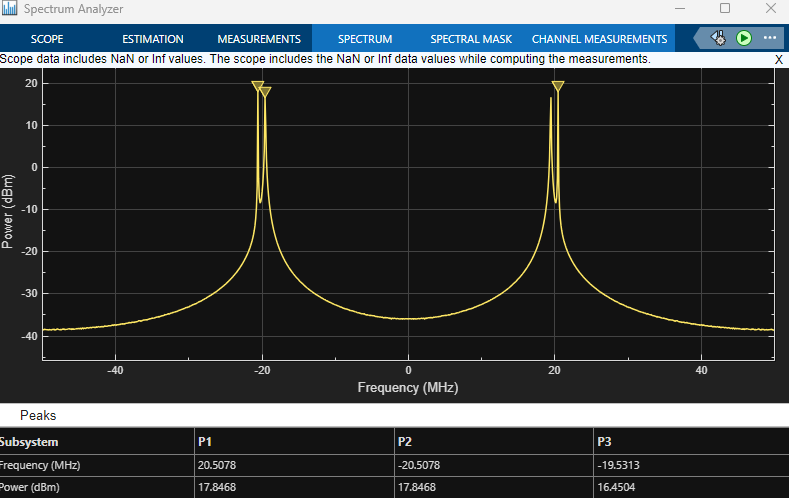
- **AM Modulation/Demodulation:** Using Model Composer to visualize real-time FFTs of demodulated signals.
- **Rapid Prototyping:** Moving from a mathematical model to a hardware-ready bitstream without writing manual RTL.
---
## Hardware Spotlight: Red Pitaya STEMlab 125-14
To test these high-speed algorithms, you need hardware that offers more than just a standard development board. The Red Pitaya (Gen 2) serves as a capable mixed-signal platform with the following core specs:
| **Component** | **Specification** |
| --- | --- |
| **SoC** | Zynq 7010 / 7020 |
| **ADC** | Dual 14-bit, 125 MSPS (LTC2145-14) |
| **DAC** | Dual 14-bit, 125 MSPS (AD9767) |
| **Expansion** | 16 Digital I/O + 4 Analog inputs/outputs |
Unlike generic FPGA boards, the Red Pitaya includes a full software stack that allows it to function as a standalone instrument (Oscilloscope, Spectrum Analyzer) or be controlled remotely via **Python** or **MATLAB**.
---
## Analyzing Analog Performance
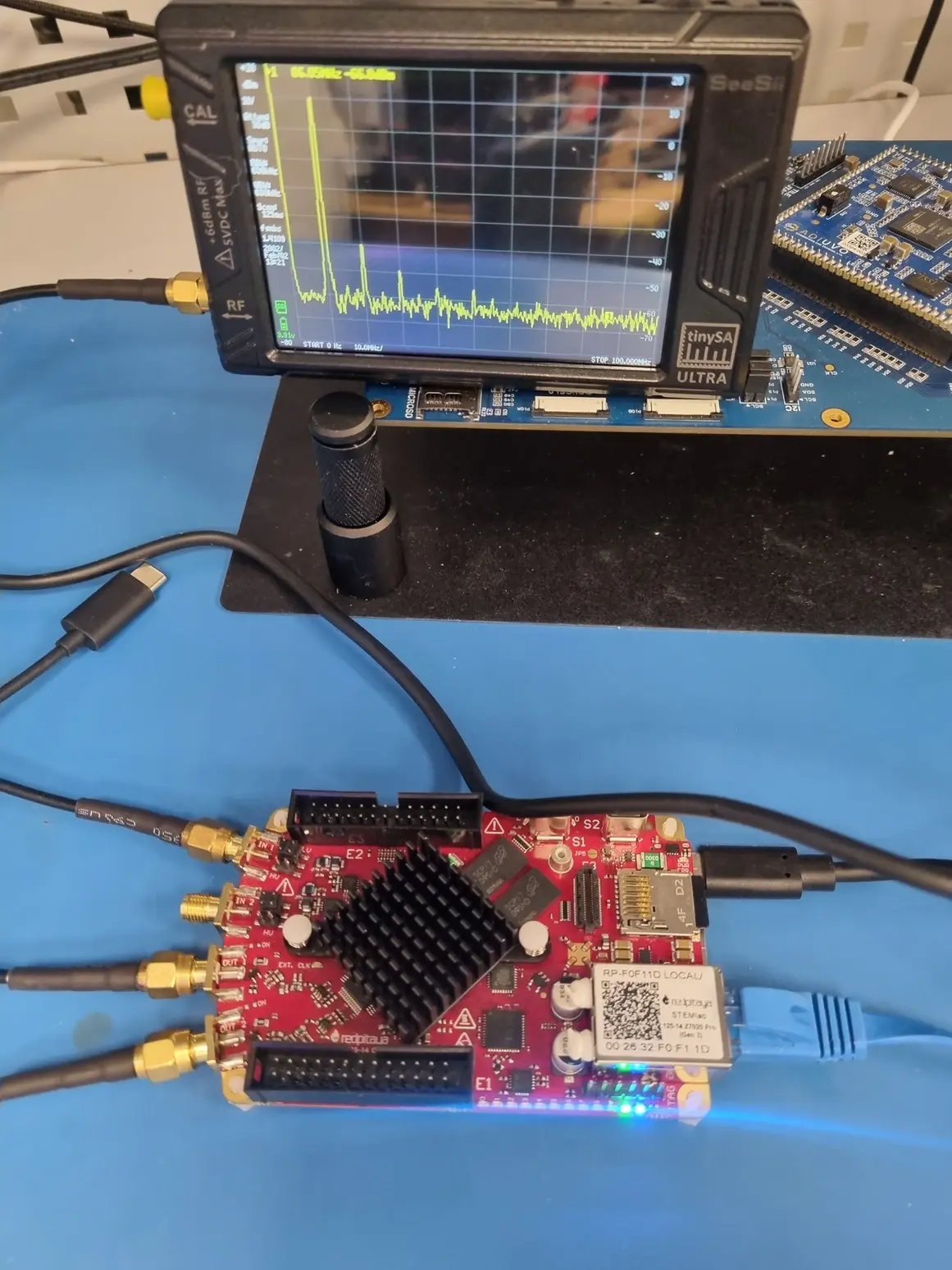
In his evaluation, Adam Taylor (MicroZed Chronicles) tested the Red Pitaya’s RF performance using a **Tiny Spectrum Analyzer (TinySA)**. Testing focused on fundamentals and harmonics at 10 MHz, 20 MHz, and 50 MHz.
- **DAC Performance:** Output testing revealed expected harmonics due to the onboard low-pass filter (approx. 50 MHz cutoff), suggesting that users generating lower-frequency signals may require additional external filtering for higher spectral purity.
- **ADC Characterization:** The front-end low-pass filter impact was clearly visible when generating 60 MHz tones, demonstrating the hardware's roll-off characteristics at the edge of its sampling Nyquist limit.
## Why This Matters for 2026
The shift toward **Software-Defined Instrumentation** is accelerating. The ability to take a design from Vitis Model Composer and deploy it directly onto the Red Pitaya's Zynq architecture enables engineers to build custom RF applications—like software-defined radios or quantum control systems—with significantly reduced development cycles.
**Read the full original article on MicroZed Chronicles:** [RF Signal Processing with Red Pitaya](https://www.adiuvoengineering.com/post/microzed-chronicles-rf-signal-processing)
---
## FAQ: RF Signal Processing with Red Pitaya
### **What is Vitis Model Composer?**
It is a toolset for MATLAB/Simulink that allows engineers to design FPGA-ready DSP algorithms using blocks that automatically generate HLS or HDL code.
### **Can Red Pitaya be used with Python?**
Yes. The Red Pitaya features a full Linux OS and a Python API, making it easy to control the ADCs and DACs for automated testing or data acquisition.
### **What is the sampling rate of the Red Pitaya STEMlab 125-14?**
It samples at 125 MSPS, making it suitable for RF signals up to approximately 50–60 MHz.
### About the Red Pitaya Team
The Red Pitaya Technical Editorial Team is a cross-functional group of technical communicators and product specialists. By synthesizing insights from our hardware developers and global research partners, we provide verified, high-value content that bridges the gap between open-source innovation and industrial-grade precision.
Our mission is to make advanced instrumentation accessible to engineers, researchers, and educators worldwide.
##### Categories
- [academia (47)](https://content.redpitaya.com/blog/tag/academia)
##### Recent Posts
- [](https://content.redpitaya.com/blog/non-invasive-gerd-detection-radiofrequency-spectrophotometry)
[Non-Invasive GERD Detection: Continuous Esophageal Monitoring via Radiofrequency Spectrophotometry](https://content.redpitaya.com/blog/non-invasive-gerd-detection-radiofrequency-spectrophotometry)
September 29, 2026
- [](https://content.redpitaya.com/blog/open-source-mri-console-ocra-marcos-red-pitaya)
[How a $500 Open-Source MRI Console Sparked a Global Research Ecosystem](https://content.redpitaya.com/blog/open-source-mri-console-ocra-marcos-red-pitaya)
September 22, 2026
- [](https://content.redpitaya.com/blog/zephyr-rtos-nordic-logic-analyzer-workshop-eestec-ljubljana)
[Probing the Wire: Red Pitaya & Zephyr RTOS Workshop with EESTEC](https://content.redpitaya.com/blog/zephyr-rtos-nordic-logic-analyzer-workshop-eestec-ljubljana)
September 17, 2026
##### Subscribe to our newsletter

An open-source solution for hobbyists, professors,
radio amateurs and industrial clients.
**Red Pitaya**
Velika pot 21,
5250 Solkan
Slovenia, Europe
Phone: +386 30 322 719
Email: [info@redpitaya.com](mailto:info@redpitaya.com)
**Red Pitaya US**
TX, Dallas - Downtown Republic Center
325 N. St. Paul Street
Suite 3100
Dallas, Texas, 75202
United States of America
IMPORTANT: This address does not accept RMAs
Phone: (888) 637-2706
Email: [US.office@redpitaya.com](mailto:US.office@redpitaya.com)
- Customer Service
- [Customer Support](https://redpitaya.com/customer-support/)
- [Shipping & Returns](https://redpitaya.com/shipping-returns/)
- [Contact us](https://redpitaya.com/contact-us/)
- [Cookie Policy](https://redpitaya.com/cookie-policy/)
- SLO
- [O nas](https://redpitaya.com/o-nas/)
- [Pogoji poslovanja](https://redpitaya.com/pogoji-poslovanja/)
- [Politika zasebnosti](https://redpitaya.com/politika-zasebnosti/)
- [Politika piškotkov](https://redpitaya.com/politika-piskotkov/)
##### Follow Us
#### Subscribe to our newsletter
Get notified about new SW features & updates, news about latest community projects & events and new Red Pitaya products & discounts
[Subscribe](https://go.redpitaya.com/cs/c/?cta_guid=36ccbdc0-0344-49c4-aa91-aa67cf437c09&signature=AAH58kHkxFYTAKU-ILQzHI1jlrdI_co0RA&placement_guid=a24cb732-1dfb-4d0a-8c52-aa6851ce9102&click=556cfaee-eee4-48e4-95e7-c483a4f78883&hsutk=537e15e740555d2fd6a1c1ad931d2b6f&canon=https%3A%2F%2Fredpitaya.com%2Fabout-us%2F&utm_referrer=https%3A%2F%2Fredpitaya.com%2Fcompare%2F&portal_id=7715357&redirect_url=APefjpGj5Dm9poAAzHFGh4S6pJ-2TvNzBdwZZlfbr7toxfw-epFUtzEHOKToHx0i2TYYr39srj9aSERdntJBh8lJqoSXL-pUF2gwhYvOW6IMm28hQVmhYML2AIbbIRrr3YaoyJkZQ0iRxq-uHlFt66i3_8XpQpXT_M2zF9fS7t0f6hlBjGBJ7X_aXDrhBwXcEAqwoWWleG4uxonSGOR-BBp3tpKcySXYELTGHeGn5Yo61r3xrFvqFP5P6BxVwxTi51_ceW9uBzOMvA1rYz4BsIhLSF8n4bhcHqJTvhibH_laJrjDNdEUUrU&__hstc=72355340.537e15e740555d2fd6a1c1ad931d2b6f.1635738083317.1635738083317.1635746314170.2&__hssc=72355340.5.1635746314170&__hsfp=530052575&contentType=standard-page)
**Red Pitaya** 2025 All Rights Reserved.
- [Privacy Policy](https://redpitaya.com/privacy-policy/)
- [Terms of Use](https://redpitaya.com/terms-of-use/)
```json
{
"@context" : "https://schema.org",
"@type" : "BlogPosting",
"author" : {
"@type" : "Person",
"name" : "Red Pitaya Technical Editorial Team",
"url" : "https://content.redpitaya.com/blog/author/red-pitaya-technical-editorial-team"
},
"dateModified" : "2026-03-17T15:23:57.954Z",
"datePublished" : "2026-03-17T15:23:57.000Z",
"headline" : "FPGA-Based RF Signal Processing: Exploring the Red Pitaya STEMlab 125-14",
"image" : [ "https://content.redpitaya.com/hubfs/blog%20featured%20image%20-%202026-03-11T120655.473.jpg" ],
"mainEntityOfPage" : {
"@id" : "https://content.redpitaya.com/blog/rf-signal-processing-red-pitaya-vitis-model-composer",
"@type" : "WebPage"
},
"publisher" : {
"@type" : "Organization",
"logo" : {
"@type" : "ImageObject",
"url" : "https://content.redpitaya.com/hubfs/Red-pitaya-logo.jpg"
},
"name" : "Red Pitaya d.o.o."
}
}
```