Overcoming software and hardware obsolescence to enable advanced upconversion nanoparticle (UCNP) characterization
In academic and industrial research laboratories alike, a frustrating bottleneck persists: high-quality optical and mechanical hardware is routinely forced into retirement. It is rarely the lenses, mirrors, or photomultiplier tubes (PMTs) that fail—instead, the culprit is the obsolescence of closed-source electronics, proprietary interface cards (such as ISA or PCI boards), and legacy software locked to dead operating systems like Windows 95.
For specialized research fields like Upconversion Nanoparticle (UCNP) characterization, this barrier is particularly acute. UCNP photophysical analysis requires time-consuming, power-dependent steady-state and time-resolved emission measurements that can easily monopolize standard shared equipment. When standard spectrofluorometers lack specific upconversion features, and purchasing a new custom multi-channel rig is financially prohibitive for niche research branches, the most viable alternative is hardware modernization.
A groundbreaking paper published in Nanoscale Advances by researchers at the University of Buenos Aires and CONICET details how they bypassed this limitation. The team successfully resurrected a 30-year-old Horiba PTI QuantaMaster 400 spectrofluorometer, transforming it from an inoperable legacy asset into a high-performance, open-source instrument capable of microsecond-resolution UCNP lifetime decay measurements using the Red Pitaya STEMlab 125-14.
The Challenge: Reverse-Engineering Legacy Instrumentation
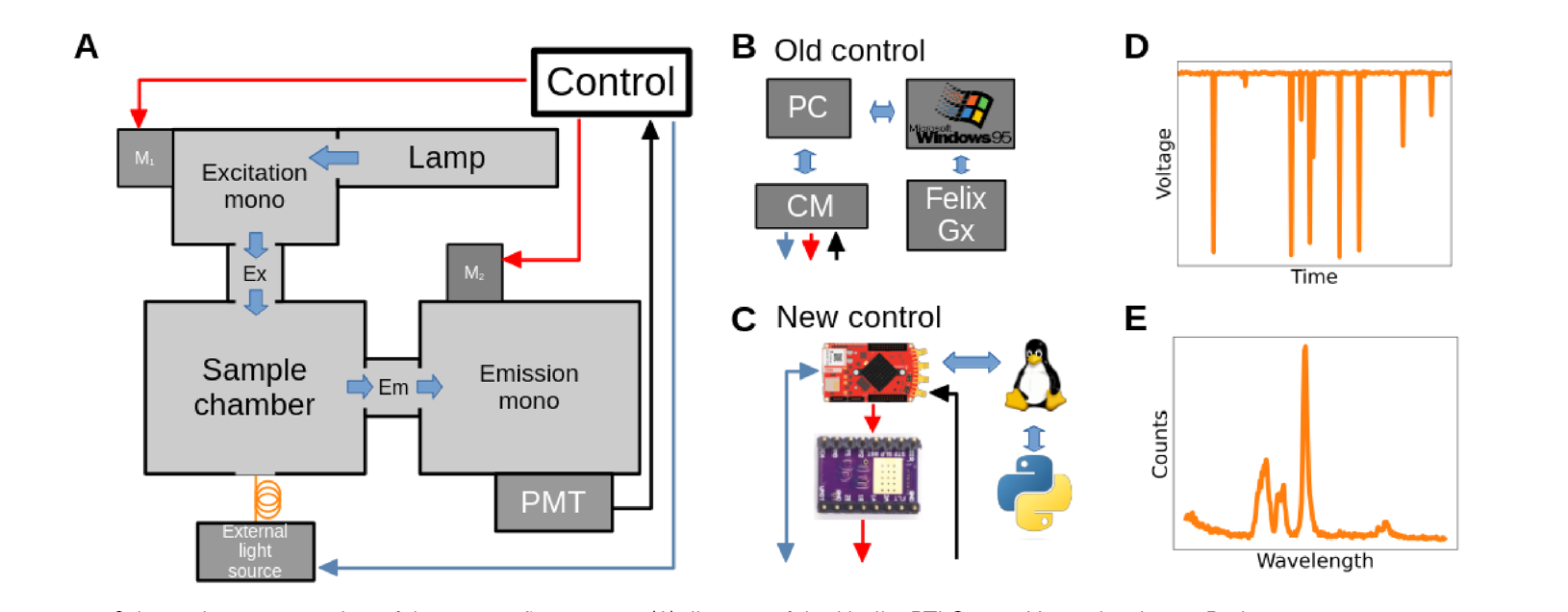
The original Horiba PTI QuantaMaster 400 was built around robust, industrial-grade optics, but its control layer relied on proprietary ISA interface boards and closed-source FelixGX software. To modernize the system without public wiring schematics, the engineering team executed a comprehensive reverse-engineering process.
They isolated the components built to last—the optics, the 75W xenon lamp casing, and the PMT detector (PTI 810)—and stripped out the bulky, obsolete control electronics.
To bring the device into the modern Linux ecosystem, the replacement control platform needed to fulfill three strict criteria:
- High-Speed Deterministic Digitization to capture the narrow electrical pulses generated by the PMT.
- Flexible Digital I/O to drive the monochromator stepper motors.
- Hardware-Software Programmability to automate dynamic upconversion testing protocols.
The Solution: STEMlab 125-14 as the Core Controller
The researchers replaced the entire legacy computer tower and control module with a single Red Pitaya STEMlab 125-14 board. The system architecture was split into distinct operational layers driven directly by Red Pitaya’s dual-core ARM Cortex-A9 processor and FPGA fabric:
- Real-Time Photon Counting: Photons hitting the PMT yield negative voltage pulses roughly 168 ns wide with a peak termination of −3.5 V into a 50 Ω load. To satisfy the Nyquist criterion for these fast transients while maximizing the 2MB memory buffer for an 8 ms integration window, the STEMlab’s 125 MS/s ADC was specifically configured to sample at 32.25 MHz.
- Precision Monochromator Drive: The original bulky motor drivers were replaced with compact DRV8825 stepper motor integrated circuits (ICs), directly commanded via the Red Pitaya’s digital I/O pins to drive the excitation and emission monochromator gratings (200 steps/rev, 0.5 nm resolution).
- Automated Laser Modulation: Because upconversion is a highly non-linear optical process, the team integrated an external 976 nm, 300 mW modulatable IR laser diode. The Red Pitaya provided the precise TTL timing synchronization needed to switch the laser source for time-resolved decay curves.
Results: Validated Performance at Microsecond Resolution
To validate the accuracy of the refurbished open-source platform, the team characterized synthesized β-NaYF4:Yb3+, ER 3+ upconversion nanoparticles.
The Red Pitaya-driven setup achieved precise technical benchmarks:
- Wavelength Fidelity: The static emission spectrum correctly mapped the sharp emission peaks of Er3+ ions across the UVA, blue, green, yellow, and red bands, matching data from expensive modern commercial systems.
- Dynamic Range & Power Laws: The instrument successfully plotted the non-linear log–log relationship IUC = Pα of upconversion intensity versus incident power density ranging from 16 to 80 mW cm-2.
- Time-Resolved Lifetime Precision: By utilizing pulsed laser excitation, the system recorded photon arrival time histograms and mapped monoexponential decay lifetimes ranging from around 25 to 400 microseconds. The total system jitter - encompassing the laser diode, PMT, and external circuitry - was determined to be just 2.4 microseconds, easily synchronized by the Red Pitaya.
The Open-Source Advantage: Scriptable Ecosystems
Beyond saving the core hardware from electronic waste, moving the spectrofluorometer to the Red Pitaya ecosystem introduced an entirely new capability: complete execution programmability.
Using Python libraries like NumPy and PyVISA alongside a custom Jupyter Widgets GUI hosted directly from the Red Pitaya’s internal Linux server, users can control the spectrofluorometer remotely over a network connection. Researchers now routinely run advanced automated scripts that acquire an upconversion emission spectrum, automatically locate the peaks, configure the monochromators, and instantly trigger the time-resolved lifetime measurement sequence without manual intervention.
For laboratories looking to open new avenues of research—such as upconversion spectroscopy, photodynamic therapies, or multi-photon polymerization—this framework proves that software-defined hardware can successfully bypass proprietary obsolescence, delivering high-tier diagnostic capabilities at a fraction of the cost of new systems.
Technical FAQ
How does Red Pitaya handle photon counting without dedicated nuclear instrumentation modules?
The STEMlab 125-14 utilizes high-speed 14-bit ADCs. By sampling the PMT output at 32.25 MHz, the software can accurately capture the 168 ns wide voltage pulses, applying a deterministic digital threshold to count individual photon arrivals within an 8 ms memory buffer window.
Did the custom motor driver modification disrupt the wavelength calibration?
No. By driving the original 200-step-per-revolution stepper motors via the Red Pitaya’s digital I/O pins and leveraging the original electromechanical limit switches for boundary verification, the system maintained its native 0.5 nm resolution and calibration.
Why is an FPGA-based SoC required for time-resolved UCNP measurements?
UCNP lifetime measurements depend on precise timing synchronization between the excitation source trigger (TTL laser pulse) and the photon arrival detection at the PMT. Standard desktop operating systems introduce non-deterministic latency (jitter). The Red Pitaya’s FPGA handles this timing synchronization deterministically, ensuring that the acquisition is not bottlenecked by OS interruptions, allowing the researchers to accurately measure a total system jitter of 2.4 microseconds.
About the Red Pitaya Team
The Red Pitaya Technical Editorial Team is a cross-functional group of technical communicators and product specialists. By synthesizing insights from our hardware developers and global research partners, we provide verified, high-value content that bridges the gap between open-source innovation and industrial-grade precision.
Our mission is to make advanced instrumentation accessible to engineers, researchers, and educators worldwide.

 September 22, 2026
 September 17, 2026