


Bypassing vendor-locked instrumentation to capture real-time, non-invasive continuous hemodynamic waveforms.
Developing medical technologies for continuous, non-invasive blood pressure monitoring presents a significant engineering challenge. Traditional blood pressure cuffs only offer intermittent, static metrics, completely missing the crucial diagnostic data hidden within continuous hemodynamic waveforms. To capture these dynamics non-invasively, medical device engineers are turning to high-frequency ultrasound to track the microsecond-level expansion and contraction of arterial walls.
However, building a functional, high-resolution ultrasound research setup typically requires incredibly expensive, closed-source desktop instrumentation or rigid, high-latency laboratory digitizer cards. These traditional platforms create major bottlenecks during rapid prototyping because they lack the embedded processing power to stream deterministic real-time data efficiently over local networks.
To overcome these structural limitations, the TONUS project team at ETH Zurich developed an innovative, open-architecture ultrasound test rig. By leveraging the Red Pitaya STEMlab 125-14, the team successfully engineered a high-precision sensor chain capable of capturing dynamic arterial diameter traces with sub-10-micrometer resolution at over 100 acquisitions per second.
The Biophysical Measurement Challenge: Resolving Fast Echo Transients
To map an arterial diameter change into a continuous pressure waveform calculation, a monitoring system must independently track the instantaneous positions of both the front and back walls of the artery during each heartbeat.
When acoustic waves travel through soft tissue, a portion of the wave reflects back toward the transducer whenever it encounters a change in acoustic impedance, such as at the tissue-artery interface. At an average speed of sound in soft tissue (approximately 1540 meters per second), the round-trip travel time for echoes bouncing off an artery with a 5 mm diameter is a mere 6 to 7 microseconds.
Capturing these ultra-fast, low-voltage transient echoes requires an instrumentation architecture that solves two critical hardware bottlenecks simultaneously:
- Extreme Dynamic Range Variance: The ultrasound echo returning from the far wall of a blood vessel is typically 20 dB to 40 dB weaker than the echo reflected from the near wall. If the digitization hardware lacks sufficient resolution, the near echo will saturate the analog-to-digital converter (ADC), or the far echo will completely vanish into the quantization noise floor.
- Deterministic Timing Constraints: To accurately track the dicrotic notch and slow diastolic decay of a pulse wave, raw data acquisition must be tightly synchronized with the acoustic transmitter pulse at the nanosecond level to prevent clock drift from distorting the spatial calculations.
Validating the Sensor Chain: The Forearm Phantom Test Rig
To rigorously evaluate the system before moving to human trials, the engineering team constructed a sophisticated laboratory biomechanical environment. This setup allows researchers to simulate human cardiovascular variables with absolute repeatability.
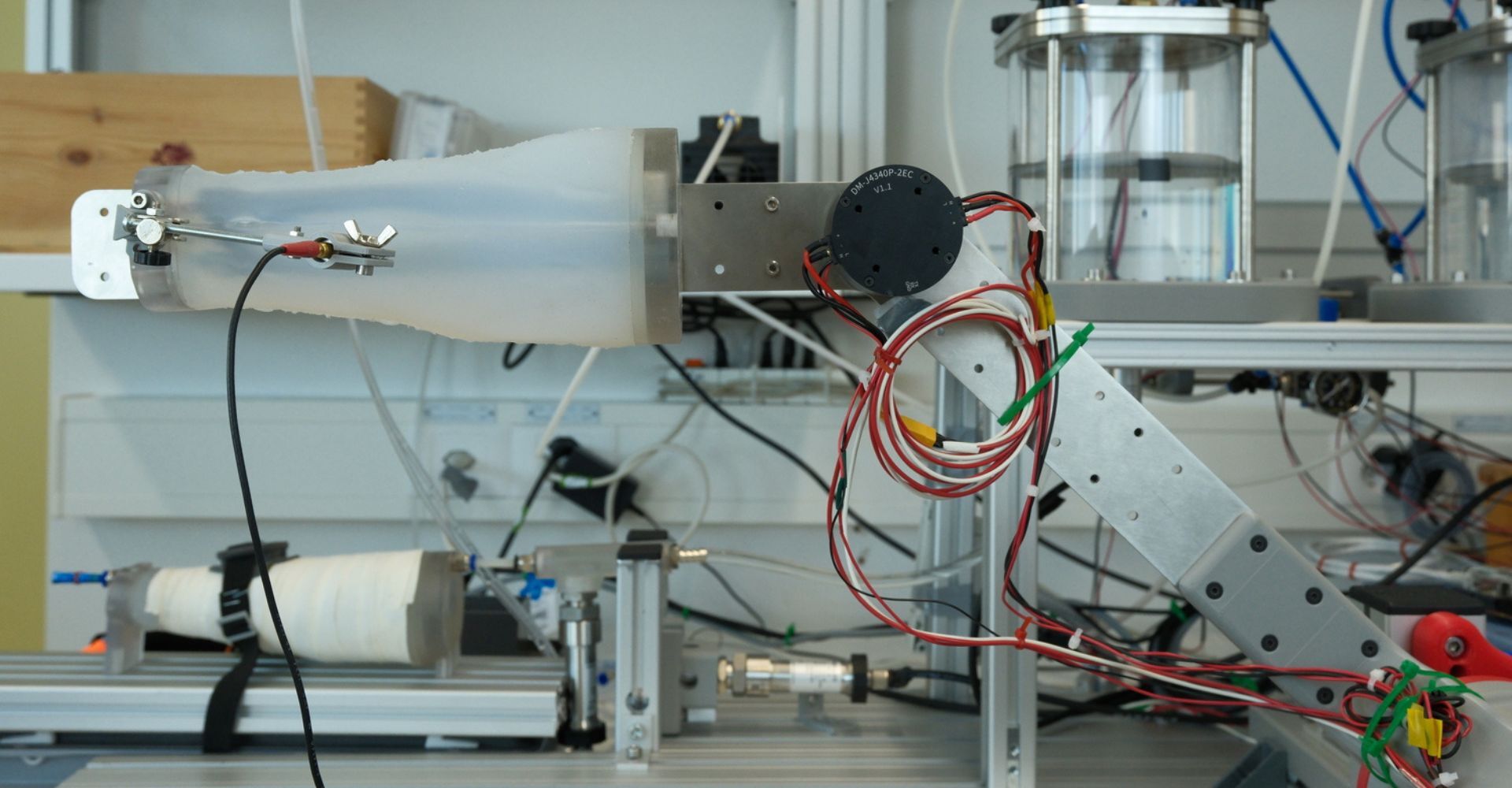
A look at the TONUS project testing setup, demonstrating the silicone forearm phantom model and the multi-component test rig used to reproduce physiological blood pressure curves with an accuracy of a few hundred Pascals.
As shown in the video demonstration above, the setup utilizes a realistic structural phantom of a human forearm embedded with a flexible synthetic artery. This phantom is integrated directly into a comprehensive test rig comprising high-precision components sourced internationally—including proportional pressure control valves, digital pressure sensors, and specialized fluid tanks. The rig generates blood pressure curves with an operational accuracy within a few hundred Pascals, providing the exact ground-truth values required to benchmark the ultrasound sensor chain.
The Architecture: End-to-End Ultrasound Signal Acquisition Chain
The complete data acquisition loop acts as a high-speed link between analog acoustic echoes and digital signal processing software. The system shifts seamlessly between high-voltage wave excitation and real-time data streaming.
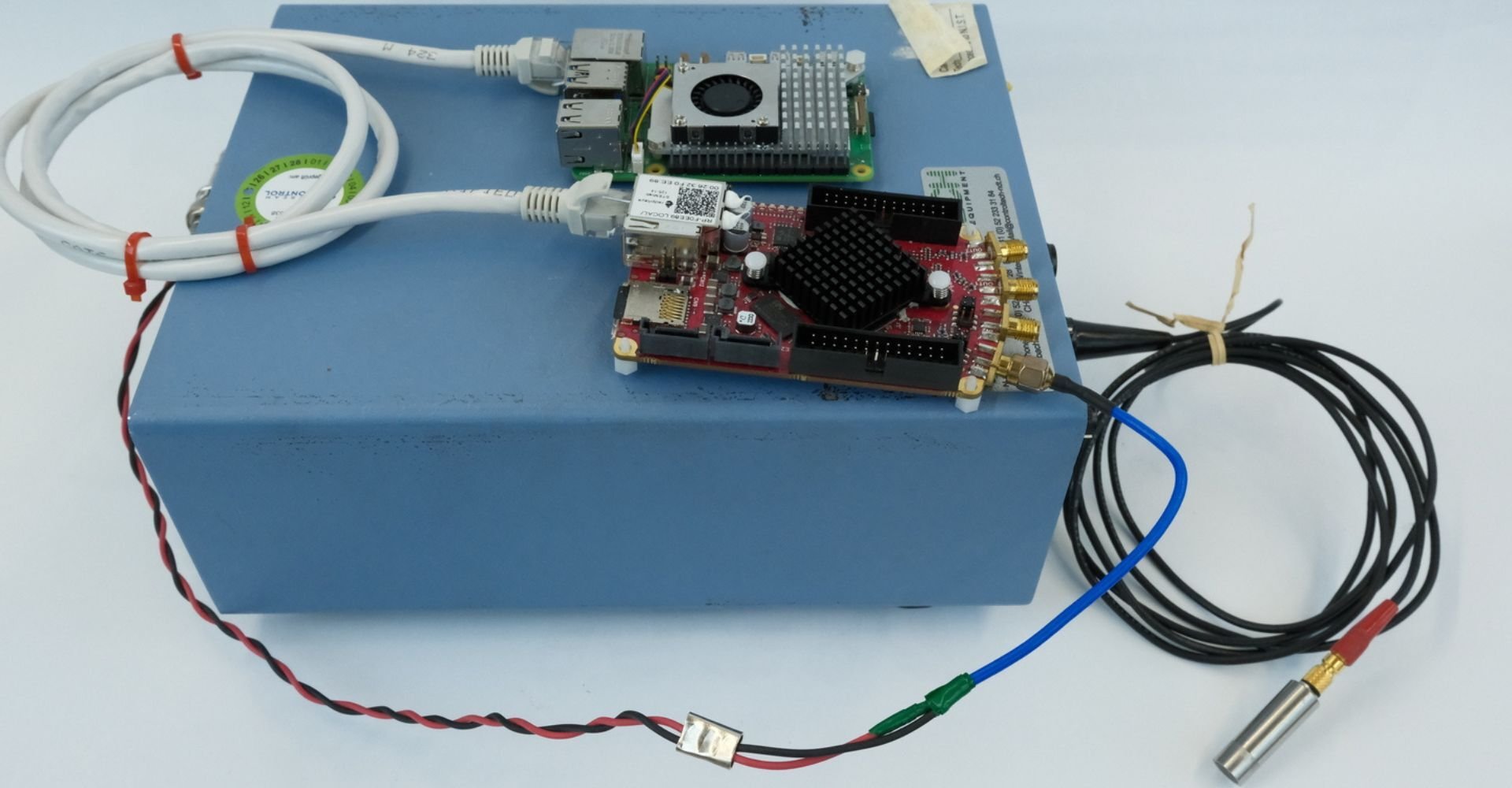
Technical overview of the ultrasonic measurement loop, illustrating how raw analog voltage echoes are routed through the pulser/receiver transmit/receive switch directly into the Red Pitaya for digitization.
The architecture operates across three fully integrated hardware and firmware layers, following the workflow shown in the electronic signal path:
Dual-Channel 14-bit Digitization
The ultrasound tracking chain uses a 10 MHz single-element transducer probe excited by an Olympus 5072PR precision pulser/receiver. As demonstrated in the video above, the pulser/receiver fires a short, intense voltage spike to vibrate the transducer, then immediately triggers an internal transmit/receive switch into receive mode. The returning low-voltage echoes are routed directly into the Red Pitaya board's dual 14-bit ADC channels sampling at 125 MSPS (one sample every 8 nanoseconds). This provides a native one-way spatial resolution of approximately 6 micrometers per sample, establishing a massive safety margin against high-frequency thermal noise while resolving both the near and far arterial walls simultaneously without signal clipping.
Nanosecond-Deterministic Firmware Triggering
Every time the Olympus instrument fires an impulse, it simultaneously emits a hardware transistor-transistor logic (TTL) trigger pulse. The Red Pitaya’s onboard Xilinx FPGA detects this incoming edge with nanosecond determinism, instantly initiating a raw data acquisition sequence across predefined parameter windows with zero software-induced operating system jitter.
Embedded UDP Data Streaming
Instead of relying on slow, buffered data transfers, a custom C application running on the Red Pitaya’s embedded ARM cortex processor interacts directly with the board's open-source C API (rp.h). The application reads the direct memory access (DMA) buffers immediately upon capture, packages the raw RF data frames (roughly 8,000 samples per pulse) into lightweight UDP datagrams, and streams them over Gigabit Ethernet directly to a master computer. This streamlined pipeline sustains over 100 complete acoustic acquisitions per second in near real-time.
Experimental Validation: Sub-10-Micrometer Tracking Precision
When evaluated on the physiological silicone phantom, the Red Pitaya ultrasound sensor chain delivered exceptional signal clarity and tracing stability.
Depending on the programmed pressure amplitudes driven by the test rig's valve matrix, the setup recorded clear peak-to-peak arterial diameter excursions ranging from 0.4 mm to 1.0 mm per simulated cardiac cycle.
At a constant resting diameter, the tracking algorithms achieved a baseline measurement standard deviation of below 0.01 mm (10 micrometers). This extreme precision delivers a signal-to-noise ratio (SNR) of approximately 40:1 against typical arterial pulsations, ensuring that fine-grained physiological waveform details—such as the dicrotic notch and structural diastolic decay curves—are captured far above the system noise floor. Crucially, the acquisition rate of over 100 measurements per second oversamples a resting cardiac cycle by a factor of roughly 60, allowing the team to validate complex delta-diameter to delta-pressure models.
Expanding the Horizon of Medical Device Prototyping
The success of the TONUS project underscores a broader structural shift in biomedical engineering instrumentation. Compared to traditional vendor-locked benchtop digitizers or high-cost PCI DAQ cards, open-source SoC platforms like the Red Pitaya STEMlab 125-14 offer hardware developers an optimal combination of low-latency performance, complete software accessibility, and low cost.
By moving away from rigid, proprietary instrumentation architectures, research institutions and medical device innovators can easily implement customized, real-time edge-processing algorithms directly at the hardware layer. This approach shortens the development cycle for advanced sensor fusion applications, bringing the next generation of continuous, non-invasive health monitoring systems to reality faster than ever before.
Red Pitaya FAQ for Biomedical Engineers
Why choose an embedded open SoC over a standard lab PC with a high-speed PCIe digitizer card?
PCIe digitizer cards require complex desktop environments and driver stacks that introduce non-deterministic software latency. This overhead can cause dropped frames during high repetition-rate acoustic pulse sequences. An embedded platform like Red Pitaya combines high-speed ADCs with programmable FPGA logic, allowing you to capture triggers with nanosecond determinism and stream pre-processed packets directly over standard network protocols.
How does the system resolve the 20–40 dB signal attenuation difference between the front and back arterial walls?
This is achieved by utilizing the STEMlab's true 14-bit dynamic range. A 14-bit ADC offers 16,384 distinct quantization levels. This fine granularity allows the system to resolve the weaker far-wall echo without needing complex time-gained amplification (TGC) circuits, preventing the highly intense near-wall echo from saturating the input channel.
Can this Red Pitaya ultrasound pipeline handle real-time edge processing on the board itself?
Yes, the hardware inherently supports it. While the specific TONUS pipeline features high computational complexity that requires external processing (streaming raw UDP datagrams to a host computer), the onboard Xilinx FPGA and ARM processor give developers the flexibility to deploy alternative, lightweight DSP code (such as digital filtering, envelope detection, or threshold peak-tracking) directly on the device for standalone applications.
Recent Posts
-
-
 September 22, 2026
 -
 September 17, 2026