---
title: "Scalable and Portable Fast Neutron Detection: Dual-Channel SiPM Readout with Red Pitaya FPGA DAQ"
description: Discover how Giessen University researchers built a USB-powered, compact fast neutron detector with dual-channel SiPMs and Red Pitaya FPGA DAQ.
image: https://content.redpitaya.com/hubfs/blog%20featured%20image%20-%202026-08-24T092005.711.jpg
---
[](https://redpitaya.com/)
[](https://redpitaya.com/)
- Products
- [STEMlab 125-14 Gen 2](https://redpitaya.com/stemlab-125-14-gen2/)
- [STEMlab 125-14](https://redpitaya.com/stemlab-125-14/)
- [SIGNALlab 250-12](https://redpitaya.com/signallab-250-12/)
- [SDRlab 122-16](https://redpitaya.com/sdrlab-122-16/)
- [STEMlab TI (Texas Instruments)](https://redpitaya.com/stemlab-ti-texas-instruments/)
- [Multi-channel Solutions](https://redpitaya.com/multi-channel-solutions/)
- [Accessories](https://redpitaya.com/accessories/)
- [Applications](https://redpitaya.com/applications/)
- Documentation
- [Technical Documentation](https://redpitaya.com/documentation/)
- [Teaching materials](https://redpitaya.com/teaching-materials/)
- [Student projects](https://redpitaya.com/student-projects/)
- [User forum](https://forum.redpitaya.com/)
- [About](https://redpitaya.com/about-us/)
- [History](https://redpitaya.com/history/)
- [Distributors](https://redpitaya.com/distibutors-red-pitaya/)
- [Blog](https://content.redpitaya.com/blog)
[Shop](https://redpitaya.com/shop/)
- [ACADEMIA](https://redpitaya.com/academia/)
- [RADIO AMATEURS](https://redpitaya.com/radio-amateurs/)
- [Home](https://redpitaya.com/)
- Products
- [STEMlab 125-10](https://redpitaya.com/stemlab-125-10/)
- [STEMlab 125-14](https://redpitaya.com/stemlab-125-14/)
- [SIGNALlab 250-12](https://redpitaya.com/signallab-250-12/)
- [SDRlab 122-16](https://redpitaya.com/sdrlab-122-16/)
- [Accessories](https://redpitaya.com/accessories/)
- [Applications](https://redpitaya.com/applications/)
- [Resources](https://redpitaya.com/documentation/)
- [Shop](https://redpitaya.com/shop/)
- [About](https://redpitaya.com/about-us/)
- [Blog](https://content.redpitaya.com/blog)
- [Compare](https://redpitaya.com/compare/)
- [Login / Register](https://redpitaya.com/my-account/)
### Red Pitaya Blog
[Home](https://redpitaya.com) » [Academia](https://content.redpitaya.com/blog/tag/academia), [Case study](https://content.redpitaya.com/blog/tag/case-study) »
[Academia](https://content.redpitaya.com/blog/tag/academia), [Case study](https://content.redpitaya.com/blog/tag/case-study)
# Scalable and Portable Fast Neutron Detection: Dual-Channel SiPM Readout with Red Pitaya FPGA DAQ
- Posted by  [Red Pitaya Technical Editorial Team](https://redpitaya.com/Red-Pitaya-Blog-team/) , September 8, 2026
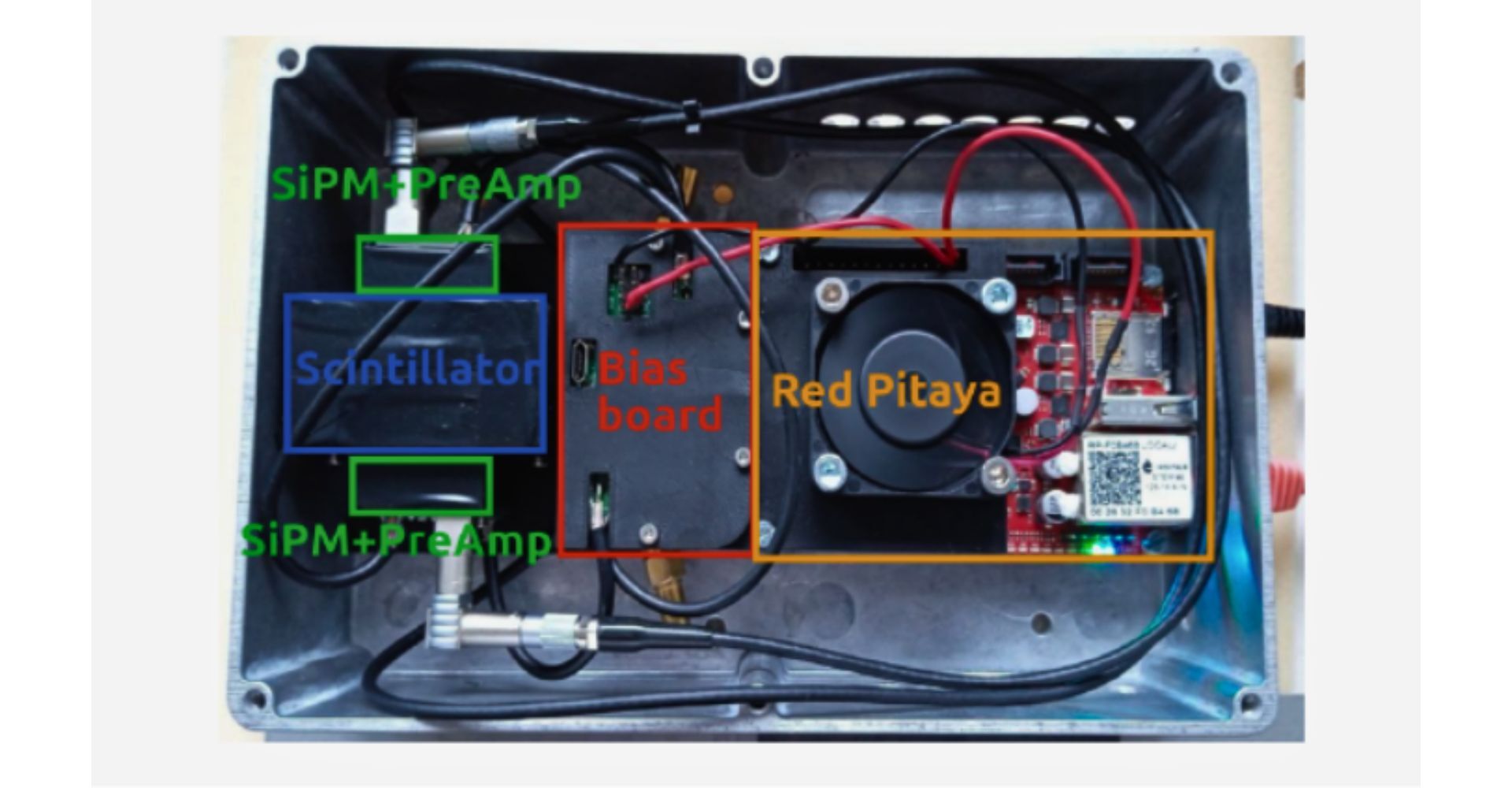
**How researchers at Justus Liebig University Giessen combined plastic scintillators, dual SiPM geometries, and Red Pitaya’s FPGA platform to replace bulky photomultiplier tubes for in-situ** 𝒏/𝜸 **discrimination.**
Fast neutron detection is essential across nuclear physics, homeland security, medical imaging, and subsurface logging. However, distinguishing fast neutrons from strong background gamma radiation in mixed radiation fields remains a major engineering challenge.
Traditionally, fast neutron detection relies on liquid scintillators or stilbene crystals coupled to bulky photomultiplier tubes (PMTs). These legacy systems require delicate glass housings, hazardous liquid handling, multi-kilovolt high-voltage power supplies, and rack-mounted benchtop Data Acquisition (DAQ) systems.
In a landmark study published in the *Journal of Instrumentation* (JINST 21 P07005), researchers **Dzmitry Kazlou, Roman Bergert, Hans-Georg Zaunick, and Kai-Thomas Brinkmann** at the 2nd Physics Institute of **Justus Liebig University Giessen** demonstrated a compact, portable, and low-cost alternative. Powered by the **Red Pitaya STEMlab 125-14** system-on-chip (SoC), their open-source detector achieves high-resolution Pulse Shape Discrimination (PSD) while operating off a single **+5 V USB power source**.
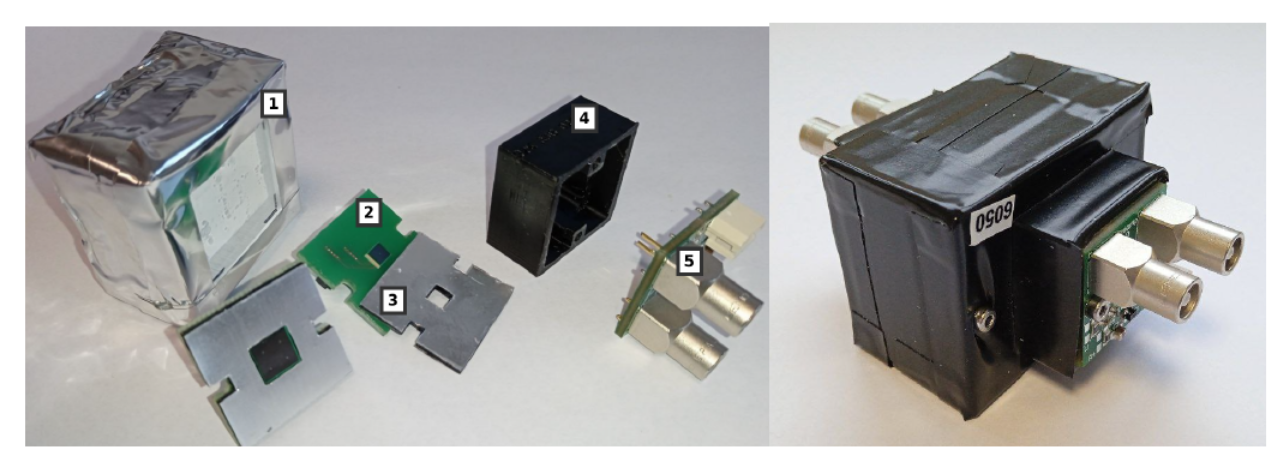 
*Detector building blocks consisting of scintillator (1) wrapped in PTFE and reflective foil, SiPM PCB (2) with levelling mask (3), preamplifier (5) with 3D-printed holder (4, left) and fully assembled detector head (right).*
## **The Engineering Challenge: Reconciling Dynamic Range and Low-Energy Sensitivity**
In fast neutron detection, neutrons undergo elastic scattering off hydrogen nuclei in organic plastic scintillators (such as EJ-276D), creating recoil protons that emit light pulses with distinct decay times compared to gamma-induced electron recoils.
When replacing fragile PMTs with solid-state Silicon Photomultipliers (SiPMs), instrumentation engineers face two conflicting constraints:
1. **High Sensitivity for Low Energy Deposits:** Detecting weak gamma emissions and low-energy recoil protons requires a large active SiPM area and high Photon Detection Efficiency (PDE).
2. **High Dynamic Range for Large Energy Deposits:** High-energy protons produce intense scintillation light that saturates standard SiPM microcells, destroying pulse shape information.
## **System Architecture: Dual-Channel Readout & USB-Powered Hardware**
To resolve this trade-off, the Giessen research group implemented a **dual-channel readout strategy** using two complementary Hamamatsu SiPMs on a single EJ-276D plastic scintillator (3.2×3.2×2 cm3).
**1. Dual-Geometry SiPM Sensor Pair**
- **Channel 1 (High Sensitivity):** Uses a Hamamatsu S14160-6050HS (6×6 mm2 area, 14,331 cells, 50 µm cell pitch, 50% PDE). Optimized for energies between 0 and 8 MeVee (electron equivalent).
- **Channel 2 (High Dynamic Range):** Uses a Hamamatsu S14160-3010PS (3×3 mm2 area, 89,984 microcells, 10 µm cell pitch). Provides an enormous cell density that extends linear measurement capability well above 100 MeVee without saturation.
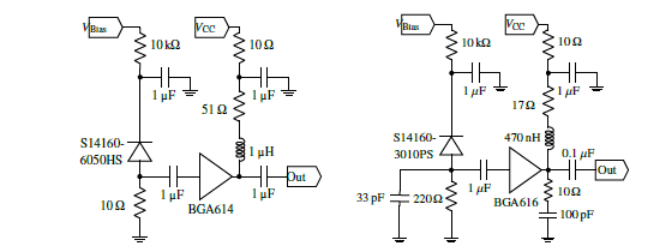 
*Schematics of SiPM preamplifiers matched to Hamamatsu S14160-6050HS (left) and S14160-3010PS (right).*
**2. Impedance-Matched MMIC Preamplifiers**
To match the fast pulse decay times of SiPMs to the 8 ns sampling resolution of the Red Pitaya’s onboard 125 MSps 14-bit ADCs, custom broadband amplifiers were designed using Infineon BGA61x MMICs and simulated in LTSpice. The circuits shape pulses to eliminate ringing and overshoot while optimizing the Signal-to-Noise Ratio (SNR).
**3. Integrated +43V SiPM Power Supply**
Instead of relying on external high-voltage power supplies, the team integrated a custom DC/DC converter PCB based on the LT8362 IC. Powered directly from the **+5 V pin on the Red Pitaya GPIO header**, the converter generates the +43 V bias voltage required for the SiPMs. The entire detector head and readout stack operate off standard USB power.
## **Data Acquisition & Real-Time Pulse Shape Discrimination (PSD)**
The Red Pitaya FPGA fabric was configured with open-source firmware to perform high-speed Direct Memory Access (DMA) transfer into circular buffers within the Zynq SoC’s DDR memory.
**Pulse Shape Discrimination Parameter:**
Pulse Shape Discrimination separates neutron events from gamma events by comparing the partial (short-gate) integral (Qs) to the total pulse integral (Ql):
PSD=1−Qs/Ql
- **Recoil Protons (Neutrons):** Exhibit a longer scintillation tail, meaning less relative light is contained in the short gate (smaller (smaller Qs), yielding higher PSD values.
- **Compton Electrons (Gammas):** Exhibit rapid pulse decay meaning almost all light is captured in the short gate (larger Qs) yielding lower PSD values.
By systematically scanning parameter space, the team determined an optimal short-gate duration of 12 clock cycles (96 ns from peak amplitude) to maximize n/𝛾 separation.
**Benchmark Results: Benchmarking** 𝒏/𝜸 **Discrimination**
The system was evaluated using standard laboratory neutron sources (252Cf, Ra-Be, and Am-Be) alongside gamma calibration sources (22Na,137Cs,207Bi,90Sr).
## **Key Experimental Findings:**
**1. Figure of Merit (FoM) of 1.61:** In the 2.75--3.0 MeVee energy window, the detector achieved an FoM of **1.61**, proving clean separation between neutron and gamma bands comparable to conventional benchtop setups.
2\. **5,000 Events/Second Throughput:** The custom FPGA logic and C++ server handle event rates up to 5000 s−1 with a total system dead time of 196.61 μs.
**3. On-Server Histogramming Mode:** The software service operates either by streaming raw digitized traces or by computing online baselines, peak amplitudes, and charge integrals directly on the embedded ARM processor—drastically reducing network data transmission overhead. 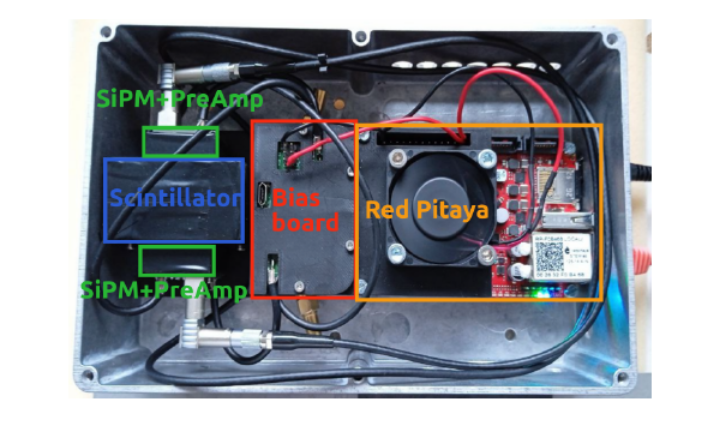
*Compact solution of the final detector setup.*
## **Technical FAQ for Nuclear Instrumentation & Radiation Shielding Engineers**
### **How is energy calibration performed when plastic scintillators lack photopeaks?**
Because plastic organic scintillators like EJ-276D have a low effective atomic number (*Z*), gamma ray interactions are dominated by Compton scattering rather than photoelectric absorption. Consequently, no distinct gamma photopeaks appear in the spectrum. Energy calibration is achieved by fitting the **Compton edge** using numerical differentiation and an error-function fit (Erfc) across standard sources 22Na, 137Cs, 207Bi, establishing an electron-equivalent energy scale (MeVee).
**Why are two different SiPM models required for a single plastic scintillator block?**
A single SiPM cannot simultaneously offer high gain for sub-MeV gamma detection and avoid microcell saturation during multi-MeV proton recoil pulses. The high-sensitivity SiPM (50 𝜇m pitch, 14,331 cells) captures faint pulses from 0 to 8 MeVee, while the high-density SiPM (10 𝜇m pitch, 89,984 cells) prevents saturation and extends measurement capabilities above 100 MeVee.
**How does the Red Pitaya DAQ overcome the default firmware split-trigger bug?**
The stock firmware provided with some default SoC configurations exhibits a sequential channel capture bug when operating in split-trigger mode. The Giessen researchers authored custom open-source FPGA firmware that restores simultaneous dual-channel sampling, ensuring exact temporal alignment between high-sensitivity and high-dynamic-range channels.
**Reference & Open-Source Code**
- **Original Publication:** D. Kazlou et al., *"Red Pitaya DAQ for fast neutron detection: a scalable, compact and low-cost solution,"* JINST 21 P07005 (2026).
- **Open-Source Repository:** Access the custom Red Pitaya FPGA bitstream, C++ server code, and ROOT analysis scripts on [GitHub (DrKazlou)](https://github.com/DrKazlou/).
### About the Red Pitaya Team
The Red Pitaya Technical Editorial Team is a cross-functional group of technical communicators and product specialists. By synthesizing insights from our hardware developers and global research partners, we provide verified, high-value content that bridges the gap between open-source innovation and industrial-grade precision.
Our mission is to make advanced instrumentation accessible to engineers, researchers, and educators worldwide.
##### Categories
- [academia (47)](https://content.redpitaya.com/blog/tag/academia)
##### Recent Posts
- [](https://content.redpitaya.com/blog/non-invasive-gerd-detection-radiofrequency-spectrophotometry)
[Non-Invasive GERD Detection: Continuous Esophageal Monitoring via Radiofrequency Spectrophotometry](https://content.redpitaya.com/blog/non-invasive-gerd-detection-radiofrequency-spectrophotometry)
September 29, 2026
- [](https://content.redpitaya.com/blog/open-source-mri-console-ocra-marcos-red-pitaya)
[How a $500 Open-Source MRI Console Sparked a Global Research Ecosystem](https://content.redpitaya.com/blog/open-source-mri-console-ocra-marcos-red-pitaya)
September 22, 2026
- [](https://content.redpitaya.com/blog/zephyr-rtos-nordic-logic-analyzer-workshop-eestec-ljubljana)
[Probing the Wire: Red Pitaya & Zephyr RTOS Workshop with EESTEC](https://content.redpitaya.com/blog/zephyr-rtos-nordic-logic-analyzer-workshop-eestec-ljubljana)
September 17, 2026
##### Subscribe to our newsletter

An open-source solution for hobbyists, professors,
radio amateurs and industrial clients.
**Red Pitaya**
Velika pot 21,
5250 Solkan
Slovenia, Europe
Phone: +386 30 322 719
Email: [info@redpitaya.com](mailto:info@redpitaya.com)
**Red Pitaya US**
TX, Dallas - Downtown Republic Center
325 N. St. Paul Street
Suite 3100
Dallas, Texas, 75202
United States of America
IMPORTANT: This address does not accept RMAs
Phone: (888) 637-2706
Email: [US.office@redpitaya.com](mailto:US.office@redpitaya.com)
- Customer Service
- [Customer Support](https://redpitaya.com/customer-support/)
- [Shipping & Returns](https://redpitaya.com/shipping-returns/)
- [Contact us](https://redpitaya.com/contact-us/)
- [Cookie Policy](https://redpitaya.com/cookie-policy/)
- SLO
- [O nas](https://redpitaya.com/o-nas/)
- [Pogoji poslovanja](https://redpitaya.com/pogoji-poslovanja/)
- [Politika zasebnosti](https://redpitaya.com/politika-zasebnosti/)
- [Politika piškotkov](https://redpitaya.com/politika-piskotkov/)
##### Follow Us
#### Subscribe to our newsletter
Get notified about new SW features & updates, news about latest community projects & events and new Red Pitaya products & discounts
[Subscribe](https://go.redpitaya.com/cs/c/?cta_guid=36ccbdc0-0344-49c4-aa91-aa67cf437c09&signature=AAH58kHkxFYTAKU-ILQzHI1jlrdI_co0RA&placement_guid=a24cb732-1dfb-4d0a-8c52-aa6851ce9102&click=556cfaee-eee4-48e4-95e7-c483a4f78883&hsutk=537e15e740555d2fd6a1c1ad931d2b6f&canon=https%3A%2F%2Fredpitaya.com%2Fabout-us%2F&utm_referrer=https%3A%2F%2Fredpitaya.com%2Fcompare%2F&portal_id=7715357&redirect_url=APefjpGj5Dm9poAAzHFGh4S6pJ-2TvNzBdwZZlfbr7toxfw-epFUtzEHOKToHx0i2TYYr39srj9aSERdntJBh8lJqoSXL-pUF2gwhYvOW6IMm28hQVmhYML2AIbbIRrr3YaoyJkZQ0iRxq-uHlFt66i3_8XpQpXT_M2zF9fS7t0f6hlBjGBJ7X_aXDrhBwXcEAqwoWWleG4uxonSGOR-BBp3tpKcySXYELTGHeGn5Yo61r3xrFvqFP5P6BxVwxTi51_ceW9uBzOMvA1rYz4BsIhLSF8n4bhcHqJTvhibH_laJrjDNdEUUrU&__hstc=72355340.537e15e740555d2fd6a1c1ad931d2b6f.1635738083317.1635738083317.1635746314170.2&__hssc=72355340.5.1635746314170&__hsfp=530052575&contentType=standard-page)
**Red Pitaya** 2025 All Rights Reserved.
- [Privacy Policy](https://redpitaya.com/privacy-policy/)
- [Terms of Use](https://redpitaya.com/terms-of-use/)
```json
{
"@context" : "https://schema.org",
"@type" : "BlogPosting",
"author" : {
"@type" : "Person",
"name" : "Red Pitaya Technical Editorial Team",
"url" : "https://content.redpitaya.com/blog/author/red-pitaya-technical-editorial-team"
},
"dateModified" : "2026-09-08T08:30:00.242Z",
"datePublished" : "2026-09-08T08:30:00.000Z",
"headline" : "Scalable and Portable Fast Neutron Detection: Dual-Channel SiPM Readout with Red Pitaya FPGA DAQ",
"image" : [ "https://content.redpitaya.com/hubfs/blog%20featured%20image%20-%202026-08-24T092005.711.jpg" ],
"mainEntityOfPage" : {
"@id" : "https://content.redpitaya.com/blog/scalable-compact-fast-neutron-detection-red-pitaya-sipm",
"@type" : "WebPage"
},
"publisher" : {
"@type" : "Organization",
"logo" : {
"@type" : "ImageObject",
"url" : "https://content.redpitaya.com/hubfs/Red-pitaya-logo.jpg"
},
"name" : "Red Pitaya d.o.o."
}
}
```