---
title: "Non-Invasive GERD Detection: Continuous Esophageal Monitoring via Radiofrequency Spectrophotometry"
description: Discover how radiofrequency spectrophotometry enables continuous, non-invasive GERD monitoring by measuring esophageal liquid flow and ionic conductivity.
image: https://content.redpitaya.com/hubfs/blog%20featured%20image%20-%202026-09-17T104035.026.jpg
---
[](https://redpitaya.com/)
[](https://redpitaya.com/)
- Products
- [STEMlab 125-14 Gen 2](https://redpitaya.com/stemlab-125-14-gen2/)
- [STEMlab 125-14](https://redpitaya.com/stemlab-125-14/)
- [SIGNALlab 250-12](https://redpitaya.com/signallab-250-12/)
- [SDRlab 122-16](https://redpitaya.com/sdrlab-122-16/)
- [STEMlab TI (Texas Instruments)](https://redpitaya.com/stemlab-ti-texas-instruments/)
- [Multi-channel Solutions](https://redpitaya.com/multi-channel-solutions/)
- [Accessories](https://redpitaya.com/accessories/)
- [Applications](https://redpitaya.com/applications/)
- Documentation
- [Technical Documentation](https://redpitaya.com/documentation/)
- [Teaching materials](https://redpitaya.com/teaching-materials/)
- [Student projects](https://redpitaya.com/student-projects/)
- [User forum](https://forum.redpitaya.com/)
- [About](https://redpitaya.com/about-us/)
- [History](https://redpitaya.com/history/)
- [Distributors](https://redpitaya.com/distibutors-red-pitaya/)
- [Blog](https://content.redpitaya.com/blog)
[Shop](https://redpitaya.com/shop/)
- [ACADEMIA](https://redpitaya.com/academia/)
- [RADIO AMATEURS](https://redpitaya.com/radio-amateurs/)
- [Home](https://redpitaya.com/)
- Products
- [STEMlab 125-10](https://redpitaya.com/stemlab-125-10/)
- [STEMlab 125-14](https://redpitaya.com/stemlab-125-14/)
- [SIGNALlab 250-12](https://redpitaya.com/signallab-250-12/)
- [SDRlab 122-16](https://redpitaya.com/sdrlab-122-16/)
- [Accessories](https://redpitaya.com/accessories/)
- [Applications](https://redpitaya.com/applications/)
- [Resources](https://redpitaya.com/documentation/)
- [Shop](https://redpitaya.com/shop/)
- [About](https://redpitaya.com/about-us/)
- [Blog](https://content.redpitaya.com/blog)
- [Compare](https://redpitaya.com/compare/)
- [Login / Register](https://redpitaya.com/my-account/)
### Red Pitaya Blog
[Home](https://redpitaya.com) » [Case study](https://content.redpitaya.com/blog/tag/case-study) »
[Case study](https://content.redpitaya.com/blog/tag/case-study)
# Non-Invasive GERD Detection: Continuous Esophageal Monitoring via Radiofrequency Spectrophotometry
- Posted by  [Red Pitaya Technical Editorial Team](https://redpitaya.com/Red-Pitaya-Blog-team/) , September 29, 2026
Diagnosing gastroesophageal reflux disease (GERD) traditionally relies on catheter-based impedance monitoring, esophageal manometry, or upper endoscopy—procedures that are often uncomfortable for patients and disrupt daily activities. To enable continuous, patient-friendly evaluation, researchers have developed a non-invasive radiofrequency (RF) spectrophotometry sensor that measures dielectric properties and liquid transit across esophageal tissue in real time. Powered by an FPGA-driven signal processing architecture, this technology provides clinicians with high-resolution diagnostic data on reflux events and mucosal health without invasive probes.
## Key Takeaways
- Non-Invasive Diagnostic Alternative: Radiofrequency (RF) spectrophotometry measures complex dielectric properties across the thoracic plexus using surface electrodes, providing a comfortable alternative to invasive catheters.
- Real-Time Reflux Tracking: The system captures continuous changes in ionic conductivity (σ\_α) during alpha dispersion, allowing real-time tracking of esophageal liquid transit and reflux severity.
- Mucosal Damage Biomarker: Shifts in beta dispersion relaxation (σ\_β, f\_β, ϵ’\_β) act as a quantitative biomarker to evaluate underlying esophageal tissue damage caused by chronic gastric acid exposure.
- FPGA-Powered Acquisition: Built on the Red Pitaya STEMlab 125-14 platform (Xilinx Zynq 7010 SoC), the hardware enables high-speed, dual-channel 14-bit signal processing at 125 MSPS.
- Lifestyle Correlations: Diagnostic data confirmed strong correlations between elevated visceral fat mass, smoking, and increased reflux frequency.
Diagnosing gastroesophageal reflux disease (GERD) presents a persistent clinical challenge. Standard diagnostic procedures—such as upper endoscopy, 24-hour ambulatory pH monitoring, esophageal manometry, and catheter-based impedance testing—provide actionable diagnostic data but carry notable limitations. These invasive tests frequently cause patient discomfort, require prolonged monitoring periods, and disrupt daily activities, which can lead to altered patient behavior during evaluation. To overcome these diagnostic constraints, a team of researchers from Universitat Politècnica de València, La Ribera University Hospital, and Catholic University of Valencia developed a non-invasive radiofrequency (RF) spectrophotometry sensor. Designed to measure real-time esophageal liquid flow and ionicity through the thoracic plexus, this technology offers a continuous, patient-friendly alternative for GERD assessment and long-term monitoring.
## The Technology: Radiofrequency Spectrophotometry
The system evaluates complex dielectric properties across the thoracic plexus to detect physiological changes within the esophagus. Dielectric constant (ϵ’) quantifies a tissue’s ability to store electric energy, while the dielectric loss factor (ϵ’‘) measures the dissipation of electric energy.

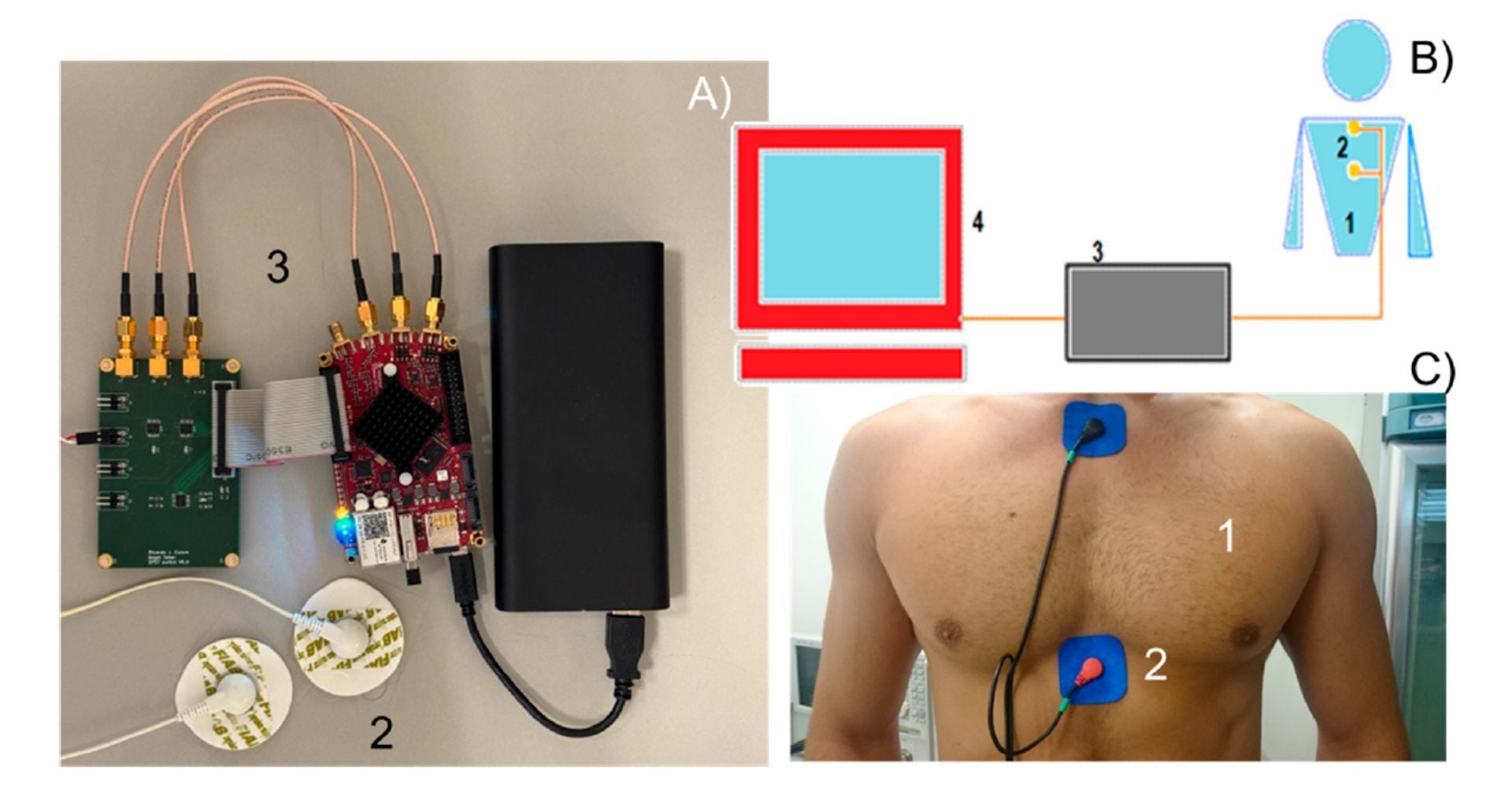
*Sensor developed to measure dielectric properties across the thoracic plexus and reach the esophagus. (**A**) represents the adhesive ECG electrodes (**2**) and the analyzer prototype (**3**); (**B**) represents a scheme of the measurer system, where 1 is the thoracic plexus, 2 is the electrodes, 3 is the analyzer, and 4 is the computer; and (**C**) represents a picture of the thoracic plexus (**1**) with the adhesive ECG electrodes (**2**) applicated in the measured disposition.*
## Hardware Architecture & Processing Pipeline
The physical setup utilizes an adapted commercial impedance analyzer built on a programmable system-on-chip (SoC) architecture:
- System-on-Chip (SoC) Platform: The core measurement platform leverages a Red Pitaya STEMlab 125-14 board featuring a Xilinx Zynq 7010 FPGA paired with a dual-core ARM Cortex-A9 processor.
- Data Converters: Dual 14-bit analog-to-digital converters (ADCs) and digital-to-analog converters (DACs) operating at 125 MSPS provide high-resolution signal generation and acquisition with a 60 MHz bandwidth.
- Electrode Configuration: Adhesive ECG surface electrodes are positioned on the subject’s trachea and xiphoid process (near the cardia), directing electric field lines through the thoracic plexus and fully encompassing the esophagus.
- Signal Generation & Acquisition: The system applies a low-amplitude current excitation signal digitally generated via the DAC. Signal conditioning stages and dual ADCs capture instantaneous voltage drop and current flow across the tissue.
- Real-Time Data Processing: The raw impedance spectrum (Z ̅=R+jX) is processed directly on the acquisition hardware or streamed to an external PC to calculate dielectric permittivity and ionic conductivity (σ=ϵ0 ϵ’‘2πf).

*Positioning of the two poles (blue) to allow the signal to penetrate the esophagus (red) and to measure the cardiac valve (orange). The electric field lines are in black. The measurement “d” represents the distance between the poles. On the right, the measurement circuit is shown, designed to determine the intensity and the voltage difference between the poles and to be able to calculate the complex permittivity.*
## Key Biomarkers Identified
By fitting low- and high-frequency dielectric constant spectra to a logistic Traffano-Schiffo model, the system isolates two key diagnostic parameters:
- Alpha (α) Dispersion Conductivity (Reflux Events): Operates across the Hz to kHz frequency range. Alpha dispersion measures charge mobility in the liquid phase. Real-time tracking of ionic conductivity in alpha dispersion (σα) differentiates between an empty esophagus and the transit of fluids with varying ionic strengths (e.g., water, juice, 1% saline solution). This capability allows the sensor to detect active reflux episodes and characterize liquid flow without invasive probes.
- Beta (β) Dispersion Relaxation (Tissue Integrity): Operates across the kHz to MHz frequency range. Beta dispersion reflects interactions with fixed charges on solid macromolecular structures, such as proteins. Study participants with a history of GERD exhibited distinct shifts in beta relaxation values (σβ, fβ, ϵ’β). This dispersion serves as a quantitative biomarker for esophageal muscle tissue damage caused by chronic gastric acid exposure.
## Clinical Implications & Lifestyle Correlations
In a study evaluating 49 stratified adult participants, the non-invasive sensor demonstrated high sensitivity in capturing esophageal liquid transit and tissue variations. Furthermore, the study examined lifestyle and physiological factors alongside impedance metrics:
- Visceral & Total Body Fat: Higher body fat mass fraction and elevated visceral fat levels showed a significant correlation with GERD incidence, consistent with increased intra-abdominal pressure weakening the lower esophageal sphincter.
- Smoking Status: A strong positive association was confirmed between smoking and reflux frequency, reinforcing the role of lifestyle factors in GERD severity.
By replacing internal catheters with lightweight surface electrodes and an FPGA-driven analyzer, this radiofrequency spectrophotometry approach enables continuous 24-to-48-hour ambulatory monitoring. Patients can maintain normal daily routines while clinicians gather continuous, real-time diagnostic data on reflux frequency and mucosal health.
Read the full research paper: For detailed experimental methodologies, sensor calibration procedures, and complete clinical data, access the full open-access study in [MDPI Sensors: Design and Application of a Radiofrequency Spectrophotometry System for Continuous Non-Invasive GERD Monitoring](http://www.mdpi.com/1424-8220/25/11/3533).
---
## Frequently Asked Questions
1\. How does radiofrequency spectrophotometry detect GERD non-invasively?
The system places adhesive electrodes on the skin over the trachea and xiphoid process. It sends a low-amplitude RF signal through the thoracic plexus to measure dielectric permittivity and ionic conductivity, tracking esophageal liquid movement and tissue status in real time.
### 2. Why is beta dispersion important in GERD diagnosis?
Beta dispersion reflects interactions with fixed charges on macromolecules like proteins. Alterations in beta relaxation values correlate with structural degradation of esophageal tissue caused by stomach acid exposure, serving as a biomarker for GERD-induced damage.
### 3. How does this technology compare to traditional pH monitoring or endoscopy?
Traditional methods require inserting endoscopic cameras, nasal catheters, or wireless capsules into the esophagus, causing discomfort and disrupting normal daily life. RF spectrophotometry uses non-invasive external surface electrodes, enabling comfortable, continuous 24-to-48-hour monitoring without invasive procedures.
### About the Red Pitaya Team
The Red Pitaya Technical Editorial Team is a cross-functional group of technical communicators and product specialists. By synthesizing insights from our hardware developers and global research partners, we provide verified, high-value content that bridges the gap between open-source innovation and industrial-grade precision.
Our mission is to make advanced instrumentation accessible to engineers, researchers, and educators worldwide.
##### Categories
- [academia (47)](https://content.redpitaya.com/blog/tag/academia)
##### Recent Posts
- [](https://content.redpitaya.com/blog/open-source-mri-console-ocra-marcos-red-pitaya)
[How a $500 Open-Source MRI Console Sparked a Global Research Ecosystem](https://content.redpitaya.com/blog/open-source-mri-console-ocra-marcos-red-pitaya)
September 22, 2026
- [](https://content.redpitaya.com/blog/zephyr-rtos-nordic-logic-analyzer-workshop-eestec-ljubljana)
[Probing the Wire: Red Pitaya & Zephyr RTOS Workshop with EESTEC](https://content.redpitaya.com/blog/zephyr-rtos-nordic-logic-analyzer-workshop-eestec-ljubljana)
September 17, 2026
- [](https://content.redpitaya.com/blog/open-source-mri-control-system-sdrlab/)
[MaRCoS: An Open-Source MRI Control System Built with Red Pitaya SDRlab 122-16](https://content.redpitaya.com/blog/open-source-mri-control-system-sdrlab/)
September 15, 2026
##### Subscribe to our newsletter

An open-source solution for hobbyists, professors,
radio amateurs and industrial clients.
**Red Pitaya**
Velika pot 21,
5250 Solkan
Slovenia, Europe
Phone: +386 30 322 719
Email: [info@redpitaya.com](mailto:info@redpitaya.com)
**Red Pitaya US**
TX, Dallas - Downtown Republic Center
325 N. St. Paul Street
Suite 3100
Dallas, Texas, 75202
United States of America
IMPORTANT: This address does not accept RMAs
Phone: (888) 637-2706
Email: [US.office@redpitaya.com](mailto:US.office@redpitaya.com)
- Customer Service
- [Customer Support](https://redpitaya.com/customer-support/)
- [Shipping & Returns](https://redpitaya.com/shipping-returns/)
- [Contact us](https://redpitaya.com/contact-us/)
- [Cookie Policy](https://redpitaya.com/cookie-policy/)
- SLO
- [O nas](https://redpitaya.com/o-nas/)
- [Pogoji poslovanja](https://redpitaya.com/pogoji-poslovanja/)
- [Politika zasebnosti](https://redpitaya.com/politika-zasebnosti/)
- [Politika piškotkov](https://redpitaya.com/politika-piskotkov/)
##### Follow Us
#### Subscribe to our newsletter
Get notified about new SW features & updates, news about latest community projects & events and new Red Pitaya products & discounts
[Subscribe](https://go.redpitaya.com/cs/c/?cta_guid=36ccbdc0-0344-49c4-aa91-aa67cf437c09&signature=AAH58kHkxFYTAKU-ILQzHI1jlrdI_co0RA&placement_guid=a24cb732-1dfb-4d0a-8c52-aa6851ce9102&click=556cfaee-eee4-48e4-95e7-c483a4f78883&hsutk=537e15e740555d2fd6a1c1ad931d2b6f&canon=https%3A%2F%2Fredpitaya.com%2Fabout-us%2F&utm_referrer=https%3A%2F%2Fredpitaya.com%2Fcompare%2F&portal_id=7715357&redirect_url=APefjpGj5Dm9poAAzHFGh4S6pJ-2TvNzBdwZZlfbr7toxfw-epFUtzEHOKToHx0i2TYYr39srj9aSERdntJBh8lJqoSXL-pUF2gwhYvOW6IMm28hQVmhYML2AIbbIRrr3YaoyJkZQ0iRxq-uHlFt66i3_8XpQpXT_M2zF9fS7t0f6hlBjGBJ7X_aXDrhBwXcEAqwoWWleG4uxonSGOR-BBp3tpKcySXYELTGHeGn5Yo61r3xrFvqFP5P6BxVwxTi51_ceW9uBzOMvA1rYz4BsIhLSF8n4bhcHqJTvhibH_laJrjDNdEUUrU&__hstc=72355340.537e15e740555d2fd6a1c1ad931d2b6f.1635738083317.1635738083317.1635746314170.2&__hssc=72355340.5.1635746314170&__hsfp=530052575&contentType=standard-page)
**Red Pitaya** 2025 All Rights Reserved.
- [Privacy Policy](https://redpitaya.com/privacy-policy/)
- [Terms of Use](https://redpitaya.com/terms-of-use/)
```json
{
"@context" : "https://schema.org",
"@type" : "BlogPosting",
"author" : {
"@type" : "Person",
"name" : "Red Pitaya Technical Editorial Team",
"url" : "https://content.redpitaya.com/blog/author/red-pitaya-technical-editorial-team"
},
"dateModified" : "2026-09-29T08:00:00.725Z",
"datePublished" : "2026-09-29T08:00:00.000Z",
"headline" : "Non-Invasive GERD Detection: Continuous Esophageal Monitoring via Radiofrequency Spectrophotometry",
"image" : [ "https://content.redpitaya.com/hubfs/blog%20featured%20image%20-%202026-09-17T104035.026.jpg" ],
"mainEntityOfPage" : {
"@id" : "https://content.redpitaya.com/blog/non-invasive-gerd-detection-radiofrequency-spectrophotometry",
"@type" : "WebPage"
},
"publisher" : {
"@type" : "Organization",
"logo" : {
"@type" : "ImageObject",
"url" : "https://content.redpitaya.com/hubfs/Red-pitaya-logo.jpg"
},
"name" : "Red Pitaya d.o.o."
}
}
```