---
title: "FPGA-Based Laser Frequency Stabilization: Architectures, Techniques, & Servo Platforms"
description: Learn FPGA laser frequency stabilization architectures, covering PDH locking, low-latency DSP, and platform comparisons like STEMlab 125-14.
image: https://content.redpitaya.com/hubfs/blog%20featured%20image%20-%202026-09-29T124318.749.jpg
---
[](https://redpitaya.com/)
[](https://redpitaya.com/)
- Products
- [STEMlab 125-14 Gen 2](https://redpitaya.com/stemlab-125-14-gen2/)
- [STEMlab 125-14](https://redpitaya.com/stemlab-125-14/)
- [SIGNALlab 250-12](https://redpitaya.com/signallab-250-12/)
- [SDRlab 122-16](https://redpitaya.com/sdrlab-122-16/)
- [STEMlab TI (Texas Instruments)](https://redpitaya.com/stemlab-ti-texas-instruments/)
- [Multi-channel Solutions](https://redpitaya.com/multi-channel-solutions/)
- [Accessories](https://redpitaya.com/accessories/)
- [Applications](https://redpitaya.com/applications/)
- Documentation
- [Technical Documentation](https://redpitaya.com/documentation/)
- [Teaching materials](https://redpitaya.com/teaching-materials/)
- [Student projects](https://redpitaya.com/student-projects/)
- [User forum](https://forum.redpitaya.com/)
- [About](https://redpitaya.com/about-us/)
- [History](https://redpitaya.com/history/)
- [Distributors](https://redpitaya.com/distibutors-red-pitaya/)
- [Blog](https://content.redpitaya.com/blog)
[Shop](https://redpitaya.com/shop/)
- [ACADEMIA](https://redpitaya.com/academia/)
- [RADIO AMATEURS](https://redpitaya.com/radio-amateurs/)
- [Home](https://redpitaya.com/)
- Products
- [STEMlab 125-10](https://redpitaya.com/stemlab-125-10/)
- [STEMlab 125-14](https://redpitaya.com/stemlab-125-14/)
- [SIGNALlab 250-12](https://redpitaya.com/signallab-250-12/)
- [SDRlab 122-16](https://redpitaya.com/sdrlab-122-16/)
- [Accessories](https://redpitaya.com/accessories/)
- [Applications](https://redpitaya.com/applications/)
- [Resources](https://redpitaya.com/documentation/)
- [Shop](https://redpitaya.com/shop/)
- [About](https://redpitaya.com/about-us/)
- [Blog](https://content.redpitaya.com/blog)
- [Compare](https://redpitaya.com/compare/)
- [Login / Register](https://redpitaya.com/my-account/)
### Red Pitaya Blog
[Home](https://redpitaya.com) » [Case study](https://content.redpitaya.com/blog/tag/case-study) »
[Case study](https://content.redpitaya.com/blog/tag/case-study)
# FPGA-Based Laser Frequency Stabilization: Architectures, Techniques, & Servo Platforms
- Posted by  [Red Pitaya Technical Editorial Team](https://redpitaya.com/Red-Pitaya-Blog-team/) , November 3, 2026
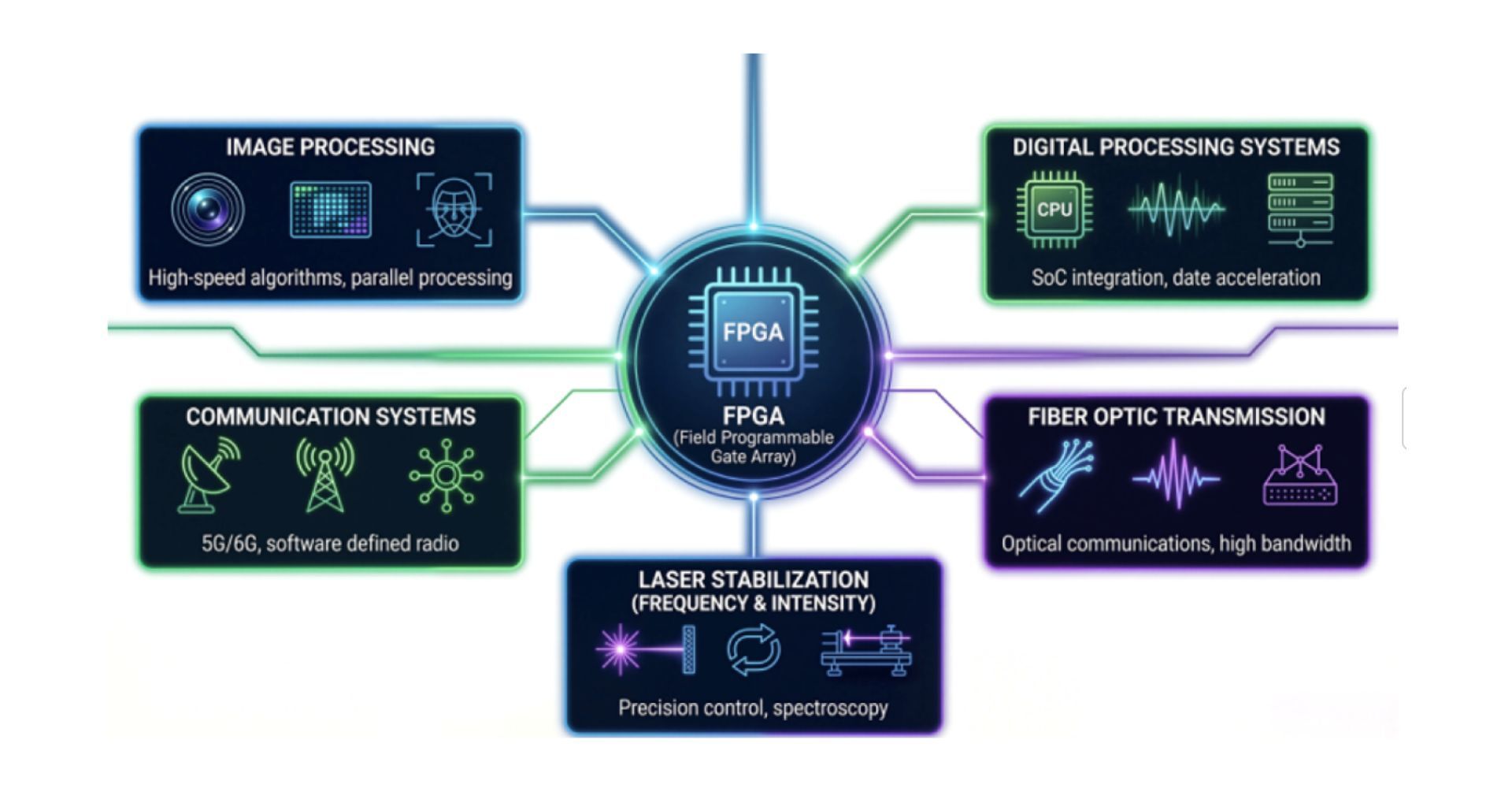
**Key Takeaways**
- **Canonical Definition:** FPGA-based stabilization moves signal generation, demodulation, filtering, and feedback control into programmable digital hardware, enabling low-latency and highly reconfigurable servo architectures while reducing dependence on analog signal-processing stages.
- **Core Architecture:** Digitizes optical photodetector signals via high-speed ADCs (14/16-bit) to execute Pound-Drever-Hall (PDH), Saturation Absorption Spectroscopy (SAS), or Modulation Transfer Spectroscopy (MTS) locking directly inside the digital domain.
- **Benchmarked Implementations:** From custom Kintex-7 setups achieving 120.5 ns latency to commercial SoC solutions. Open-source platforms like the Red Pitaya STEMlab 125-14 (running PyRPL, Linien, or lock-in+pid) achieve ~200 ns loop delays, delivering dual-actuator (current/PZT) control, multi-board distributed locking, and 1D-CNN lock acquisition.
## Overview & Core Challenges
Laser frequency stabilization sets the performance boundary for quantum optics, optical atomic clocks, precision metrology, and high-resolution spectroscopy. Standard analog feedback control systems struggle with environmental temperature drift, rigid control loop topologies, bulky physical footprints, and limited integration capability.
Field-programmable gate arrays (FPGAs) solve these physical limitations by shifting signal processing into hardware-programmable digital logic. Using parallel processing execution, high-speed data acquisition, and low loop latency, modern digital servo architectures enable real-time error signal generation, automatic locking, and multi-loop control on compact System-on-Chip (SoC) boards.

## Core Stabilization Techniques Integrated on FPGA Logic
FPGAs accommodate multiple error-signal generation protocols inside a single digital processing pipeline. The platform digitizes raw photodetector inputs, executes phase-sensitive demodulation, and delivers digital feedback control outputs without analog mixer phase distortion.
- **Pound-Drever-Hall (PDH) Locking:** Phase-modulates laser light via an electro-optic modulator (EOM) before entering an optical Fabry-Pérot reference cavity. Reflected light is captured by a photodetector, digitized by an ADC, and mixed digitally with a Direct Digital Synthesis (DDS) carrier reference to derive a steep dispersive error signal for high-bandwidth cavity locking.
- **Saturation Absorption Spectroscopy (SAS):** Uses counter-propagating pump and probe beams inside an atomic gas cell (such as Rubidium or Cesium) to eliminate Doppler broadening, revealing narrow Lamb dip transition lines for absolute frequency locking.
- **Frequency Modulation Spectroscopy (FMS):** Applies high-frequency phase modulation to shift the optical error signal away from low-frequency 1/f1/f technical noise, improving signal-to-noise ratio during lock-in acquisition.
- **Modulation Transfer Spectroscopy (MTS):** Exploits nonlinear four-wave mixing in an atomic vapor cell to transfer modulation sidebands from the pump beam directly to an unmodulated probe beam, producing zero-crossing error signals with flat baselines.
## Primary Digital Signal Processing Building Blocks
Executing real-time laser feedback requires low-latency pipelining inside the FPGA fabric:
**Direct Digital Synthesis (DDS):** Generates phase-continuous sinusoidal and scanning waveforms with fine frequency resolution for modulation and frequency-sweep functions.
- **Digital Phase Demodulation & Filtering:** Replaces much of the analog mixing and filtering with FPGA-based multipliers and FIR/IIR filters, reducing dependence on drifting analog signal-processing components.
- **Digital Proportional-Integral-Derivative (PID) Control:** Executes discretized difference equations across fully parallel logic blocks. Independent proportional, integral, and derivative channels adjust laser current drive inputs for fast noise suppression and piezoelectric transducer (PZT) controllers for long-term drift correction.
- **Dual-Actuator Control:** Diode lasers commonly use a fast current-feedback path for high-frequency noise suppression and a slower PZT path for low-frequency drift correction. FPGA servos can split the error signal between these paths using digital filters, reducing integrator saturation and minimizing the need for manual re-centering.

## Comparing Modern Digital Servo Implementations
FPGA servo designs balance signal processing latency, sampling rate, loop bandwidth, and hardware flexibility.
| **Platform Architecture** | **Hardware Core** | **ADC / DAC Configuration** | **Open-Loop Latency** | **Bandwidth Metric & Scope** | **Key System Advantage** |
| --- | --- | --- | --- | --- | --- |
| **Custom Ultra-Low Latency Servo** | Xilinx Kintex-7 | 18-bit ADCs; 16/18-bit DACs | **120.5 ns** | ~549.5 kHz (Closed-loop unity gain) | Optimized for ultra-stable optical cavity locking; 5.54 ×10{−18} servo noise at 1 s. |
| **Modular General Purpose Servo** | Opal Kelly XEM6010 + Custom Mezzanine | Fast: 16-bit at 100MSps; Slow: 20-bit DACs | **320 ns** | Up to ~1 MHz (Reported feedback BW) | Flexible MIMO locking with automated threshold re-lock for AMO physics. |
| **High-Speed Dedicated SoC** | Koheron Alpha250 (Zynq-7020) | Dual 14-bit ADC / Dual 16-bit DAC at 250 MSps | **200 ns** (24 ns ADC + 144 Ns PL + 32 ns DAC) | 1.0 MHz (Closed-loop demonstration) | High-speed processing core paired with embedded Linux network controls. |
| **Reconfigurable Open Source SoC** | Red Pitaya STEMlab 125-14 (Zynq-7010) | Dual 14-bit ADC / Dual 14-bit DAC at 125 MSps | **200(5) ns** | 1.25 MHz (Digital controller BW) | Accessible ecosystem (PyRPL, Linien, lock-in+pid) supporting dual fast/slow actuator control. |
## Next-Generation Trends: Machine Learning and Distributed Locking
FPGA laser stabilization platforms are moving beyond traditional fixed-gain digital feedback loops toward fully autonomous systems:
- **1D-CNN Deep Learning on SoC Logic:** Rather than relying on manual thresholding or derivative zero-crossing detectors that fail under optical power drift, recent work integrates neural networks at the edge. In 2026, Yan et al. demonstrated automated Rubidium MTS locking by deploying a lightweight 1D-CNN directly on a Red Pitaya board. The embedded model classified atomic saturation features in real time during frequency sweeps, autonomously acquiring and recovering lock without user intervention. The stabilized laser maintained frequency deviations within 181.28 kHz over two hours (standard deviation σ= 26.89"\\ kHz) and reached a relative Allan variance of 1.16×10⁻¹¹ at an averaging time of 256 s.
- **Automatic Relocking Frameworks:** Real-time hardware state machines continuously monitor loop parameters (such as error signal variance or transmitted optical power). When acoustic or mechanical disturbances trigger a lock loss, the system instantly engages frequency scanning and re-establishes lock within sub-millisecond to seconds depending on the implementation
- **Multi-Board Distributed Locking:** Scaling complex atomic physics experiments often demands locking multiple laser heads, reference cavities, and frequency-doubling stages simultaneously. In 2025, Su et al. deployed three independent Red Pitaya units operating in coordination to stabilize multiple seed lasers and an external second-harmonic generation (SHG) cavity, producing 319 nm ultraviolet single-frequency light. This distributed architecture can reduce hardware count and wiring by replacing banks of discrete analog servo boxes with coordinated FPGA/SoC units.
- **Automated Parameter Self-Optimization:** Open-source frameworks built around the STEMlab 125-14 continue to advance autonomous operation:
- - *Linien:* Integrates Covariance Matrix Adaptation Evolution Strategy (CMA-ES) optimization to dynamically adjust modulation frequency and modulation depth, maximizing error signal slope for spectroscopic locks under varying optical power.
- *Lock-in+pid:* Implements square-wave demodulation up to 31.25 MHz with shift-register-optimized PID scaling, running background Allan variance logging directly on the ARM processing system.

## Further Reading & Reference Implementation
To dive deeper into a practical, real-world deployment—including SIMO PID topologies, integrated lock-in modulation, and diagnostic FIFO streaming—check out the complete original case document:
Read the Full Case Study: [Advances in FPGA-Based Laser Frequency Stabilization Techniques](https://www.mdpi.com/2072-666X/17/7/838)
---
## Frequently Asked Questions (FAQ)
### **1. Why choose an FPGA over traditional analog electronics for laser frequency stabilization?**
FPGAs can reduce sensitivity to drift and offset associated with analog signal-processing stages by implementing mixing, filtering, and control functions digitally. However, the overall system remains sensitive to ADC/DAC characteristics, clock stability, analog front-end behavior, actuator response, and environmental conditions.
### **2. How does loop latency dictate the maximum achievable laser locking bandwidth?**
Loop delay adds phase lag linearly (**Phase Lag = 360° × Frequency × Delay**). To maintain a stable 45° phase margin with an integrating controller, the loop's unity-gain frequency must stay well below **1 / (4 × Delay)**.
A 200 ns delay contributes 90° of phase lag at 1.25 MHz, so practical unity-gain bandwidth must be chosen below this theoretical delay limit and with sufficient phase margin for the rest of the loop.
### **3. What open-source software platforms turn a Red Pitaya into a turnkey laser servo?**
Representative open-source ecosystems include PyRPL, Linien, and lock-in+pid.
1. **PyRPL:** Comprehensive DSP suite (lock-in, IIR filters, PID, spectrum analyzer, oscilloscope) configured via Python GUI/API, running deterministic DSP blocks on the FPGA at 125 MSps.
2. **Linien:** Spectroscopic locking package featuring autonomous line identification, automated relocking, and CMA-ES optimization of modulation depth and frequency.
3. **Lock-in+pid:** Lightweight web-hosted servo GUI optimized for wideband square-wave demodulation up to 31.25 MHz with embedded long-term Allan variance logging.
### **4. What role does machine learning play inside an FPGA laser lock?**
Embedded machine learning models (such as quantized 1D-CNNs or evolutionary optimization algorithms like CMA-ES) run directly inside the FPGA-SoC architecture. These models automatically identify spectroscopic lines, optimize modulation depth, and re-acquire locks without human intervention.
### About the Red Pitaya Team
The Red Pitaya Technical Editorial Team is a cross-functional group of technical communicators and product specialists. By synthesizing insights from our hardware developers and global research partners, we provide verified, high-value content that bridges the gap between open-source innovation and industrial-grade precision.
Our mission is to make advanced instrumentation accessible to engineers, researchers, and educators worldwide.
##### Categories
- [academia (47)](https://content.redpitaya.com/blog/tag/academia)
##### Recent Posts
- [](https://content.redpitaya.com/blog/end-of-life-notice-stemlab-125-14-original-generation-boards-gen-2-migration-guide)
[End of Life Notice: STEMlab 125-14 Original-Generation Boards & Gen 2 Migration Guide](https://content.redpitaya.com/blog/end-of-life-notice-stemlab-125-14-original-generation-boards-gen-2-migration-guide)
October 29, 2026
- [](https://content.redpitaya.com/blog/hardware-fingerprinting-red-pitaya-cyber-physical-security)
[Hardware Fingerprinting for Cyber-Physical Systems: How an FPGA-Based Board Identifies Rogue Devices at the Physical Layer](https://content.redpitaya.com/blog/hardware-fingerprinting-red-pitaya-cyber-physical-security)
October 27, 2026
- [](https://content.redpitaya.com/blog/experimenting-with-red-pitaya-stemlab-gen-2-book)
[What’s Inside Experimenting with Red Pitaya STEMlab Gen 2?](https://content.redpitaya.com/blog/experimenting-with-red-pitaya-stemlab-gen-2-book)
October 20, 2026
##### Subscribe to our newsletter

An open-source solution for hobbyists, professors,
radio amateurs and industrial clients.
**Red Pitaya**
Velika pot 21,
5250 Solkan
Slovenia, Europe
Phone: +386 30 322 719
Email: [info@redpitaya.com](mailto:info@redpitaya.com)
**Red Pitaya US**
TX, Dallas - Downtown Republic Center
325 N. St. Paul Street
Suite 3100
Dallas, Texas, 75202
United States of America
IMPORTANT: This address does not accept RMAs
Phone: (888) 637-2706
Email: [US.office@redpitaya.com](mailto:US.office@redpitaya.com)
- Customer Service
- [Customer Support](https://redpitaya.com/customer-support/)
- [Shipping & Returns](https://redpitaya.com/shipping-returns/)
- [Contact us](https://redpitaya.com/contact-us/)
- [Cookie Policy](https://redpitaya.com/cookie-policy/)
- SLO
- [O nas](https://redpitaya.com/o-nas/)
- [Pogoji poslovanja](https://redpitaya.com/pogoji-poslovanja/)
- [Politika zasebnosti](https://redpitaya.com/politika-zasebnosti/)
- [Politika piškotkov](https://redpitaya.com/politika-piskotkov/)
##### Follow Us
#### Subscribe to our newsletter
Get notified about new SW features & updates, news about latest community projects & events and new Red Pitaya products & discounts
[Subscribe](https://go.redpitaya.com/cs/c/?cta_guid=36ccbdc0-0344-49c4-aa91-aa67cf437c09&signature=AAH58kHkxFYTAKU-ILQzHI1jlrdI_co0RA&placement_guid=a24cb732-1dfb-4d0a-8c52-aa6851ce9102&click=556cfaee-eee4-48e4-95e7-c483a4f78883&hsutk=537e15e740555d2fd6a1c1ad931d2b6f&canon=https%3A%2F%2Fredpitaya.com%2Fabout-us%2F&utm_referrer=https%3A%2F%2Fredpitaya.com%2Fcompare%2F&portal_id=7715357&redirect_url=APefjpGj5Dm9poAAzHFGh4S6pJ-2TvNzBdwZZlfbr7toxfw-epFUtzEHOKToHx0i2TYYr39srj9aSERdntJBh8lJqoSXL-pUF2gwhYvOW6IMm28hQVmhYML2AIbbIRrr3YaoyJkZQ0iRxq-uHlFt66i3_8XpQpXT_M2zF9fS7t0f6hlBjGBJ7X_aXDrhBwXcEAqwoWWleG4uxonSGOR-BBp3tpKcySXYELTGHeGn5Yo61r3xrFvqFP5P6BxVwxTi51_ceW9uBzOMvA1rYz4BsIhLSF8n4bhcHqJTvhibH_laJrjDNdEUUrU&__hstc=72355340.537e15e740555d2fd6a1c1ad931d2b6f.1635738083317.1635738083317.1635746314170.2&__hssc=72355340.5.1635746314170&__hsfp=530052575&contentType=standard-page)
**Red Pitaya** 2025 All Rights Reserved.
- [Privacy Policy](https://redpitaya.com/privacy-policy/)
- [Terms of Use](https://redpitaya.com/terms-of-use/)
```json
{
"@context" : "https://schema.org",
"@type" : "BlogPosting",
"author" : {
"@type" : "Person",
"name" : "Red Pitaya Technical Editorial Team",
"url" : "https://content.redpitaya.com/blog/author/red-pitaya-technical-editorial-team"
},
"dateModified" : "2026-11-03T09:00:00.713Z",
"datePublished" : "2026-11-03T09:00:00.000Z",
"headline" : "FPGA-Based Laser Frequency Stabilization: Architectures, Techniques, & Servo Platforms",
"image" : [ "https://content.redpitaya.com/hubfs/blog%20featured%20image%20-%202026-09-29T124318.749.jpg" ],
"mainEntityOfPage" : {
"@id" : "https://content.redpitaya.com/blog/fpga-laser-frequency-stabilization-advances",
"@type" : "WebPage"
},
"publisher" : {
"@type" : "Organization",
"logo" : {
"@type" : "ImageObject",
"url" : "https://content.redpitaya.com/hubfs/Red-pitaya-logo.jpg"
},
"name" : "Red Pitaya d.o.o."
}
}
```