---
title: A Mössbauer Spectroscopy Setup With Nothing More Than a STEMlab Board
description: A Mössbauer spectroscopy setup using STEMlab for efficient data acquisition and analysis.
image: https://content.redpitaya.com/hubfs/undefined-Dec-09-2024-11-08-23-4221-AM.png
---
[](https://redpitaya.com/)
[](https://redpitaya.com/)
- Products
- [STEMlab 125-14 Gen 2](https://redpitaya.com/stemlab-125-14-gen2/)
- [STEMlab 125-14](https://redpitaya.com/stemlab-125-14/)
- [SIGNALlab 250-12](https://redpitaya.com/signallab-250-12/)
- [SDRlab 122-16](https://redpitaya.com/sdrlab-122-16/)
- [STEMlab TI (Texas Instruments)](https://redpitaya.com/stemlab-ti-texas-instruments/)
- [Multi-channel Solutions](https://redpitaya.com/multi-channel-solutions/)
- [Accessories](https://redpitaya.com/accessories/)
- [Applications](https://redpitaya.com/applications/)
- Documentation
- [Technical Documentation](https://redpitaya.com/documentation/)
- [Teaching materials](https://redpitaya.com/teaching-materials/)
- [Student projects](https://redpitaya.com/student-projects/)
- [User forum](https://forum.redpitaya.com/)
- [About](https://redpitaya.com/about-us/)
- [History](https://redpitaya.com/history/)
- [Distributors](https://redpitaya.com/distibutors-red-pitaya/)
- [Blog](https://content.redpitaya.com/blog)
[Shop](https://redpitaya.com/shop/)
- [ACADEMIA](https://redpitaya.com/academia/)
- [RADIO AMATEURS](https://redpitaya.com/radio-amateurs/)
- [Home](https://redpitaya.com/)
- Products
- [STEMlab 125-10](https://redpitaya.com/stemlab-125-10/)
- [STEMlab 125-14](https://redpitaya.com/stemlab-125-14/)
- [SIGNALlab 250-12](https://redpitaya.com/signallab-250-12/)
- [SDRlab 122-16](https://redpitaya.com/sdrlab-122-16/)
- [Accessories](https://redpitaya.com/accessories/)
- [Applications](https://redpitaya.com/applications/)
- [Resources](https://redpitaya.com/documentation/)
- [Shop](https://redpitaya.com/shop/)
- [About](https://redpitaya.com/about-us/)
- [Blog](https://content.redpitaya.com/blog)
- [Compare](https://redpitaya.com/compare/)
- [Login / Register](https://redpitaya.com/my-account/)
### Red Pitaya Blog
[Home](https://redpitaya.com) » [Case study](https://content.redpitaya.com/blog/tag/case-study), [Research](https://content.redpitaya.com/blog/tag/research) »
[Case study](https://content.redpitaya.com/blog/tag/case-study), [Research](https://content.redpitaya.com/blog/tag/research)
# A Mössbauer Spectroscopy Setup With Nothing More Than a STEMlab Board
- Posted by  [Red Pitaya Technical Editorial Team](https://redpitaya.com/Red-Pitaya-Blog-team/) , January 15, 2025
Probably not too many people are familiar with the name Mössbauer, so there’s no shame in having to look it up to see what it relates to. The Mössbauer effect refers to a gamma ray absorption phenomenon by certain nuclei, bound in a solid, that is used in Mössbauer spectroscopy. This technique studies the properties of atomic nuclei and their interactions with the surrounding environment through the absorption and re-emission of gamma rays. Measuring the absorption rate and energy shifts can help scientists gain insights into the chemical bonding and electronic environment around the nucleus, magnetic material properties, the oxidation states of elements, and crystalline structures and defects, to name a few applications.
In Mössbauer spectroscopy, the channel-to-velocity relation in the acquisition of the spectrum is fundamental to its quality. The velocity of the radioactive source is usually controlled by a servo-amplifier, from which two signals are distinguished: the Monitor signal, which is proportional to the required velocity in a secondary coil, and the Error signal, which is proportional to the difference between actual secondary coil voltage and required voltage. The determination of these signals allows control of the correct functioning of the spectrometer and can be used to improve the determination of the channel-velocity relationship.
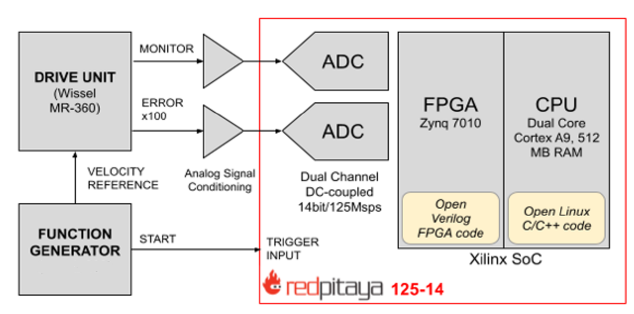
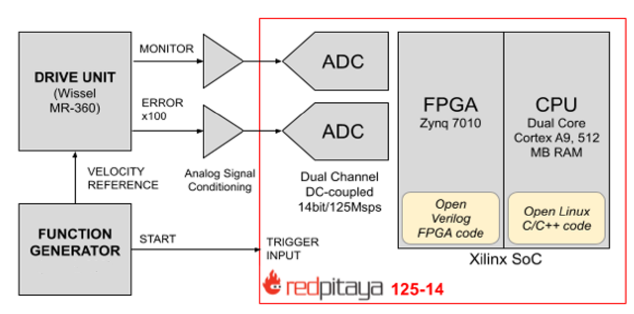
In their article *Embedded Device for Monitor and Error Velocity Signals in Mössbauer Spectroscopy*, Matías J. Oliva and colleagues from the Universidad Nacional de La Plata (Argentina) describe how, building further on previous work where data acquisition was done via a standard digital oscilloscope, they built a new experimental setup, taking full advantage of many of the features a STEMlab 125-14 can offer. In their setup, its FPGA is responsible for data acquisition, while the CPU takes care of system control and user interfacing, as shown in the simplified block diagram below. Therefore, no other hardware was required for this project.

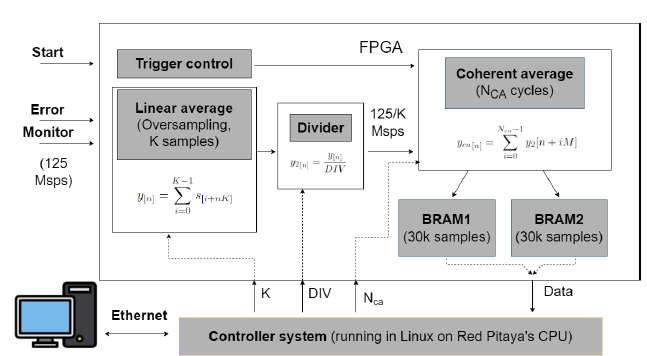
The FPGA process can be seen in the following diagram, and includes key operations such as oversampling and linear averaging, coherent averaging, and trigger control. FPGA-sampled and -processed data is stored in the STEMlab memory and accessed by the CPU for further analysis or transmission, thereby minimizing noise, increasing resolution, and reducing manual calibration time, leading to improved efficiency of the Mössbauer spectroscopy experiment. System control was done via a C-program, running on the STEMlab’s CPU, managing the acquisition, averaging and visualization of the results.
Systems must obviously be validated, so an acquisition run was compared with another one obtained using a Tektronix oscilloscope. The Red Pitaya ADCs produced some offset and gain errors that were estimated during the comparison, obtaining a gain error of approximately 1.131 and an offset error of around 0.015V. The digitalization of Monitor and Error signals, shown in the figure below, leads to significantly faster data acquisition with a comparable resolution. The remaining small alinearities will probably be the subject of a future upgrade.
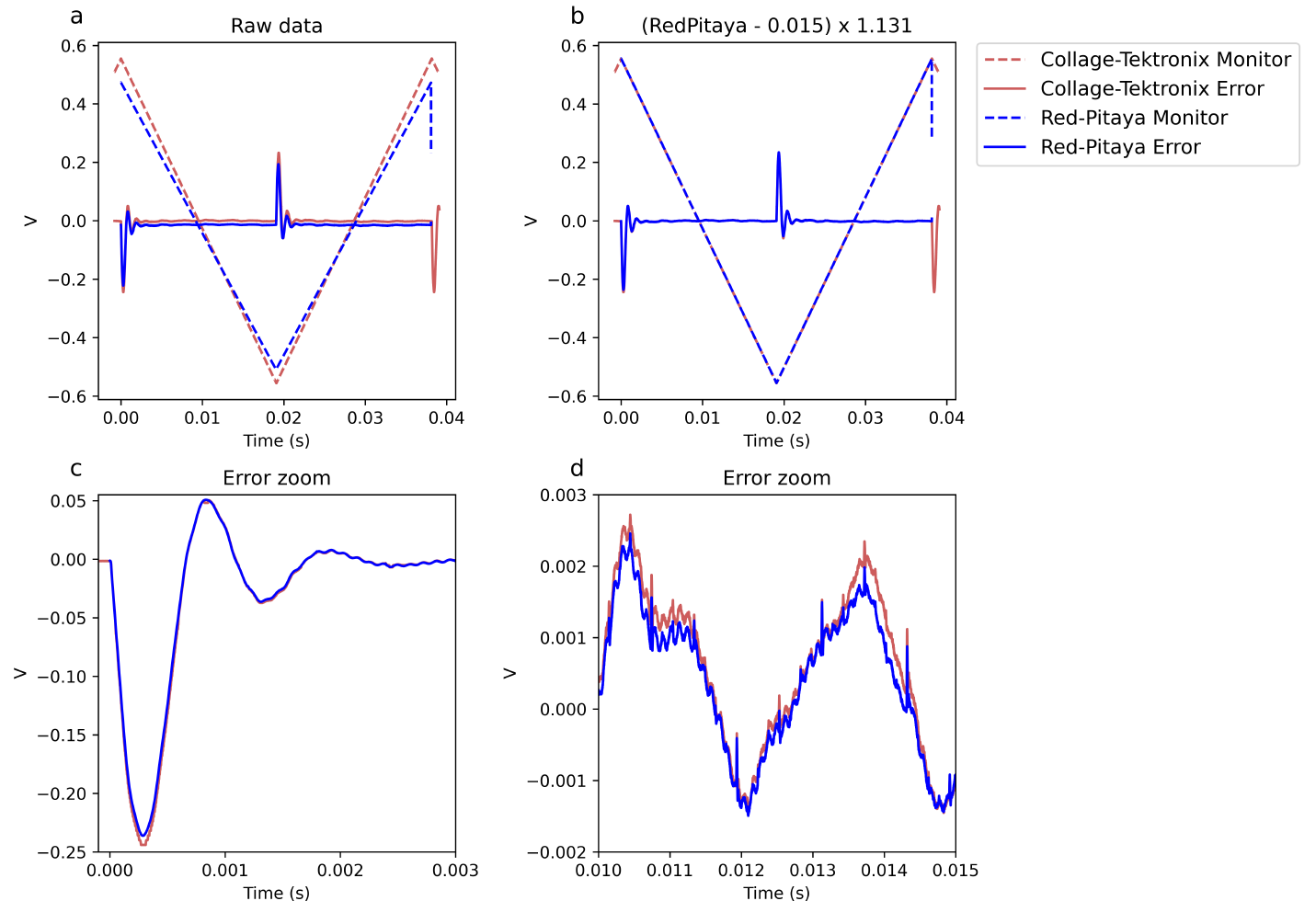

*System validation: a) raw data; b) offset and gain error correction; c) and d) partial zooms of the Error signal with evidence of alinearities*
The description of how the Red Pitaya board was integrated into the project and the conclusion of the original paper demonstrate the perfect fit of the STEMlab for ambitious scientific projects, improving system performance along the way. Not only that, but it seems the authors are also considering taking advantage of some of the features they have so far neglected in future applications, such as the Ethernet connection. All very promising indeed, and further proof that you never know how far a Red Pitaya board will take you.
### About the Red Pitaya Team
The Red Pitaya Technical Editorial Team is a cross-functional group of technical communicators and product specialists. By synthesizing insights from our hardware developers and global research partners, we provide verified, high-value content that bridges the gap between open-source innovation and industrial-grade precision.
Our mission is to make advanced instrumentation accessible to engineers, researchers, and educators worldwide.
##### Categories
- [academia (47)](https://content.redpitaya.com/blog/tag/academia)
##### Recent Posts
- [](https://content.redpitaya.com/blog/experimenting-with-red-pitaya-stemlab-gen-2-book)
[What’s Inside Experimenting with Red Pitaya STEMlab Gen 2?](https://content.redpitaya.com/blog/experimenting-with-red-pitaya-stemlab-gen-2-book)
October 20, 2026
- [](https://content.redpitaya.com/blog/red-pitaya-input-impedance-50-ohm-high-z)
[Why Is My Signal Voltage Doubled? Understanding Red Pitaya Input Impedance & 50 ΩTermination](https://content.redpitaya.com/blog/red-pitaya-input-impedance-50-ohm-high-z)
October 12, 2026
- [](https://content.redpitaya.com/blog/red-pitaya-copilot-instrument-development)
[Red Pitaya Copilot: How to Build Custom FPGA Instruments with AI Assistance](https://content.redpitaya.com/blog/red-pitaya-copilot-instrument-development)
October 12, 2026
##### Subscribe to our newsletter

An open-source solution for hobbyists, professors,
radio amateurs and industrial clients.
**Red Pitaya**
Velika pot 21,
5250 Solkan
Slovenia, Europe
Phone: +386 30 322 719
Email: [info@redpitaya.com](mailto:info@redpitaya.com)
**Red Pitaya US**
TX, Dallas - Downtown Republic Center
325 N. St. Paul Street
Suite 3100
Dallas, Texas, 75202
United States of America
IMPORTANT: This address does not accept RMAs
Phone: (888) 637-2706
Email: [US.office@redpitaya.com](mailto:US.office@redpitaya.com)
- Customer Service
- [Customer Support](https://redpitaya.com/customer-support/)
- [Shipping & Returns](https://redpitaya.com/shipping-returns/)
- [Contact us](https://redpitaya.com/contact-us/)
- [Cookie Policy](https://redpitaya.com/cookie-policy/)
- SLO
- [O nas](https://redpitaya.com/o-nas/)
- [Pogoji poslovanja](https://redpitaya.com/pogoji-poslovanja/)
- [Politika zasebnosti](https://redpitaya.com/politika-zasebnosti/)
- [Politika piškotkov](https://redpitaya.com/politika-piskotkov/)
##### Follow Us
#### Subscribe to our newsletter
Get notified about new SW features & updates, news about latest community projects & events and new Red Pitaya products & discounts
[Subscribe](https://go.redpitaya.com/cs/c/?cta_guid=36ccbdc0-0344-49c4-aa91-aa67cf437c09&signature=AAH58kHkxFYTAKU-ILQzHI1jlrdI_co0RA&placement_guid=a24cb732-1dfb-4d0a-8c52-aa6851ce9102&click=556cfaee-eee4-48e4-95e7-c483a4f78883&hsutk=537e15e740555d2fd6a1c1ad931d2b6f&canon=https%3A%2F%2Fredpitaya.com%2Fabout-us%2F&utm_referrer=https%3A%2F%2Fredpitaya.com%2Fcompare%2F&portal_id=7715357&redirect_url=APefjpGj5Dm9poAAzHFGh4S6pJ-2TvNzBdwZZlfbr7toxfw-epFUtzEHOKToHx0i2TYYr39srj9aSERdntJBh8lJqoSXL-pUF2gwhYvOW6IMm28hQVmhYML2AIbbIRrr3YaoyJkZQ0iRxq-uHlFt66i3_8XpQpXT_M2zF9fS7t0f6hlBjGBJ7X_aXDrhBwXcEAqwoWWleG4uxonSGOR-BBp3tpKcySXYELTGHeGn5Yo61r3xrFvqFP5P6BxVwxTi51_ceW9uBzOMvA1rYz4BsIhLSF8n4bhcHqJTvhibH_laJrjDNdEUUrU&__hstc=72355340.537e15e740555d2fd6a1c1ad931d2b6f.1635738083317.1635738083317.1635746314170.2&__hssc=72355340.5.1635746314170&__hsfp=530052575&contentType=standard-page)
**Red Pitaya** 2025 All Rights Reserved.
- [Privacy Policy](https://redpitaya.com/privacy-policy/)
- [Terms of Use](https://redpitaya.com/terms-of-use/)
```json
{
"@context" : "https://schema.org",
"@type" : "BlogPosting",
"author" : {
"@type" : "Person",
"name" : "Red Pitaya Technical Editorial Team",
"url" : "https://content.redpitaya.com/blog/author/red-pitaya-technical-editorial-team"
},
"dateModified" : "2025-01-15T07:16:35.896Z",
"datePublished" : "2025-01-15T07:16:35.000Z",
"headline" : "A Mössbauer Spectroscopy Setup With Nothing More Than a STEMlab Board",
"image" : [ "https://content.redpitaya.com/hubfs/undefined-Dec-09-2024-11-08-23-4221-AM.png" ],
"mainEntityOfPage" : {
"@id" : "https://content.redpitaya.com/blog/a-mössbauer-spectroscopy-setup-with-nothing-more-than-a-stemlab-board",
"@type" : "WebPage"
},
"publisher" : {
"@type" : "Organization",
"logo" : {
"@type" : "ImageObject",
"url" : "https://content.redpitaya.com/hubfs/Red-pitaya-logo.jpg"
},
"name" : "Red Pitaya d.o.o."
}
}
```